New Hampshire Transfer on Death Revocation
County Specific Legal Forms Validated as recently as November 15, 2026 by our Forms Development Team
About the New Hampshire Transfer on Death Revocation
How to Use This Form
- Select your county from the list
- Download the county-specific form
- Fill in the required information
- Have the document notarized if required
- Record with your county recorder's office
What Others Like You Are Saying
"Deeds.com made this process of electronic document recording so easy! The communication was quick, f…"
"Wow! Deeds.com provided proficient eRecording with great response time and great service... and it w…"
"Very easy to use and easy to download"
"Excellent service, very reliable."
"Deeds.com was a life saver! I was able to have a document recorded the very same day of my request. …"
4.8/5 from 4,856 reviews. Read all
A New Hampshire transfer on death deed stays revocable for as long as the owner lives, but once it is recorded there is one way to take it back: a later instrument, signed and acknowledged like a deed and recorded in time. This New Hampshire Transfer on Death Revocation is that instrument, an instrument of revocation under RSA 563-D:11 by which the owner or owners who made a recorded transfer on death deed, sometimes called a TOD deed or beneficiary deed, revoke it.
A revocation with a recording deadline
The Uniform Real Property Transfer on Death Act, RSA Chapter 563-D, took effect in New Hampshire on July 1, 2024. Under RSA 563-D:6 a transfer on death deed is revocable even if the deed says otherwise, and under RSA 563-D:11 a recorded deed is revoked only by one of three recorded instruments: a later transfer on death deed that revokes expressly or by inconsistency, an instrument of revocation that expressly revokes the deed, or a deed that expressly revokes it. Each must be executed with the formalities of a deed under RSA 477:3, acknowledged after the acknowledgment of the deed being revoked, and recorded at length in the registry of deeds for the county where the land lies by the earlier of 60 days from execution and the owner's death. An instrument recorded outside that window does not revoke anything, and RSA 563-D:11, II rules out revocation by marking, tearing, or otherwise acting on the recorded deed itself.
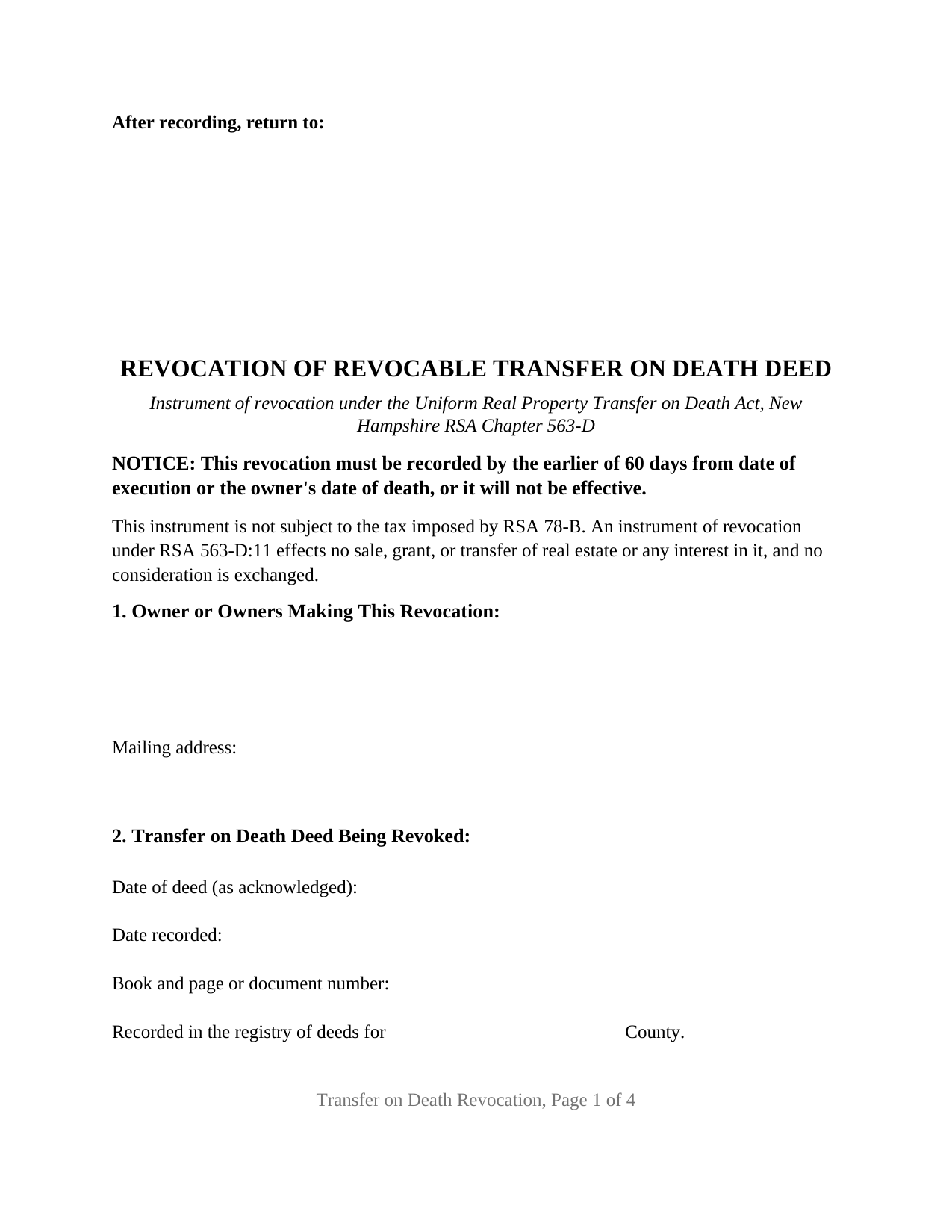
The form carries that rule where the signer sees it. The notice printed at the top of the instrument, in the words of the optional statutory form in RSA 563-D:20, states that the revocation must be recorded by the earlier of 60 days from the date of execution or the owner's date of death, or it will not be effective. The revocation sentence in Section 4 is the statutory form's own: I revoke all my previous transfers of this property by revocable transfer on death deed, pursuant to the Uniform Real Property Transfer on Death Act, New Hampshire RSA 563-D. A second sentence expressly revokes, in its entirety, the deed identified on the form, which is the element RSA 563-D:11 names for an instrument of revocation.
Identifying the deed being revoked
Section 2 of the form identifies the recorded transfer on death deed by the date it was acknowledged, the date it was recorded, its book and page or document number, and the county registry that holds it. The acknowledgment date does work here: RSA 563-D:11 requires the revocation to be acknowledged after the deed it revokes, so the two dates on the face of the instrument show the sequence the statute requires. Section 3 carries the property sentence of the statutory form, naming the town or city and the county before the legal description, which places the municipality in the first sentence of the first description paragraph as RSA 478:4-a directs for every instrument a New Hampshire register accepts.
One or two owners on the same instrument
The form recites a free-form owner block and two signature blocks, headed OWNER and SECOND OWNER (if applicable), each followed by its own acknowledgment certificate. One owner who made a deed alone uses the first block and leaves the second blank. Two owners who together made one transfer on death deed sign in both blocks. Nothing about marital status, ownership form, or capacity is preprinted; the owner block carries the names as they appear on the recorded deed, with whatever status recital the owners state, and the guide describes what those entries commonly contain.
RSA 563-D:11, I(b) governs a deed made by more than one transferor. A revocation by one transferor does not affect the deed as to the interest of another, and a deed of joint owners, meaning co-owners with a right of survivorship under RSA 563-D:2, is revoked only if all of the living joint owners revoke it. Two joint tenants who made one deed therefore both sign; a surviving joint tenant signs alone after the other's death; and tenants in common who made one deed each revoke as to their own interests. The form is not set up as a revocation by an entity, a trustee, an agent under a power of attorney, or three or more owners on one instrument, and it is not set up to revoke only part of a deed, which RSA 563-D:11 also permits through different drafting. An owner who intends to name a different beneficiary rather than simply withdraw the designation records a new transfer on death deed, which is prepared and recorded separately and is not included in this package.
Execution and the acknowledgment certificate
New Hampshire deed formalities are spare. RSA 477:3 requires the signature of the party and an acknowledgment before a justice, notary public, or commissioner; no seal and no subscribing witnesses are required. The acknowledgment certificate on the form follows the RSA 456-B:8 short form and prints an officer line reading Notary Public or Justice of the Peace, with a Title (and Rank) line where the officer states the office held, the content RSA 456-B:7 makes part of every New Hampshire certificate. Each signer has a separate certificate as a matter of the form's layout, so two owners can acknowledge on different days, before different officers, or in different states. The capacity to revoke is the capacity to make a will under RSA 551:1, by RSA 563-D:8.
Transfer tax and recording
RSA 78-B:6 permits a register to record an instrument without transfer-tax stamps only when the instrument states that the transaction is not subject to the tax. The form carries that statement on its first page: an instrument of revocation effects no sale, grant, or transfer of real estate or any interest in it, and no consideration is exchanged. The first page also leaves the upper right empty for the register and places the return address in the upper left, following the Uniform Standards adopted under RSA 478:4-a by the New Hampshire registers of deeds, and the printed name entries under each signature meet the name-under-signature rule in the same statute. Recording fees under RSA 478:17-g run $10 for the first page and $4 for each additional page, with county surcharges that vary.
The package includes the fillable form, a completed example filled in for a fictional Merrimack County fact pattern, and the guide that walks through every numbered section, the statutes behind each, and the recording process. This description and the guide describe the form and the governing New Hampshire statutes in general terms; they are not legal advice.
Important: County-Specific Forms
Our transfer on death revocation forms are specifically formatted for each of the 10 counties in New Hampshire.
After selecting your county, you'll receive forms that meet all local recording requirements, ensuring your documents will be accepted without delays or rejection fees.