New York Quitclaim Deed
County Specific Legal Forms Validated as recently as September 22, 2026 by our Forms Development Team
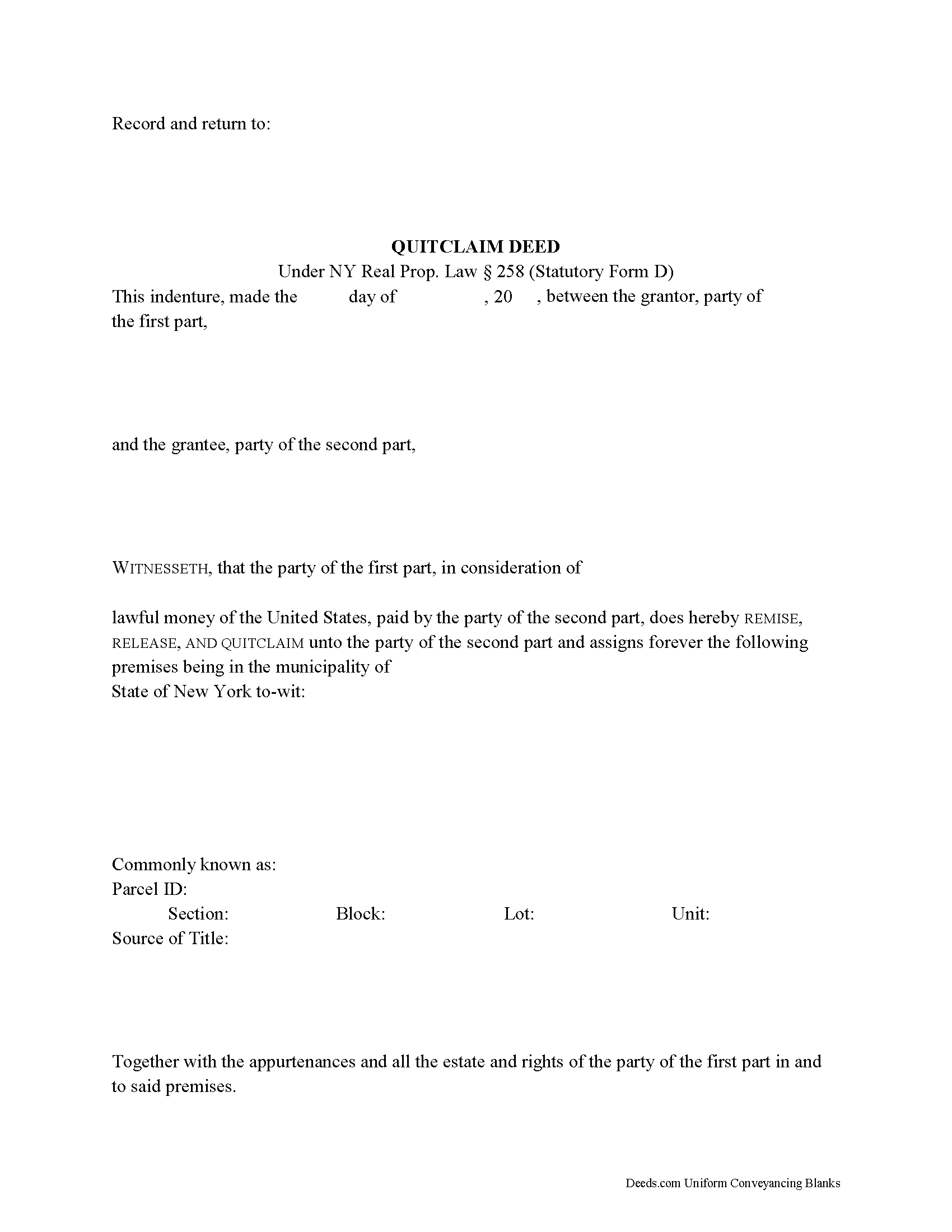
About the New York Quitclaim Deed
How to Use This Form
- Select your county from the list
- Download the county-specific form
- Fill in the required information
- Have the document notarized if required
- Record with your county recorder's office
What Others Like You Are Saying
"This is a very valuable resource. It was user friendly and made transfer happen in a day!"
"Quick, easy and reasonably priced."
"Quick and easy. Highly recommend. Thanks!"
"This is a very nice service. Easy to use and reasonable. I especially appreciated the helpful explan…"
"This was the easiest process ever. Thank you for making this so easy. No hassle, just upload your do…"
4.8/5 from 4,828 reviews. Read all
New York keeps its deed forms inside a statute, and the quitclaim deed printed there still opens on the words "This indenture, made the ... day of ..., nineteen hundred and ..." Real Property Law Section 258 prints that schedule, then says two things about it: the statutory forms are lawful, and the validity of other forms is preserved. This New York quitclaim deed, also written quit claim deed, carries the operative words of Statutory Form D in a numbered modern layout.
Lawful forms, and other forms
Three verbs do the work in Section 258's quitclaim: the grantor does hereby remise, release, and quitclaim to the grantee, together with the appurtenances and all the estate and rights of the grantor in and to the premises. Nothing else is promised. Real Property Law Section 251 keeps it that way: a covenant is not implied in a conveyance of real property, whether or not the conveyance contains special covenants. The instrument states that posture in its own words, and the listing of recorded matters beside it says on its face that it creates no covenant or warranty.
One or two people on either side
This is the base configuration of the line, and its party blocks are open rather than preprinted. The Grantor section receives one or two individual grantors signing in their own capacity, with whatever status words they state. The Grantee section receives one or two grantees plus any words of co-ownership they choose, which is where a designation such as as tenants in common or as tenants by the entirety appears. Two signature blocks are printed, each with its own certificate in the substance of the Real Property Law Section 309-a uniform form, and a deed signed by one grantor leaves the second pair blank. Nothing about status, capacity, or vesting is preprinted. Releases in the record with this shape include a sole owner passing a parcel to an adult child and two heirs clearing inherited fractional interests into one name. An entity grantor recites its organizing jurisdiction and its signing authority, and three or more owners on a side exceed the two names this form carries.
What the recording officer is told to look for
Real Property Law Section 333 reads as an instruction to the clerk rather than to the parties. A recording officer is directed not to record or accept a conveyance unless the residences of the parties, with street numbers where any exist, are stated, and a deed transferring title states the city, town, and village where the land sits. County practice adds the tax map designation: Suffolk requires its own, and Nassau asks for section, block, and lot on the first page. Then the same statute saves the title, providing that an omission or error in that information does not invalidate the conveyance or impair title. A rejection at the counter and a defect in the chain are two different problems, and Section 333 draws the line between them.
A covenant printed when nothing is being built
Every customary New York printed deed carries the trust fund covenant of Lien Law Section 13, and this one does too. Subdivision 5 explains why: a conveyance recorded after an improvement has begun, and before the lien filing period has run, is not valid against liens filed in a corresponding period measured from the recording, unless the deed carries the grantor's covenant to hold the consideration as a trust fund applied first to the improvement's cost.
Before the clerk takes it
The finished deed goes to the county clerk where the land is situated, or to the City Register through ACRIS in four boroughs. Tax Law Section 1410 bars the recording officer from recording a conveyance until the transfer tax return is filed and the tax paid, and Section 1409 makes that return due whether or not tax is owed; the RP-5217 transfer report follows Section 333 on legal paper with its own fee. Section 1405 lists the exemptions, a bona fide gift among them, claimed on the filed return rather than on the deed face.
The download holds three items: the blank New York quitclaim deed as a fillable PDF, a completed example prepared for an Ulster County gift of a platted lot, and a plain language guide covering the thirteen sections, both certificates, and the recording package. These materials are informational and are not legal advice. What a quitclaim release reaches on a particular chain of title is a question for a New York attorney.
Important: County-Specific Forms
Our quitclaim deed forms are specifically formatted for each of the 62 counties in New York.
After selecting your county, you'll receive forms that meet all local recording requirements, ensuring your documents will be accepted without delays or rejection fees.