Cortland County Transfer on Death Deed (Married Owners, Tenancy by the Entirety, Last Survivor) Form
Last validated November 19, 2026 by our Forms Development TeamFormatted for recording in Cortland County, for property anywhere in the county: rural and unincorporated areas as well as Blodgett Mills, Cincinnatus, Cortland, East Homer, Harford, Homer, Little York, Marathon and 4 more.
- 3 documents included
- Immediate PDF download
- Formatting guarantee
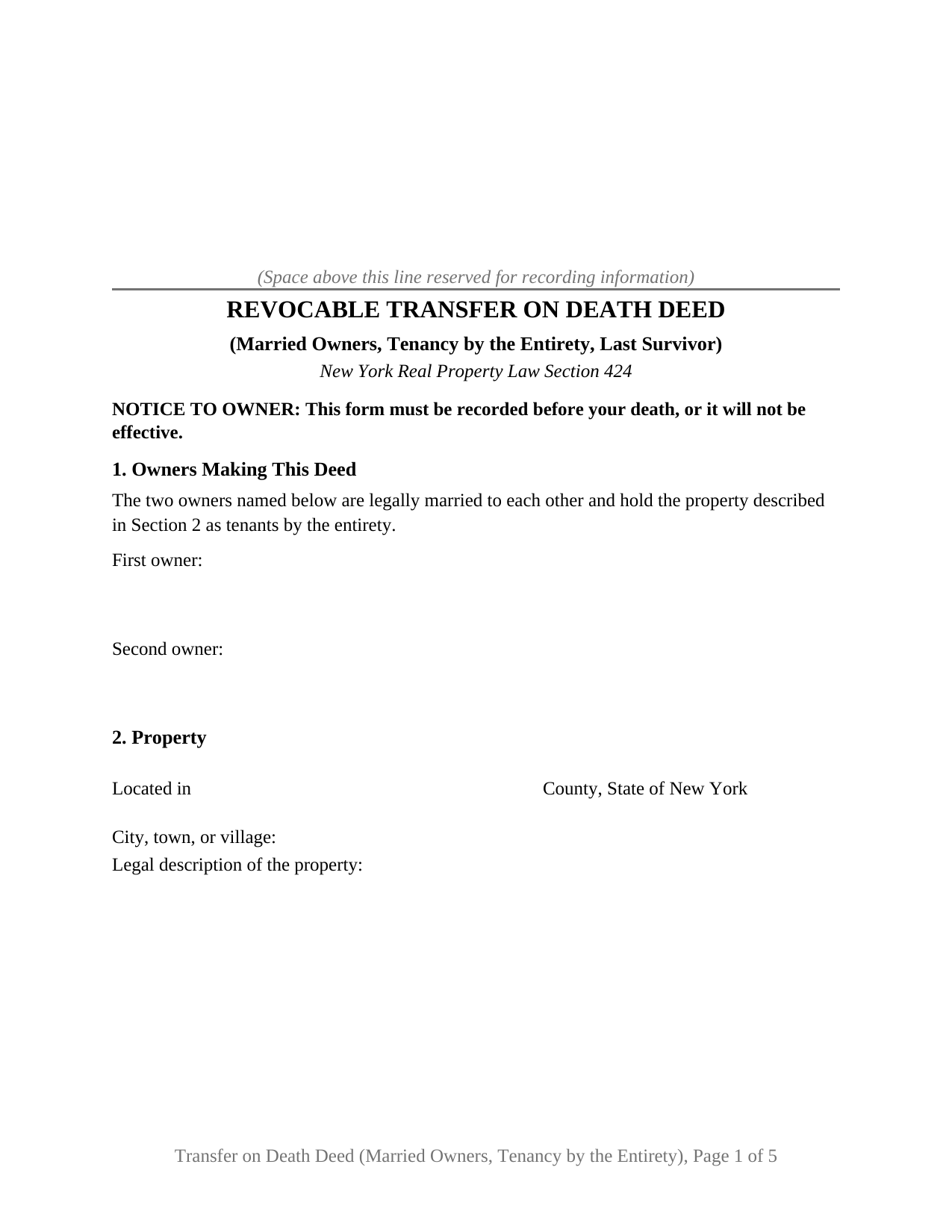
Cortland County Transfer on Death Deed (Married Owners, Tenancy by the Entirety, Last Survivor) Form
Fill in the blank Transfer on Death Deed (Married Owners, Tenancy by the Entirety, Last Survivor) form formatted to comply with all New York recording and content requirements.
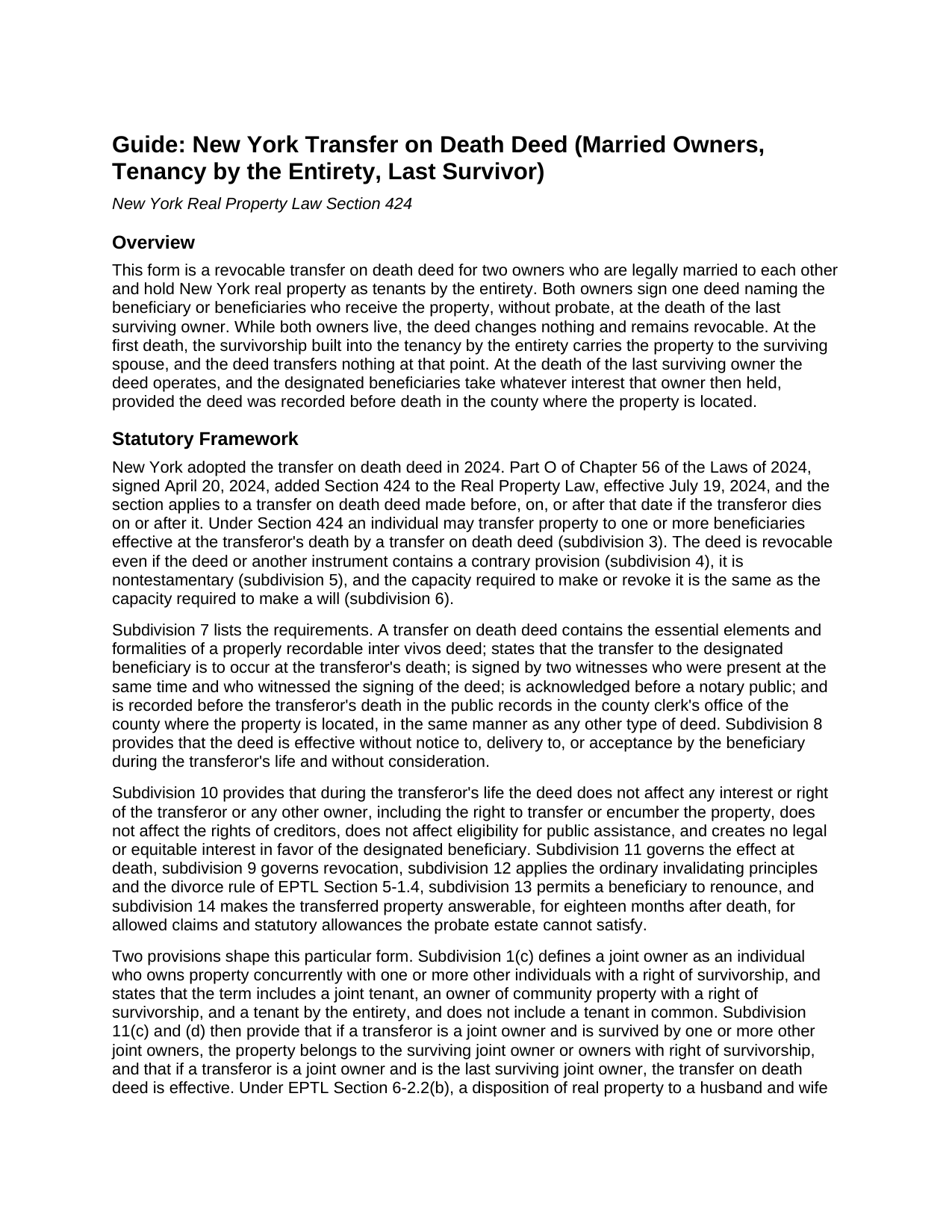
Cortland County Transfer on Death Deed (Married Owners, Tenancy by the Entirety, Last Survivor) Guide
Line by line guide explaining every blank on the Transfer on Death Deed (Married Owners, Tenancy by the Entirety, Last Survivor) form.
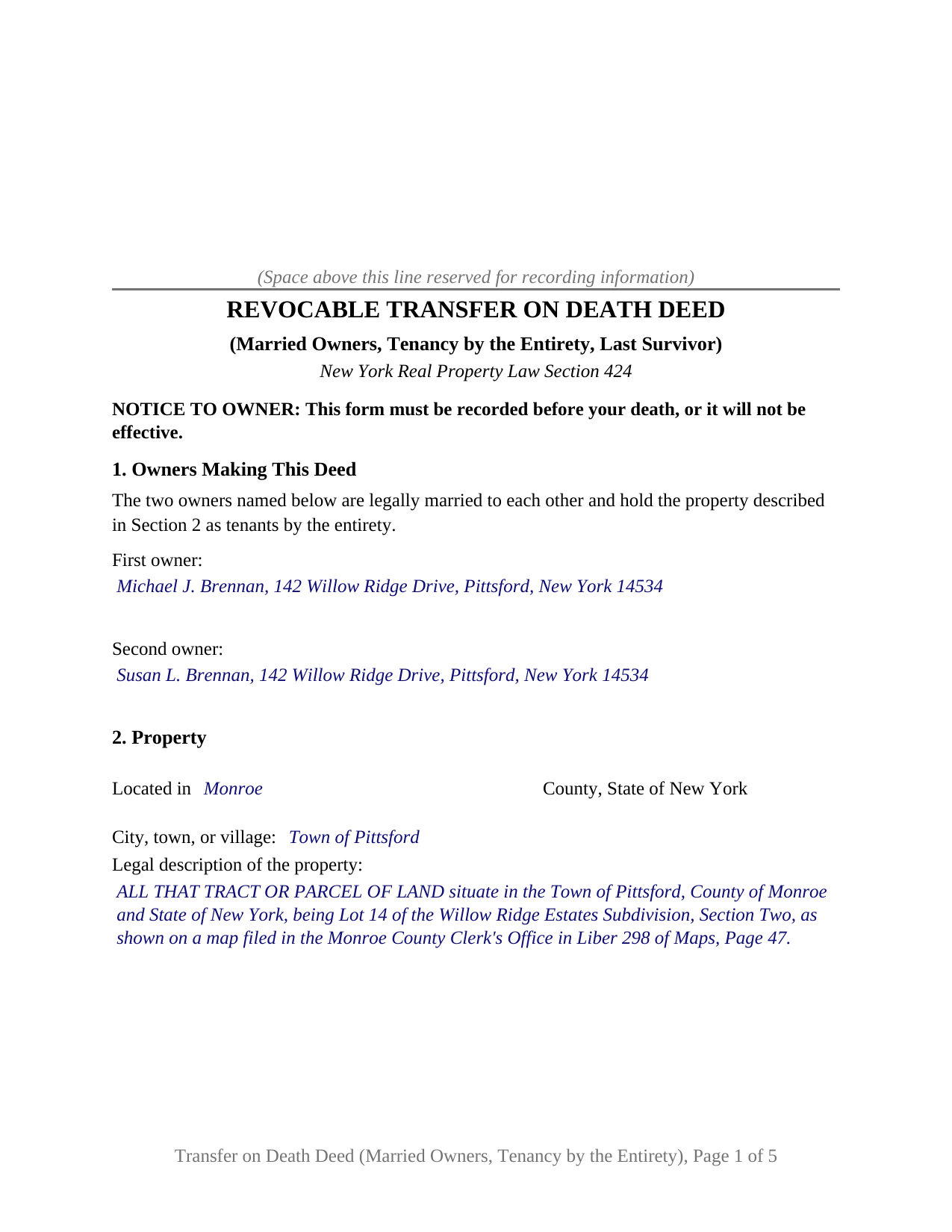
Cortland County Completed Example of the Transfer on Death Deed (Married Owners, Tenancy by the Entirety, Last Survivor) Document
Example of a properly completed New York Transfer on Death Deed (Married Owners, Tenancy by the Entirety, Last Survivor) document for reference.
All 3 documents above included • One-time purchase • No recurring fees
Immediate Download • Secure Checkout
Additional New York and Cortland County documents included at no extra charge:
Where to Record Your Documents
Cortland County Clerk
Cortland, New York 13045
Hours: 8:30 to 4:30 Monday through Friday
Phone: (607) 753-5021
Recording Tips for Cortland County:
- Bring your driver's license or state-issued photo ID
- Ensure all signatures are in blue or black ink
- Documents must be on 8.5 x 11 inch white paper
- Double-check legal descriptions match your existing deed
- Verify all names are spelled correctly before recording
Cities and Jurisdictions in Cortland County
Properties in any of these areas use Cortland County forms:
- Blodgett Mills
- Cincinnatus
- Cortland
- East Homer
- Harford
- Homer
- Little York
- Marathon
- Mc Graw
- Preble
- Truxton
- Willet
Hours, fees, requirements, and more for Cortland County
How do I get my forms?
Forms are available for immediate download after payment. The Cortland County forms will be in your account ready to download to your computer. An account is created for you during checkout if you don't have one. Forms are NOT emailed.
Are these forms guaranteed to be recordable in Cortland County?
Yes. Our form blanks are guaranteed to meet or exceed the applicable formatting requirements used for recording in Cortland County, including margin requirements, font requirements, and other layout standards. This guarantee applies to formatting, not to the legal sufficiency of information entered by the user or the suitability of a form for a particular transaction.
Can I reuse these forms?
Yes. You can reuse the forms for your personal use. For example, if you have multiple properties in Cortland County you only need to order once.
What do I need to use these forms?
The forms are PDFs that you fill out on your computer. The free Adobe Acrobat Reader is recommended, and most PDF apps also work. You do NOT enter your property information online - you download the blank forms and complete them privately on your own computer.
Are there any recurring fees?
No. This is a one-time purchase. Nothing to cancel, no memberships, no recurring fees.
How much does it cost to record in Cortland County?
Recording fees in Cortland County vary. Contact the recorder's office at (607) 753-5021 for current fees.
Questions answered? Let's get started!
Two New York spouses who hold their property as tenants by the entirety can name, in one recorded deed, who receives it after both of them have died. This transfer on death deed is prepared under Section 424 of the New York Real Property Law for exactly that configuration: two owners who are legally married to each other, holding by the entirety, both signing a single deed that transfers nothing until the second death.
A deed that waits for the second death
The timing is built into the statute rather than drafted around it. Section 424(1)(c) defines a joint owner as an individual who owns property concurrently with others with a right of survivorship, and the definition names the tenant by the entirety expressly. Section 424(11)(c) then provides that where a transferor who is a joint owner is survived by another joint owner, the property belongs to the surviving joint owner with right of survivorship; Section 424(11)(d) provides that where the transferor is the last surviving joint owner, the transfer on death deed is effective. Read together, the two paragraphs mean that at the first death the surviving spouse owns the whole property by the survivorship inherent in the tenancy by the entirety, and the deed does nothing at that point. At the death of the last surviving owner the deed operates, and the beneficiaries named in it take the property without probate.
The deed says so on its face. Its transfer section carries the statutory form's own sentence, At my death, I transfer my interest in the described property to the beneficiaries as designated above, followed by fixed text reciting that the owners are joint owners within the meaning of Section 424(1)(c) and that the deed is effective at the death of the last surviving owner. Because the deed operates at the second death, the survival condition the statute attaches to every designation, under Section 424(11)(a)(2), is measured against the last surviving owner: a beneficiary who outlives one spouse but not the other does not take.
What the married owners recital fixes
Section 1 of the deed recites that the two owners named in it are legally married to each other and hold the described property as tenants by the entirety. That recital is fixed deed text, not a choice box, and the record title it describes is the ordinary one for a New York couple: under EPTL Section 6-2.2(b), a conveyance of real property to a husband and wife creates a tenancy by the entirety unless the deed expressly declares a joint tenancy or a tenancy in common. A couple's vesting deed shows which of those estates they hold. The form is set up for the entirety estate and for no other: a deed to two people who are not legally married creates a joint tenancy under EPTL Section 6-2.2(d) even where it calls them spouses, a tenancy in common sits outside the Section 424(1)(c) definition altogether, and a property held by one spouse alone presents a single owner pattern. Those titles are described by other configurations, and this deed recites exactly two married owners holding by the entirety.
Two signatures, two witnesses, two acknowledgments
Section 424(7) attaches execution formalities that New York does not otherwise place on a deed. The deed is signed by two witnesses who were present at the same time and who witnessed the signing, and it is acknowledged before a notary public. On this form each spouse signs a separate owner block, both signing before the same two witnesses, who sign under a sentence attesting that they were present at the same time and witnessed each owner's signing. Each spouse then acknowledges the deed under a separate certificate in the form Real Property Law Section 309-a(1) prescribes, with STATE OF NEW YORK printed as the venue, the county, day, month, and year left for the notary, the lines for the notary's name, county of qualification, and commission expiration that Executive Law Section 137 calls for, and a line for the notary's registration number. The separate certificates are the form's architecture; New York permits one certificate to cover two signers who appear together, and the two certificates simply let each spouse acknowledge on a different day or before a different notary.
Revoking a deed two people made
A transfer on death deed is revocable for the owners' entire lives, and Section 424(9)(b) adds the rule for a deed with more than one transferor. Revocation by one transferor does not affect the deed as to the interest of the other, and a deed of joint owners is revoked only if all of the living joint owners revoke it. While both spouses live, both join in the revocation; after the first death the surviving spouse is the only living joint owner and may revoke alone. Whoever revokes does it by a recorded instrument, a later transfer on death deed, an instrument of revocation, or a lifetime deed that expressly revokes the earlier one, acknowledged after this deed and recorded before death in the same clerk's office. The instrument of revocation is prepared and recorded separately and is not included in this package. A will does not revoke the deed, and under Section 424(9)(c) neither does marking up or destroying a deed once it is recorded.
Recorded before death, without the transfer tax package
Recording is the formality that gives the deed life. Section 424(7)(e) requires the deed to be recorded before the transferor's death, in the office of the county clerk for the county in which the property sits and in the same manner as any other deed, and the statutory form's own notice warns that an unrecorded deed is not effective. On a two-owner deed, recording promptly after signing, while both spouses are living, places the deed of record before either death. The recording package is lighter than the one a sale carries: the New York State Department of Taxation and Finance has published that a transfer on death deed is recorded in the same manner as other deeds but need not be accompanied by the RP-5217 transfer report or the TP-584 transfer tax return. Recording fees vary county by county under CPLR Section 8021, and the deed carries the owners' residences, the municipality, and the tax map designation that Real Property Law Section 333 and the county clerks look for.
What stays with the spouses
During both owners' lives the deed changes nothing. Section 424(10) leaves every lifetime right where it was: each spouse keeps the right to transfer or encumber the property, by sale, mortgage, or otherwise; the rights of either spouse's creditors are unaffected; eligibility for public assistance is unaffected; and the beneficiaries hold no legal or equitable interest while either owner lives. At the second death the beneficiaries take subject to every mortgage, lien, and other interest then affecting the property, without covenant or warranty of title, and the property remains answerable for eighteen months for estate claims the probate estate cannot satisfy, under Sections 424(11) and 424(14). The surviving spouse's right of election and the family exemption operate between the spouses before the deed ever does.
The package includes the fillable transfer on death deed form, a completed example filled in for a realistic Monroe County fact pattern, and the guide, which takes each numbered section in turn, explains the witness and notary blocks, and sets out the recording steps. Both the guide and this description are general accounts of the form and of the New York statutes behind it, and neither is legal advice.
Important: Your property must be located in Cortland County to use these forms. Documents should be recorded at the county recording office listed above.
This Transfer on Death Deed (Married Owners, Tenancy by the Entirety, Last Survivor) meets all recording requirements specific to Cortland County.
Our Promise
The documents you receive here are guaranteed to meet or exceed the applicable Cortland County recording format requirements. If there is a rejection caused by our formatting, we will correct the issue or refund your payment. This guarantee applies to document formatting only and does not extend to information entered by the user, the selection of the form, or the legal effect of the completed document.
Save Time and Money
Get your Cortland County Transfer on Death Deed (Married Owners, Tenancy by the Entirety, Last Survivor) form done right the first time with Deeds.com Uniform Conveyancing Blanks. At Deeds.com, we understand that your time and money are valuable resources, and we don't want you to face a penalty fee or rejection imposed by a county recorder for submitting nonstandard documents. We constantly review and update our forms to meet rapidly changing state and county recording requirements for roughly 3,500 counties and local jurisdictions.
4.8 out of 5 - ( 4,864 Reviews )
Christopher B. 5 out of 5 stars
Process went smoothly and will use for my next recording. Only area for improvement would be to provide the ability for the user to delete and replace uploaded documents.
Thank you for your feedback. We really appreciate it. Have a great day!
Jesse B. 5 out of 5 stars
Bought a quit claim deed form. Came with great instructions that were easy to follow and allowed me to do it over a couple of times until I got it right. Was also cheaper than most other options I found online.
Thank you for your feedback. We really appreciate it. Have a great day!
JEFFREY C. 5 out of 5 stars
This is pretty amazing...! Very simple and immediate. I would definitely recommend deed.com
Thank you!
Lori F. 5 out of 5 stars
These folks are so amazing! They were very kind, patient and the communication was above and beyond. Basically, THEY ROCK!
Thank you!
Jermaine H. 5 out of 5 stars
Great informative site.... helped me find exactly what I was looking for. DETAILED information on my property!
Thank you for your feedback. We really appreciate it. Have a great day!
Janet R. 5 out of 5 stars
The site was easy to navigate...all the information needed to fill in the forms was included, which was very helpful and a pleasant surprise...form completed in short order...made taking care of business quick and easy...Thanks for the thoughtful and excellent help, I will share the link with others and I will use the site again...Thanks
We appreciate your business and value your feedback. Thank you. Have a wonderful day!
Deborah V. 5 out of 5 stars
Helpful and informative.
We appreciate your business and value your feedback. Thank you. Have a wonderful day!
John Y. 5 out of 5 stars
Too much money for a form!
Thank you!
Crystal W. 5 out of 5 stars
This is the easiest process.
Thank you for your feedback. We really appreciate it. Have a great day!
Elizabeth M. 5 out of 5 stars
Thanks for making the Quitclaim Mineral Deed easy to understand, and the process so affordable.
Thank you, Elizabeth. We're glad the Quitclaim Mineral Deed package made the process clear and accessible. Mineral rights conveyances can feel intimidating without the right tools, and we appreciate you taking the time to share your experience.
Deirdre M. 5 out of 5 stars
Good documents good price saved me a lot of money and time.
Thanks for the feedback Deirdre, we appreciate it.
Anthony N. 3 out of 5 stars
The site was not easy to navigate. Maybe putting the different things offered at the heading instead of searching for it.
Thank you for your feedback. We really appreciate it. Have a great day!
Cruz C. 5 out of 5 stars
L-o-v-e your site. Great over-all usable docs. thanks
Thank you for your feedback. We really appreciate it. Have a great day!
Patsy B. 5 out of 5 stars
This website is very user friendly. I easily found the form I needed and was given an example for filling it out. Highly recommend this website!
We appreciate your business and value your feedback. Thank you. Have a wonderful day!
Richard H. 5 out of 5 stars
Excellent service, very user friendly
Thank you!