New York County Transfer on Death Deed (Sole Owner, One Individual Beneficiary) Form
Last validated November 19, 2026 by our Forms Development TeamFormatted for recording in New York County, for property anywhere in the county: rural and unincorporated areas as well as New York.
- 3 documents included
- Immediate PDF download
- Formatting guarantee
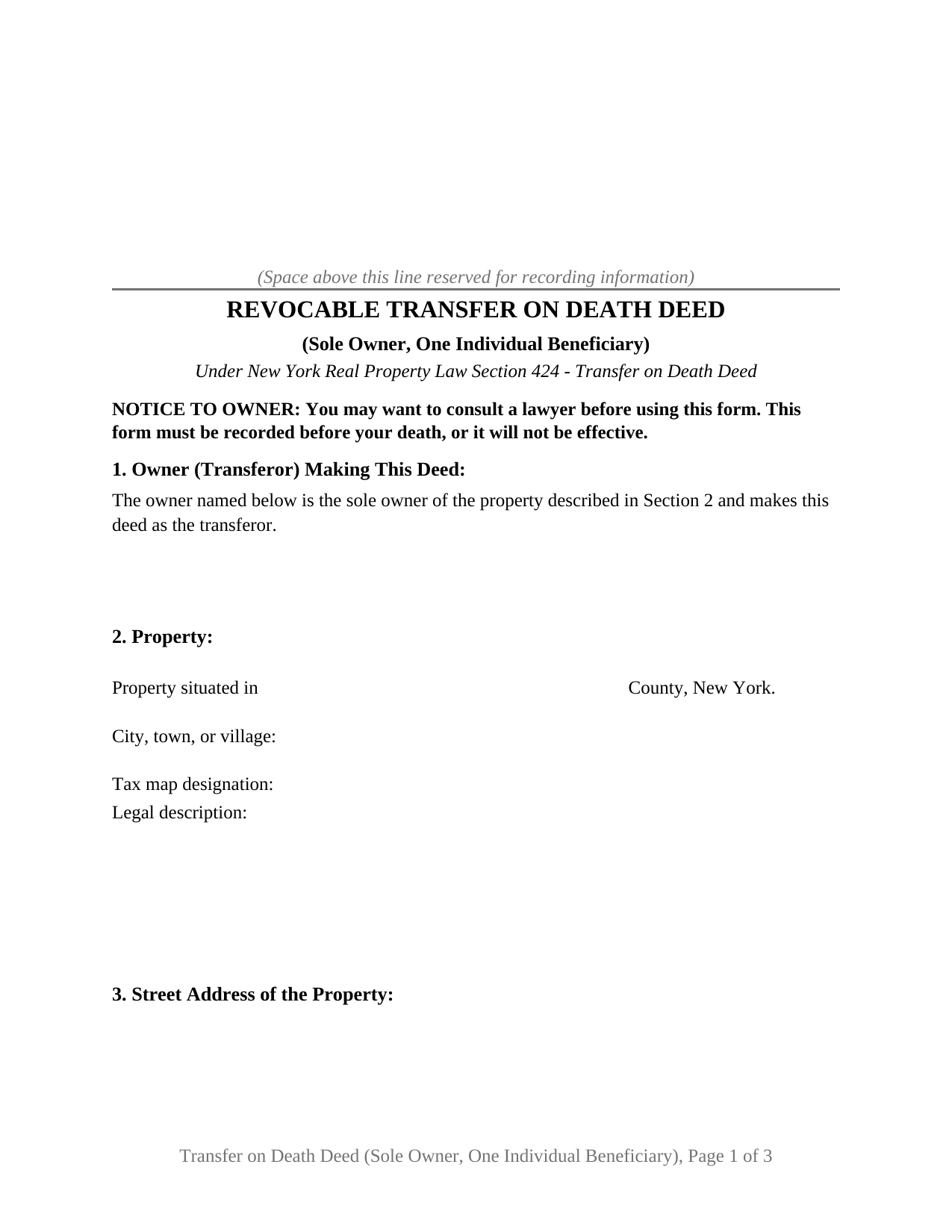
New York County Transfer on Death Deed (Sole Owner, One Individual Beneficiary) Form
Fill in the blank Transfer on Death Deed (Sole Owner, One Individual Beneficiary) form formatted to comply with all New York recording and content requirements.
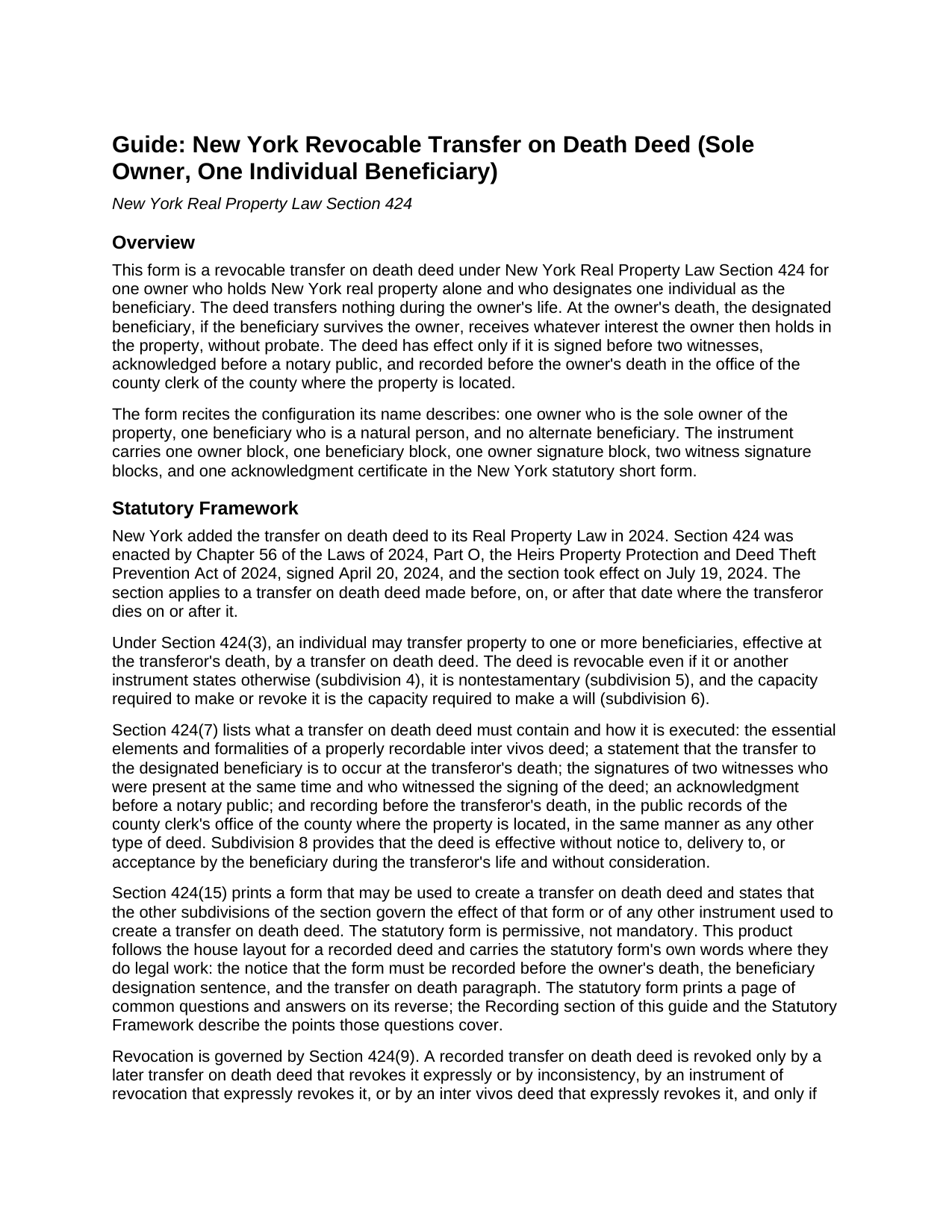
New York County Transfer on Death Deed (Sole Owner, One Individual Beneficiary) Guide
Line by line guide explaining every blank on the Transfer on Death Deed (Sole Owner, One Individual Beneficiary) form.
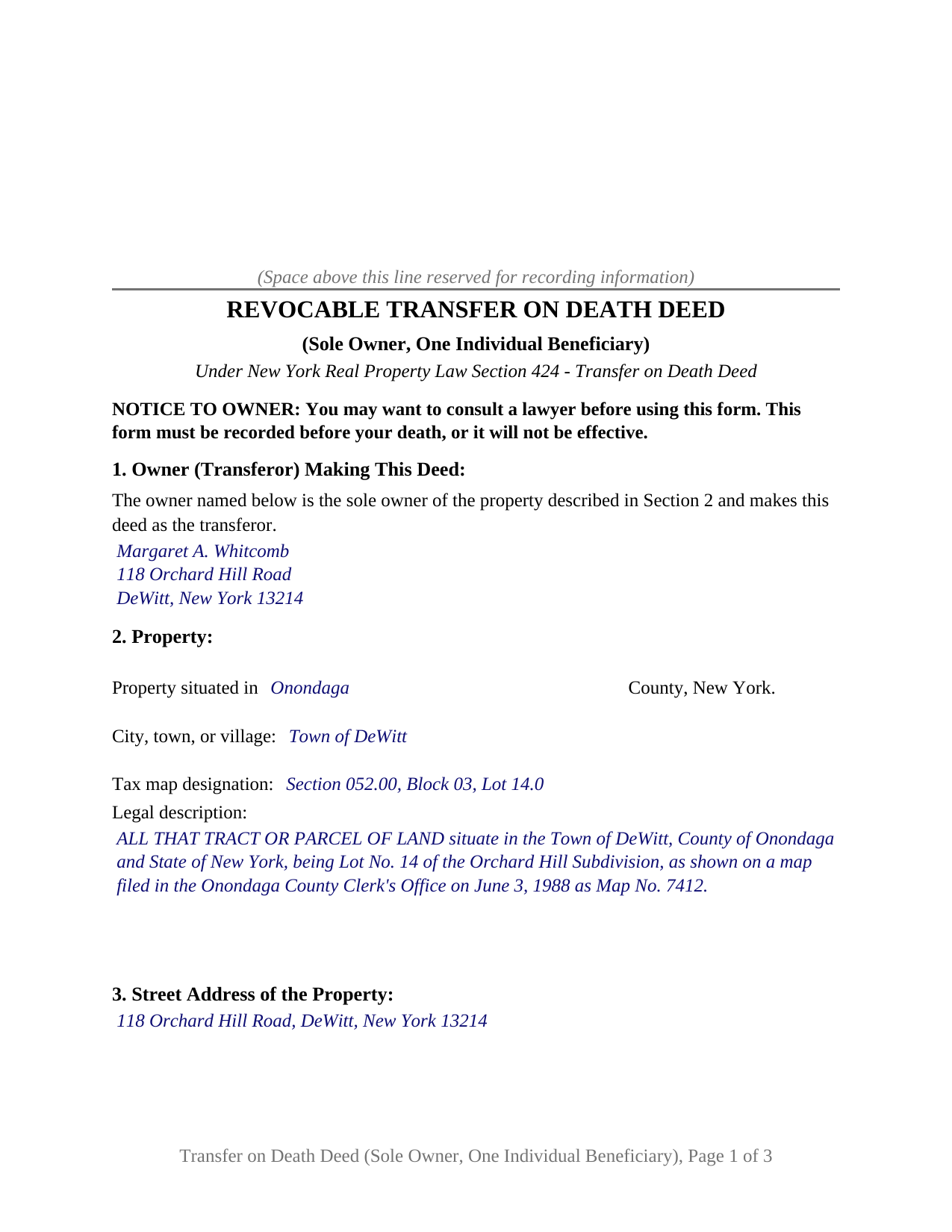
New York County Completed Example of the Transfer on Death Deed (Sole Owner, One Individual Beneficiary) Document
Example of a properly completed New York Transfer on Death Deed (Sole Owner, One Individual Beneficiary) document for reference.
All 3 documents above included • One-time purchase • No recurring fees
Immediate Download • Secure Checkout
Additional New York and New York County documents included at no extra charge:
Where to Record Your Documents
City of New York Register
New York, New York 10038
Hours: 9:00am to 4:30pm M-F
Phone: 311 or (212) NEW-YORK
Recording Tips for New York County:
- Bring your driver's license or state-issued photo ID
- Ensure all signatures are in blue or black ink
- Make copies of your documents before recording - keep originals safe
- Recorded documents become public record - avoid including SSNs
- Recording fees may differ from what's posted online - verify current rates
Cities and Jurisdictions in New York County
Properties in any of these areas use New York County forms:
- New York
Hours, fees, requirements, and more for New York County
How do I get my forms?
Forms are available for immediate download after payment. The New York County forms will be in your account ready to download to your computer. An account is created for you during checkout if you don't have one. Forms are NOT emailed.
Are these forms guaranteed to be recordable in New York County?
Yes. Our form blanks are guaranteed to meet or exceed the applicable formatting requirements used for recording in New York County, including margin requirements, font requirements, and other layout standards. This guarantee applies to formatting, not to the legal sufficiency of information entered by the user or the suitability of a form for a particular transaction.
Can I reuse these forms?
Yes. You can reuse the forms for your personal use. For example, if you have multiple properties in New York County you only need to order once.
What do I need to use these forms?
The forms are PDFs that you fill out on your computer. The free Adobe Acrobat Reader is recommended, and most PDF apps also work. You do NOT enter your property information online - you download the blank forms and complete them privately on your own computer.
Are there any recurring fees?
No. This is a one-time purchase. Nothing to cancel, no memberships, no recurring fees.
How much does it cost to record in New York County?
Recording fees in New York County vary. Contact the recorder's office at 311 or (212) NEW-YORK for current fees.
Questions answered? Let's get started!
This New York transfer on death deed is built for the simplest designation the state's new statute allows: one owner who holds the property alone names one person, and nobody else, to receive it at death. The deed recites that the owner is the sole owner of the described property, designates exactly one individual beneficiary, and designates no alternate. It is prepared under Section 424 of the New York Real Property Law, the transfer on death deed provision that took effect on July 19, 2024.
One owner, one name, nothing in reserve
The configuration is what distinguishes this form. Section 424 permits an owner to name several beneficiaries, an entity, or an alternate who takes if the first choice dies first, and the statutory form prints an optional alternate line. This deed carries none of that. Its beneficiary section recites that the deed designates one beneficiary, the individual named below, and no alternate beneficiary, followed by the statute's own designation sentence: I designate the following beneficiary if the beneficiary survives me. The chapter supplies the consequence of that single designation. Under Section 424(11)(a)(2) the beneficiary's interest is contingent on surviving the owner, and the interest of a beneficiary who does not survive lapses, so a deed with no alternate transfers nothing in that event and the property passes with the rest of the owner's estate. An owner who wants a second name in reserve is working with a different pattern than the one this deed recites.
The owner side is fixed the same way. The deed recites a sole owner, which matches a title held in severalty with no co-owner of record. Section 424(11)(c) and (d) treat co-owned survivorship property differently: a joint tenant's or a tenant by the entirety's deed takes effect only if that transferor is the last surviving joint owner, and New York spouses who acquired property together ordinarily hold it by the entirety under EPTL Section 6-2.2(b). Those owners present a two-owner pattern, not this one.
What the deed does while the owner is alive: nothing
A New York TOD deed, sometimes searched as a beneficiary deed, changes no rights during the owner's life. Section 424(10) provides that the deed does not affect the owner's right to sell, mortgage, or otherwise transfer or encumber the property, does not affect creditors, does not affect eligibility for public assistance, and creates no legal or equitable interest in the beneficiary. The deed is revocable even if it says otherwise, and Section 424(9) spells out how: a later transfer on death deed, an instrument of revocation, or a lifetime deed that expressly revokes it, acknowledged after this deed and recorded before the owner's death. A will does not revoke it, and neither does tearing it up once it has been recorded. The revocation instrument is prepared and recorded separately and is not included in this package.
Two witnesses, a notary, and a recording before death
New York attached execution formalities to this deed that an ordinary deed in the state does not carry together. Section 424(7) requires the deed to be signed by two witnesses who were present at the same time and who witnessed the owner's signing, and to be acknowledged before a notary public. The form carries one owner signature block, two witness signature blocks under a sentence reciting that both witnesses were present at the same time, and one acknowledgment certificate in the New York short form of Real Property Law Section 309-a, with the venue, the day, month, and year blanks, and the notary's statement of authority under Executive Law Section 137 laid out for the officer. The third formality is the one that decides everything: the deed must be recorded before the owner's death in the county clerk's office of the county where the property is located, in the same manner as any other deed. The statutory form's own notice says so, and the form carries that sentence in bold under its title. A deed that is signed, witnessed, and notarized but still unrecorded when the owner dies transfers nothing.
Recording a TOD deed in New York is lighter than recording a sale. The Department of Taxation and Finance states that transfer on death deeds do not need to be accompanied by Form RP-5217 or Form TP-584, the transfer report and transfer tax return that travel with an ordinary deed, and county clerks have published their own pages on how the new instrument is accepted. The form itself carries the residence, municipality, and tax map entries Real Property Law Section 333 contemplates for a recorded deed, so the clerk's indexing items are on the face of the instrument in every county, including the section, block, and lot practice of Nassau and the tax map designation Suffolk asks for.
What the beneficiary receives
At the owner's death the named individual takes whatever interest the owner then holds, subject to every mortgage, lien, and other interest affecting the property at that moment, and without covenant or warranty of title; Section 424(11) builds both rules into the statute. The property also remains answerable, for eighteen months after death, for estate claims and statutory allowances the probate estate cannot satisfy, under Section 424(14). What the beneficiary does not have to do is open a probate proceeding to take title, which is the reason a New York transfer on death deed exists.
Who signs and who does not
Only the record owner signs, before the two witnesses and the notary. New York has no community property and no homestead joinder statute, and a transfer on death deed conveys nothing during life, so a spouse who is not on the title is not a transferor and has no signature line on this form. The deed leaves untouched the surviving spouse's right of election against the estate under EPTL Section 5-1.1-A, and under Section 424(12)(b) a divorce has the same effect on the designation that EPTL Section 5-1.4 gives it on other revocable dispositions, treating the former spouse as having predeceased. The guide walks through each of these points with the statute beside it.
The package includes the fillable transfer on death deed form, a completed example filled in for a realistic Onondaga County fact pattern, and the guide that walks through every numbered section, the signing formalities, and the recording process. This description and the guide describe the form and the governing New York statutes in general terms; they are not legal advice.
Important: Your property must be located in New York County to use these forms. Documents should be recorded at the county recording office listed above.
This Transfer on Death Deed (Sole Owner, One Individual Beneficiary) meets all recording requirements specific to New York County.
Our Promise
The documents you receive here are guaranteed to meet or exceed the applicable New York County recording format requirements. If there is a rejection caused by our formatting, we will correct the issue or refund your payment. This guarantee applies to document formatting only and does not extend to information entered by the user, the selection of the form, or the legal effect of the completed document.
Save Time and Money
Get your New York County Transfer on Death Deed (Sole Owner, One Individual Beneficiary) form done right the first time with Deeds.com Uniform Conveyancing Blanks. At Deeds.com, we understand that your time and money are valuable resources, and we don't want you to face a penalty fee or rejection imposed by a county recorder for submitting nonstandard documents. We constantly review and update our forms to meet rapidly changing state and county recording requirements for roughly 3,500 counties and local jurisdictions.
4.8 out of 5 - ( 4,864 Reviews )
Fallon G. 5 out of 5 stars
Very easy to use, thank you!
Knowing our customers are happy is our top priority. Thank you for the wonderful feedback!
Jerome R. 5 out of 5 stars
great service clean and accurate
Thank you for your feedback. We really appreciate it. Have a great day!
Andre H. 5 out of 5 stars
World class forms, great for someone like me that has no clue what I'm doing! Always better to let the pros do it than think one knows it all and gets themselves in trouble!
Thank you for your feedback. We really appreciate it. Have a great day!
Tanya B. 5 out of 5 stars
Very convenient way to record documents without leaving the office. Responses to any questions have always been very quick. Would recommend using the site to anyone who needs to record documents and wants to save valuable time.
Thank you!
Daniel B. 5 out of 5 stars
easy to use and upload.
We are delighted to have been of service. Thank you for the positive review!
Lynne B. 5 out of 5 stars
It was very easy to navigate and very fast response time.
Thank you!
Meridith B. 5 out of 5 stars
Well, When I got the question right I got the answers right from Claim Deed. In the end it all worked out very, very good. I'm pleased with the deed and the price was very fair. Thank you for answering all my crazy questions. Now all we have to do is go to UPS and sign it. Thank, again.
Thank you!
Rachel Y. 5 out of 5 stars
I liked the ease of use, however I would love to be able to add multiple APN’s and delete lines that are not applicable
Thank you, Rachel. We’re glad you found the form easy to use, and we appreciate your suggestions about adding multiple APNs and removing inapplicable lines. Feedback like this helps us improve our forms.
Elena R. 4 out of 5 stars
Very helpful forms and guide. Would use again if needed.
Thank you for your feedback. We really appreciate it. Have a great day!
William P. 5 out of 5 stars
I was very pleased with the end results regarding Quitclaim deeds.
Thank you!
Tamra L. 5 out of 5 stars
excellent instructions and clear forms. Thank you for your service!
Glad everything was clear and easy to follow. We appreciate you taking the time to share this.
Judith G. 5 out of 5 stars
Thank you, it was easy and fast. The clerks office filed without question.
Thank you Judith, have a fantastic day!
Thomas J. 5 out of 5 stars
I'm pleased with the service
Thank you!
Angel C. 5 out of 5 stars
Solid forms hitting all the marks (statutory requirements) Fairly simple to accomplish what I was looking to do with minimal research. Would certainly use again when needed.
Thank you!
Jeffery H. 5 out of 5 stars
Very easy to use. Thanks for your quick response on my document submissions and follow up and guidance on specific questions.
Thank you for your positive words! We’re thrilled to hear about your experience.