New York Transfer on Death Deed (Sole Owner, One Individual Beneficiary)
County Specific Legal Forms Validated as recently as November 19, 2026 by our Forms Development Team
About the New York Transfer on Death Deed (Sole Owner, One Individual Beneficiary)
How to Use This Form
- Select your county from the list
- Download the county-specific form
- Fill in the required information
- Have the document notarized if required
- Record with your county recorder's office
What Others Like You Are Saying
"Thanks for the service which was excellent and timely. Instructions were easy to follow and results …"
"Thank you for responding so quickly to my question. I was able to locate the form and get everything…"
"All the material included made preparing the quit claim deed very easy. Good product."
"Good experience, good service too - thanks."
"Very easy to use and saved a lot of time"
4.8/5 from 4,864 reviews. Read all
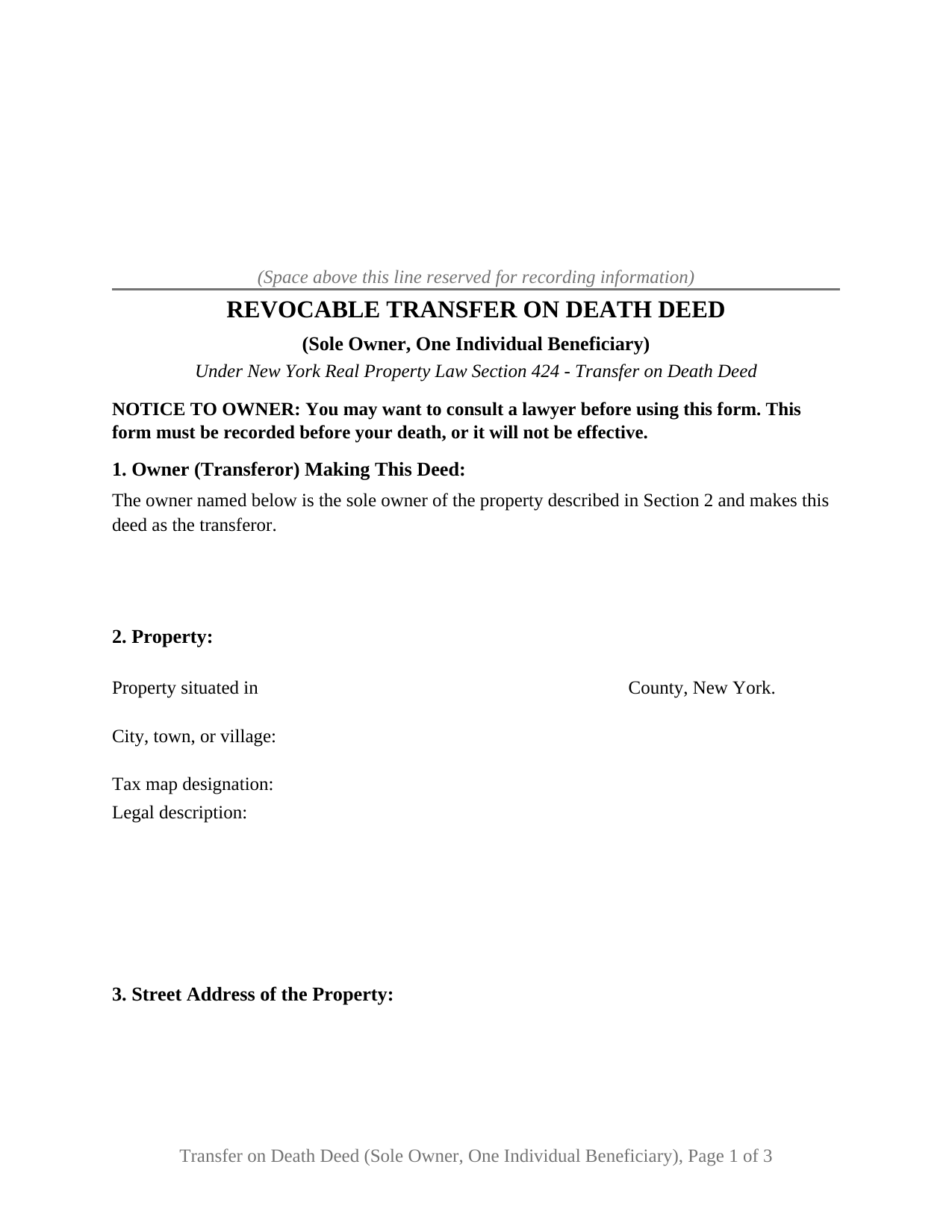
This New York transfer on death deed is built for the simplest designation the state's new statute allows: one owner who holds the property alone names one person, and nobody else, to receive it at death. The deed recites that the owner is the sole owner of the described property, designates exactly one individual beneficiary, and designates no alternate. It is prepared under Section 424 of the New York Real Property Law, the transfer on death deed provision that took effect on July 19, 2024.
One owner, one name, nothing in reserve
The configuration is what distinguishes this form. Section 424 permits an owner to name several beneficiaries, an entity, or an alternate who takes if the first choice dies first, and the statutory form prints an optional alternate line. This deed carries none of that. Its beneficiary section recites that the deed designates one beneficiary, the individual named below, and no alternate beneficiary, followed by the statute's own designation sentence: I designate the following beneficiary if the beneficiary survives me. The chapter supplies the consequence of that single designation. Under Section 424(11)(a)(2) the beneficiary's interest is contingent on surviving the owner, and the interest of a beneficiary who does not survive lapses, so a deed with no alternate transfers nothing in that event and the property passes with the rest of the owner's estate. An owner who wants a second name in reserve is working with a different pattern than the one this deed recites.
The owner side is fixed the same way. The deed recites a sole owner, which matches a title held in severalty with no co-owner of record. Section 424(11)(c) and (d) treat co-owned survivorship property differently: a joint tenant's or a tenant by the entirety's deed takes effect only if that transferor is the last surviving joint owner, and New York spouses who acquired property together ordinarily hold it by the entirety under EPTL Section 6-2.2(b). Those owners present a two-owner pattern, not this one.
What the deed does while the owner is alive: nothing
A New York TOD deed, sometimes searched as a beneficiary deed, changes no rights during the owner's life. Section 424(10) provides that the deed does not affect the owner's right to sell, mortgage, or otherwise transfer or encumber the property, does not affect creditors, does not affect eligibility for public assistance, and creates no legal or equitable interest in the beneficiary. The deed is revocable even if it says otherwise, and Section 424(9) spells out how: a later transfer on death deed, an instrument of revocation, or a lifetime deed that expressly revokes it, acknowledged after this deed and recorded before the owner's death. A will does not revoke it, and neither does tearing it up once it has been recorded. The revocation instrument is prepared and recorded separately and is not included in this package.
Two witnesses, a notary, and a recording before death
New York attached execution formalities to this deed that an ordinary deed in the state does not carry together. Section 424(7) requires the deed to be signed by two witnesses who were present at the same time and who witnessed the owner's signing, and to be acknowledged before a notary public. The form carries one owner signature block, two witness signature blocks under a sentence reciting that both witnesses were present at the same time, and one acknowledgment certificate in the New York short form of Real Property Law Section 309-a, with the venue, the day, month, and year blanks, and the notary's statement of authority under Executive Law Section 137 laid out for the officer. The third formality is the one that decides everything: the deed must be recorded before the owner's death in the county clerk's office of the county where the property is located, in the same manner as any other deed. The statutory form's own notice says so, and the form carries that sentence in bold under its title. A deed that is signed, witnessed, and notarized but still unrecorded when the owner dies transfers nothing.
Recording a TOD deed in New York is lighter than recording a sale. The Department of Taxation and Finance states that transfer on death deeds do not need to be accompanied by Form RP-5217 or Form TP-584, the transfer report and transfer tax return that travel with an ordinary deed, and county clerks have published their own pages on how the new instrument is accepted. The form itself carries the residence, municipality, and tax map entries Real Property Law Section 333 contemplates for a recorded deed, so the clerk's indexing items are on the face of the instrument in every county, including the section, block, and lot practice of Nassau and the tax map designation Suffolk asks for.
What the beneficiary receives
At the owner's death the named individual takes whatever interest the owner then holds, subject to every mortgage, lien, and other interest affecting the property at that moment, and without covenant or warranty of title; Section 424(11) builds both rules into the statute. The property also remains answerable, for eighteen months after death, for estate claims and statutory allowances the probate estate cannot satisfy, under Section 424(14). What the beneficiary does not have to do is open a probate proceeding to take title, which is the reason a New York transfer on death deed exists.
Who signs and who does not
Only the record owner signs, before the two witnesses and the notary. New York has no community property and no homestead joinder statute, and a transfer on death deed conveys nothing during life, so a spouse who is not on the title is not a transferor and has no signature line on this form. The deed leaves untouched the surviving spouse's right of election against the estate under EPTL Section 5-1.1-A, and under Section 424(12)(b) a divorce has the same effect on the designation that EPTL Section 5-1.4 gives it on other revocable dispositions, treating the former spouse as having predeceased. The guide walks through each of these points with the statute beside it.
The package includes the fillable transfer on death deed form, a completed example filled in for a realistic Onondaga County fact pattern, and the guide that walks through every numbered section, the signing formalities, and the recording process. This description and the guide describe the form and the governing New York statutes in general terms; they are not legal advice.
Important: County-Specific Forms
Our transfer on death deed (sole owner, one individual beneficiary) forms are specifically formatted for each of the 62 counties in New York.
After selecting your county, you'll receive forms that meet all local recording requirements, ensuring your documents will be accepted without delays or rejection fees.