Chemung County Transfer on Death Deed (Sole Owner, Primary and Alternate Beneficiary) Form
Last validated November 19, 2026 by our Forms Development TeamFormatted for recording in Chemung County, for property anywhere in the county: rural and unincorporated areas as well as Big Flats, Breesport, Chemung, Elmira, Erin, Horseheads, Lowman, Millport and 4 more.
- 3 documents included
- Immediate PDF download
- Formatting guarantee
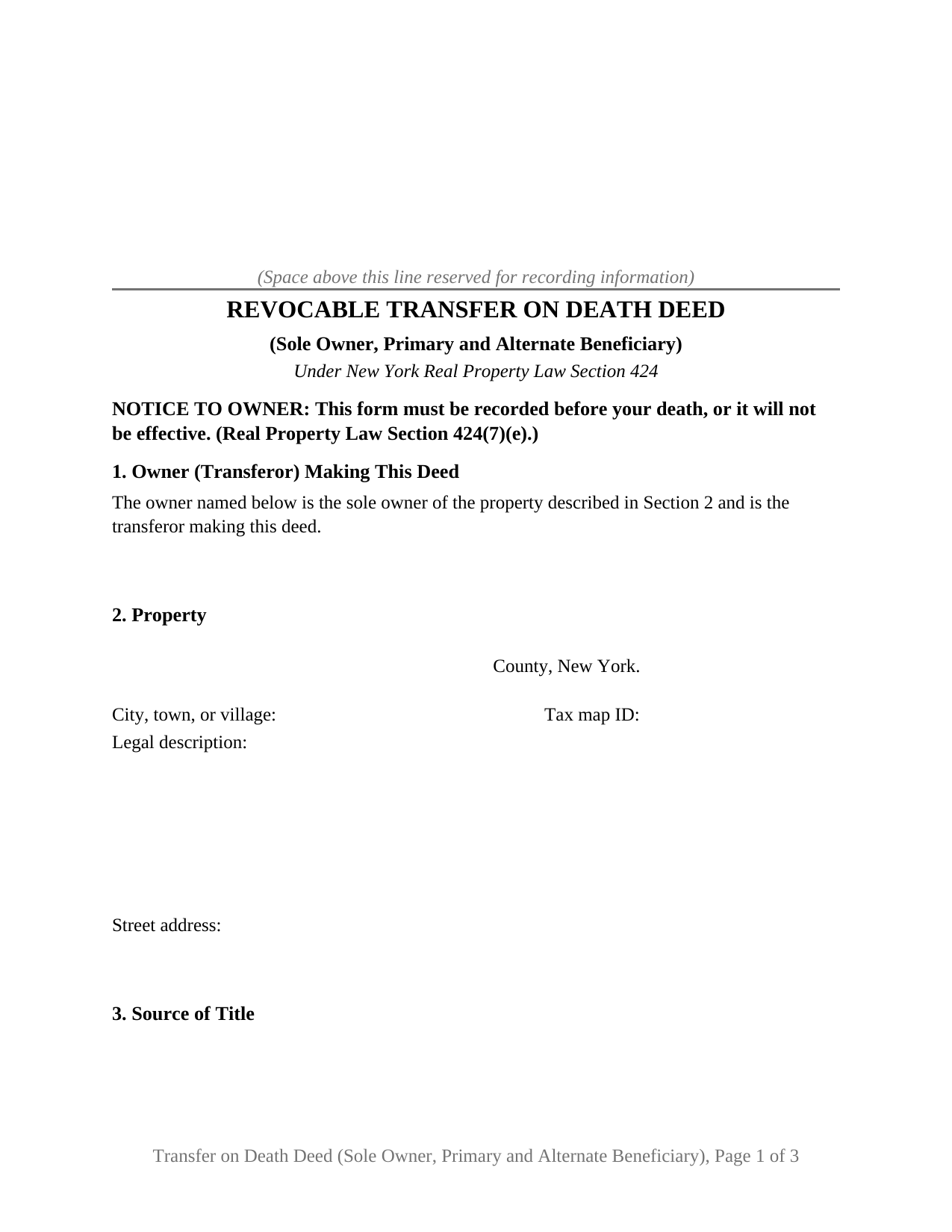
Chemung County Transfer on Death Deed (Sole Owner, Primary and Alternate Beneficiary) Form
Fill in the blank Transfer on Death Deed (Sole Owner, Primary and Alternate Beneficiary) form formatted to comply with all New York recording and content requirements.
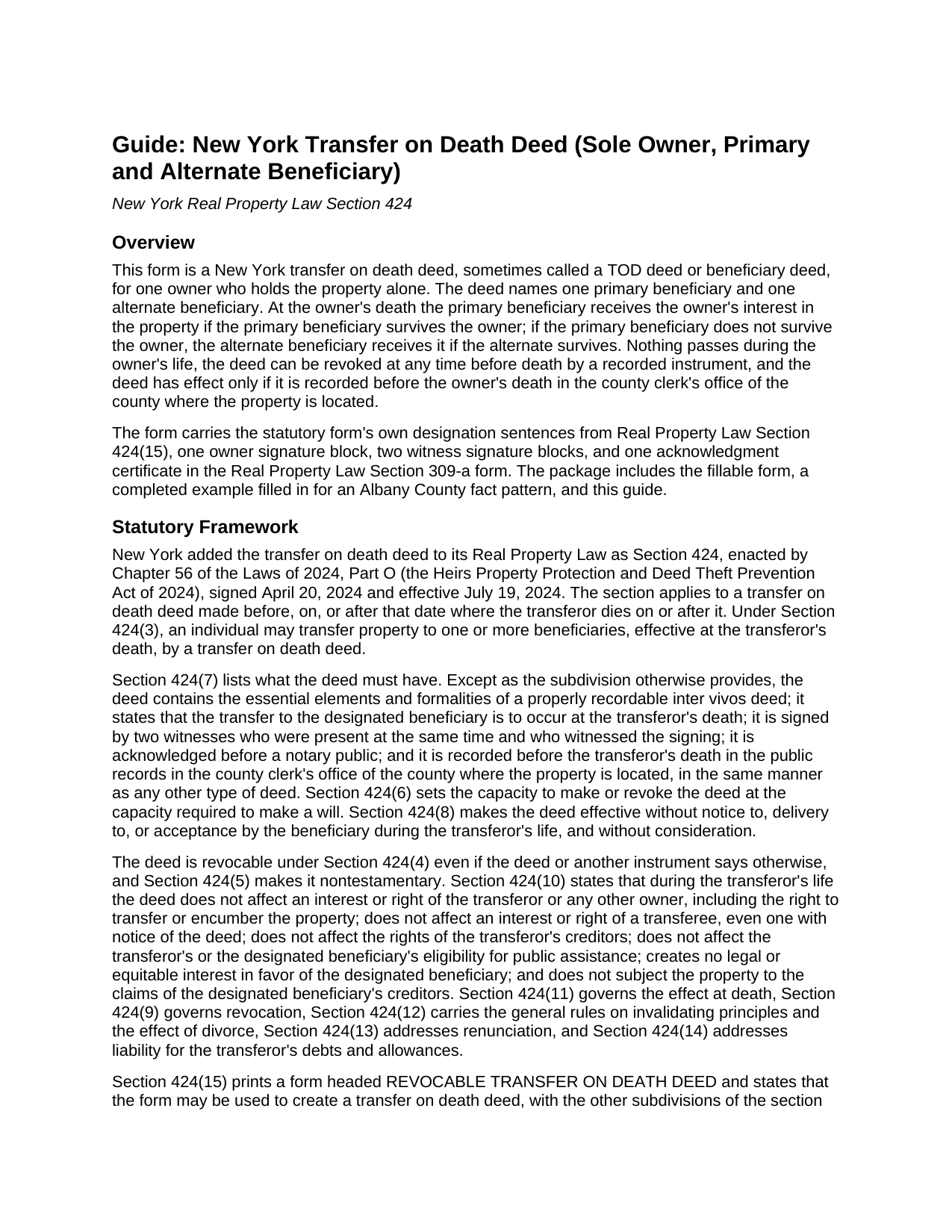
Chemung County Transfer on Death Deed (Sole Owner, Primary and Alternate Beneficiary) Guide
Line by line guide explaining every blank on the Transfer on Death Deed (Sole Owner, Primary and Alternate Beneficiary) form.
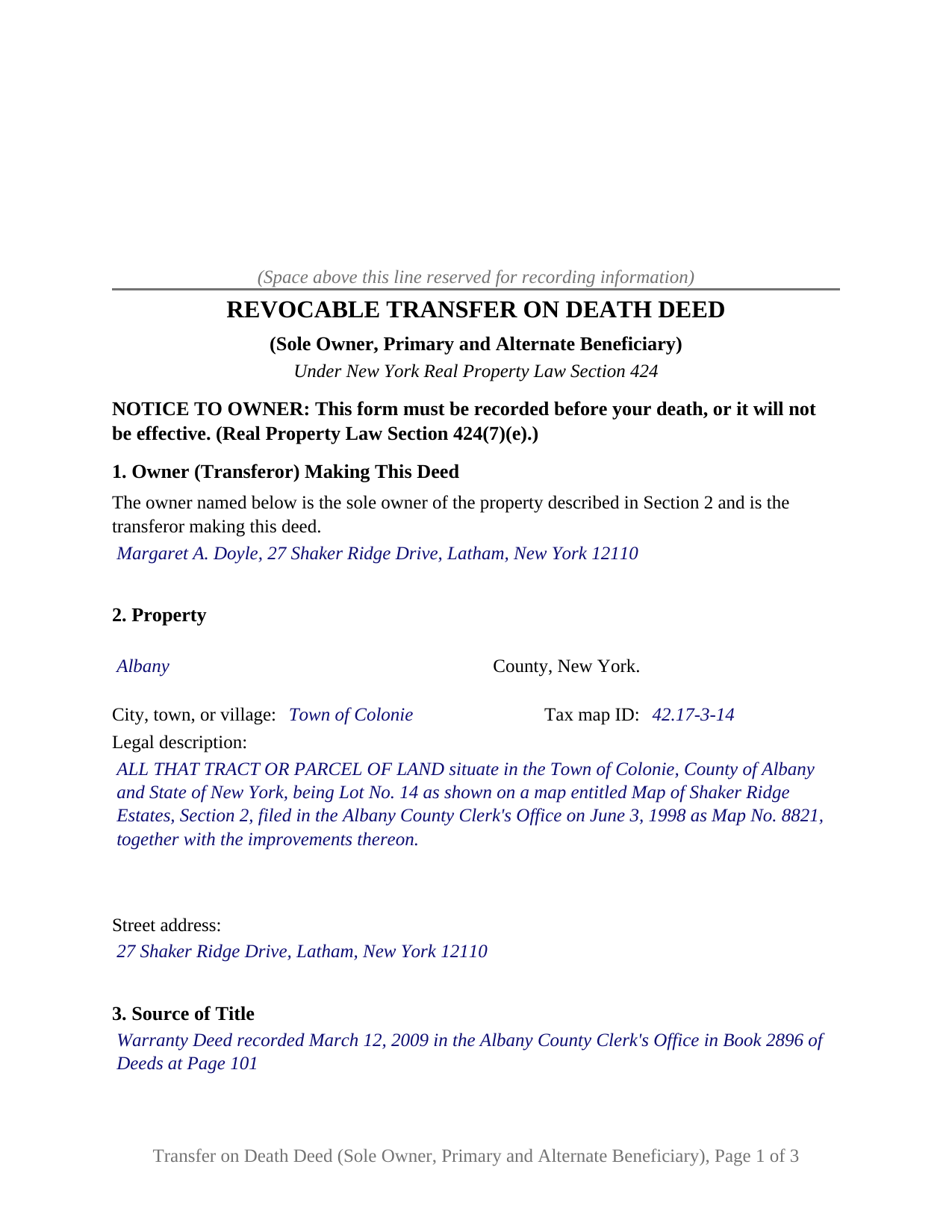
Chemung County Completed Example of the Transfer on Death Deed (Sole Owner, Primary and Alternate Beneficiary) Document
Example of a properly completed New York Transfer on Death Deed (Sole Owner, Primary and Alternate Beneficiary) document for reference.
All 3 documents above included • One-time purchase • No recurring fees
Immediate Download • Secure Checkout
Additional New York and Chemung County documents included at no extra charge:
Where to Record Your Documents
Chemung County Clerk
Elmira, New York 14902-0588
Hours: Monday - Friday 8:30am - 4:30pm
Phone: (607) 737-2920
Recording Tips for Chemung County:
- Bring your driver's license or state-issued photo ID
- Ensure all signatures are in blue or black ink
- Double-check legal descriptions match your existing deed
- Verify all names are spelled correctly before recording
- White-out or correction fluid may cause rejection
Cities and Jurisdictions in Chemung County
Properties in any of these areas use Chemung County forms:
- Big Flats
- Breesport
- Chemung
- Elmira
- Erin
- Horseheads
- Lowman
- Millport
- Pine City
- Pine Valley
- Van Etten
- Wellsburg
Hours, fees, requirements, and more for Chemung County
How do I get my forms?
Forms are available for immediate download after payment. The Chemung County forms will be in your account ready to download to your computer. An account is created for you during checkout if you don't have one. Forms are NOT emailed.
Are these forms guaranteed to be recordable in Chemung County?
Yes. Our form blanks are guaranteed to meet or exceed the applicable formatting requirements used for recording in Chemung County, including margin requirements, font requirements, and other layout standards. This guarantee applies to formatting, not to the legal sufficiency of information entered by the user or the suitability of a form for a particular transaction.
Can I reuse these forms?
Yes. You can reuse the forms for your personal use. For example, if you have multiple properties in Chemung County you only need to order once.
What do I need to use these forms?
The forms are PDFs that you fill out on your computer. The free Adobe Acrobat Reader is recommended, and most PDF apps also work. You do NOT enter your property information online - you download the blank forms and complete them privately on your own computer.
Are there any recurring fees?
No. This is a one-time purchase. Nothing to cancel, no memberships, no recurring fees.
How much does it cost to record in Chemung County?
Recording fees in Chemung County vary. Contact the recorder's office at (607) 737-2920 for current fees.
Questions answered? Let's get started!
A name in reserve is what this New York transfer on death deed adds to the basic designation. One owner who holds the property alone names a primary beneficiary and, in the same deed, an alternate beneficiary who receives the property only if the primary beneficiary does not survive the owner. The deed is made under Real Property Law Section 424, the transfer on death deed statute that took effect on July 19, 2024, and it carries that statute's own designation sentences for both names.
How the alternate steps in
Section 424(11)(a)(2) makes every designated beneficiary's interest contingent on surviving the transferor, and it provides that the interest of a beneficiary who fails to survive lapses. A deed with a single name therefore transfers nothing in that event, and the property passes with the rest of the owner's estate. The alternate beneficiary is the statute's own answer. The form printed in Section 424(15) carries a PRIMARY BENEFICIARY line and an ALTERNATE BENEFICIARY line, and this deed carries both of the sentences that go with them: the primary designation, made if the beneficiary survives the owner, and the alternate designation, made if the primary beneficiary does not survive the owner and the alternate does. The alternate has no interest while the primary beneficiary survives, and neither beneficiary has any interest while the owner lives.
Because the deed fixes one name in each position, the beneficiary sections ask for nothing but a printed name and a mailing address, the two items the statutory form itself requests. There is no share to write in and no second primary name. A beneficiary under Section 424(1)(d) may be a natural person or an entity such as a corporation, a partnership, or a governmental body; the statutory definition of person does not name a trust, and the guide describes the definition as the statute writes it.
One owner, holding alone
The owner section opens with a fixed recital that the named owner is the sole owner of the described property and is the transferor making the deed, followed by a single blank for the owner's name and residence address. The form fixes nothing about marital status. A married owner who holds title alone signs alone: New York has no community property, no statute requires a spouse to join a deed of property titled in the other spouse's name, dower is confined by Real Property Law Section 190 to marriages before September 1930, and curtesy was abolished by Section 189. Because Section 424(1)(g) defines a transferor as an individual who makes a transfer on death deed, a spouse who holds no title is not one and the form gives that spouse no signature line. The surviving spouse's right of election under Estates, Powers and Trusts Law Section 5-1.1-A is a separate matter the deed does not touch.
Co-owned title is a different configuration. Section 424(11)(c) and (d) provide that a joint tenant's or a tenant by the entirety's deed operates only if that transferor is the last surviving joint owner, and a deed by two owners carries two signature blocks and two acknowledgments. This form carries one of each.
Two witnesses, a notary, then the county clerk
New York attached more formality to the TOD deed than to an ordinary deed. Section 424(7)(c) calls for two witnesses, present at the same time, who witness the owner's signing and sign the deed themselves, and Section 424(7)(d) calls for an acknowledgment before a notary public. The form therefore carries one owner signature block, two witness blocks with printed names, and one acknowledgment certificate in the Real Property Law Section 309-a short form, with the day, month, and year blanks the statute prints and the identity lines Executive Law Section 137 has a New York notary complete beneath the signature. An owner who appears before an officer outside New York takes that officer's certificate under Real Property Law Sections 299-a and 309-b, and the guide describes that path.
Recording is what gives the deed effect. Under Section 424(7)(e) the deed goes of record, before the owner dies, with the county clerk of the county where the property is located, and the statutory form's notice that the form is ineffective unless recorded before death appears in bold under the title. Recording a beneficiary deed of this kind is lighter than recording a sale: the Department of Taxation and Finance states that transfer on death deeds do not need Form RP-5217 or Form TP-584, and the deed itself carries the owner's residence, the city, town, or village, and the tax map designation that Real Property Law Section 333 places in a recorded deed. County cover pages and fee items vary from clerk to clerk, and the guide walks through them.
What stays the same while the owner lives
Under Section 424(10) the recorded deed changes nothing during the owner's life. The owner keeps the right to sell, mortgage, or give the property away, the owner's creditors are unaffected, eligibility for public assistance is unaffected, and neither beneficiary acquires any legal or equitable interest. The deed is revocable under Section 424(4) whatever a later document says, and Section 424(9) allows revocation only through a recorded instrument: a later TOD deed that revokes it expressly or by inconsistency, a separate instrument of revocation, or an ordinary deed that expressly revokes it, in each case acknowledged after this deed and placed of record before the owner dies. Neither a will nor the destruction of the recorded original revokes it. The revocation instrument, for which Section 424(16) prints a form, is prepared and recorded separately and is not included in this package.
At the owner's death the beneficiary who takes receives the owner's interest subject to every mortgage, lien, and other interest then affecting the property, without covenant or warranty of title, under Section 424(11)(b) and (e). The estate may reach the property for allowed claims and statutory allowances in a proceeding commenced within eighteen months after the death under Section 424(14).
The configuration this form recites
The form recites exactly one transferor, the sole owner of the property, exactly one primary beneficiary, and exactly one alternate beneficiary. It carries one owner signature block, two witness blocks, one acknowledgment certificate, and no share, survivorship, or special-provision blank. An owner naming a spouse who is not on the title as primary beneficiary and an adult child as the alternate, and a parent naming one child first with a grandchild in reserve, present the pattern this deed recites. The form is not set up as a deed by two or more owners, a deed naming two or more primary beneficiaries, a deed with no alternate, a deed with written-in shares, or a deed signed by a trustee, an entity, or an attorney-in-fact.
Included in the package are the fillable deed, a completed example worked through an Albany County fact pattern, and the guide covering each section of the form, the signing formalities, and the recording steps. The description and the guide describe the form and New York's statutes in general terms and are not legal advice.
Important: Your property must be located in Chemung County to use these forms. Documents should be recorded at the county recording office listed above.
This Transfer on Death Deed (Sole Owner, Primary and Alternate Beneficiary) meets all recording requirements specific to Chemung County.
Our Promise
The documents you receive here are guaranteed to meet or exceed the applicable Chemung County recording format requirements. If there is a rejection caused by our formatting, we will correct the issue or refund your payment. This guarantee applies to document formatting only and does not extend to information entered by the user, the selection of the form, or the legal effect of the completed document.
Save Time and Money
Get your Chemung County Transfer on Death Deed (Sole Owner, Primary and Alternate Beneficiary) form done right the first time with Deeds.com Uniform Conveyancing Blanks. At Deeds.com, we understand that your time and money are valuable resources, and we don't want you to face a penalty fee or rejection imposed by a county recorder for submitting nonstandard documents. We constantly review and update our forms to meet rapidly changing state and county recording requirements for roughly 3,500 counties and local jurisdictions.
4.8 out of 5 - ( 4,864 Reviews )
Sheila P. 5 out of 5 stars
What a great service to provide with excellent directions! At first I thought I would need an attorney, but I walked through the steps and now I have it finished! Saved a ton of money. Thanks Deed.com.
Thank you for your feedback. We really appreciate it. Have a great day!
David K. 5 out of 5 stars
Excellent instructions to guide one through the warranty deed.
Thank you for your feedback. We really appreciate it. Have a great day!
Diane C. 5 out of 5 stars
This was just the info I needed
Thank you!
Joseph L. 5 out of 5 stars
Very easy to fill out and and saved a lot of extra cost by doing it ourselves and getting it notarized.
Thank you Joseph, we really appreciate your feedback.
David R. 3 out of 5 stars
$40 is an excessively expensive price for this very simple form, especially since I couldn't view it before purchasing. I did successfully register the TODD at my county clerks office, although I wasn't certain it would be accepted given the notary format was on a separate page. Knowing what I know now, I would have formatted a form on my computer and filled it in with a pen. The background materials were superfluous and in my case, didn't add value.
David, we’re glad you successfully recorded your deed using our form. The value of a DIY package is not measured by how complicated the finished document looks or how easily it could be recreated on a computer. It provides a prepared form and supporting information rather than requiring you to research and draft a document from scratch. Having that starting point is what the purchase provides—even when, in hindsight, doing it yourself appears straightforward.
DONNA P. 5 out of 5 stars
Deeds.com was quick, efficient, and cost effective. Deeds.com works with individuals where I found other companies only offer services to title companies, settlement companies, etc. Thank you Deeds.com!
Thank you for your feedback. We really appreciate it. Have a great day!
Denise G. 5 out of 5 stars
It was so easy to locate and download all the forms I needed. Saved so much time.
We appreciate your business and value your feedback. Thank you. Have a wonderful day!
CHRISTINE M. 5 out of 5 stars
It was all I needed and guided me to fill it out.
Thank you!
Brenda G. 5 out of 5 stars
So far have only done the download, will come back with further review at a later date.
Thank you!
Ray L. 5 out of 5 stars
This was my first time using Deeds.com It was very easy to understand and use. I was pleasantly suprised.
We appreciate your business and value your feedback. Thank you. Have a wonderful day!
Cynthia N. 5 out of 5 stars
great service, quick and easy!
Thank you!
Peter W. 5 out of 5 stars
Thanks worked out great
Thank you for the follow up Peter. Have a great day!
DELORES D. 5 out of 5 stars
SO EASY. love that there is an example to follow and instructions.
Thank you!
Scott H. 5 out of 5 stars
Good experience, good service too - thanks.
Your feedback is appreciated. Thank you for letting us know how we did.
Craig L. 5 out of 5 stars
So far so good. I will let you know after a successful recordation of the deed.
Thank you!