New York Transfer on Death Deed (Sole Owner, Primary and Alternate Beneficiary)
County Specific Legal Forms Validated as recently as November 19, 2026 by our Forms Development Team
About the New York Transfer on Death Deed (Sole Owner, Primary and Alternate Beneficiary)
How to Use This Form
- Select your county from the list
- Download the county-specific form
- Fill in the required information
- Have the document notarized if required
- Record with your county recorder's office
What Others Like You Are Saying
"Easy to use. Documents as stated."
"Absolutely great. The staff is responsive and knowledgeable. The online interface is excellent. The …"
"Thank you, thie was very helpful. I did find the forms I needed.Very easy to use.,"
"I requested a property report and it was completed fast and accurately. I would highly recommend thi…"
"I was very impressed with the speed at which information was retrieved on my very first search. Unfo…"
4.8/5 from 4,864 reviews. Read all
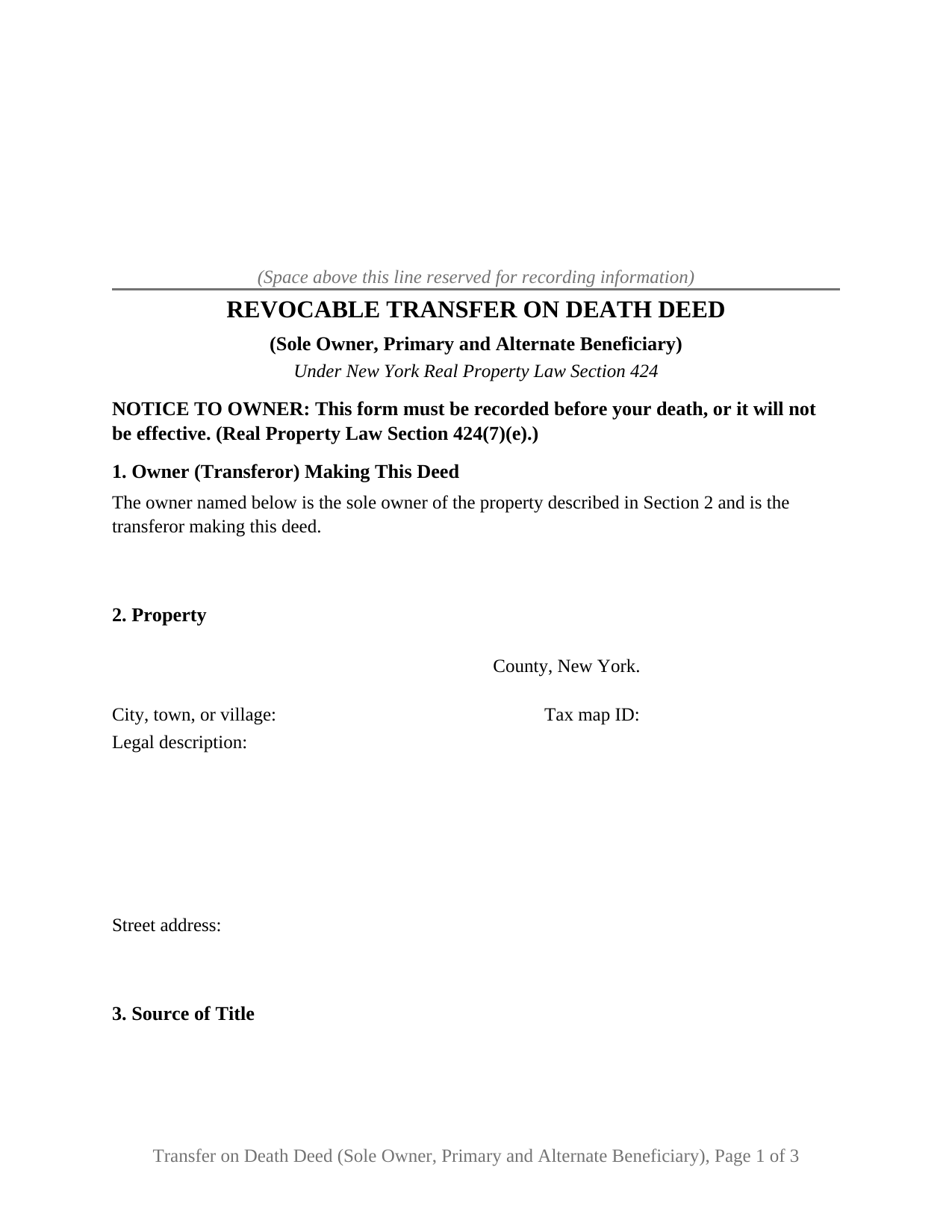
A name in reserve is what this New York transfer on death deed adds to the basic designation. One owner who holds the property alone names a primary beneficiary and, in the same deed, an alternate beneficiary who receives the property only if the primary beneficiary does not survive the owner. The deed is made under Real Property Law Section 424, the transfer on death deed statute that took effect on July 19, 2024, and it carries that statute's own designation sentences for both names.
How the alternate steps in
Section 424(11)(a)(2) makes every designated beneficiary's interest contingent on surviving the transferor, and it provides that the interest of a beneficiary who fails to survive lapses. A deed with a single name therefore transfers nothing in that event, and the property passes with the rest of the owner's estate. The alternate beneficiary is the statute's own answer. The form printed in Section 424(15) carries a PRIMARY BENEFICIARY line and an ALTERNATE BENEFICIARY line, and this deed carries both of the sentences that go with them: the primary designation, made if the beneficiary survives the owner, and the alternate designation, made if the primary beneficiary does not survive the owner and the alternate does. The alternate has no interest while the primary beneficiary survives, and neither beneficiary has any interest while the owner lives.
Because the deed fixes one name in each position, the beneficiary sections ask for nothing but a printed name and a mailing address, the two items the statutory form itself requests. There is no share to write in and no second primary name. A beneficiary under Section 424(1)(d) may be a natural person or an entity such as a corporation, a partnership, or a governmental body; the statutory definition of person does not name a trust, and the guide describes the definition as the statute writes it.
One owner, holding alone
The owner section opens with a fixed recital that the named owner is the sole owner of the described property and is the transferor making the deed, followed by a single blank for the owner's name and residence address. The form fixes nothing about marital status. A married owner who holds title alone signs alone: New York has no community property, no statute requires a spouse to join a deed of property titled in the other spouse's name, dower is confined by Real Property Law Section 190 to marriages before September 1930, and curtesy was abolished by Section 189. Because Section 424(1)(g) defines a transferor as an individual who makes a transfer on death deed, a spouse who holds no title is not one and the form gives that spouse no signature line. The surviving spouse's right of election under Estates, Powers and Trusts Law Section 5-1.1-A is a separate matter the deed does not touch.
Co-owned title is a different configuration. Section 424(11)(c) and (d) provide that a joint tenant's or a tenant by the entirety's deed operates only if that transferor is the last surviving joint owner, and a deed by two owners carries two signature blocks and two acknowledgments. This form carries one of each.
Two witnesses, a notary, then the county clerk
New York attached more formality to the TOD deed than to an ordinary deed. Section 424(7)(c) calls for two witnesses, present at the same time, who witness the owner's signing and sign the deed themselves, and Section 424(7)(d) calls for an acknowledgment before a notary public. The form therefore carries one owner signature block, two witness blocks with printed names, and one acknowledgment certificate in the Real Property Law Section 309-a short form, with the day, month, and year blanks the statute prints and the identity lines Executive Law Section 137 has a New York notary complete beneath the signature. An owner who appears before an officer outside New York takes that officer's certificate under Real Property Law Sections 299-a and 309-b, and the guide describes that path.
Recording is what gives the deed effect. Under Section 424(7)(e) the deed goes of record, before the owner dies, with the county clerk of the county where the property is located, and the statutory form's notice that the form is ineffective unless recorded before death appears in bold under the title. Recording a beneficiary deed of this kind is lighter than recording a sale: the Department of Taxation and Finance states that transfer on death deeds do not need Form RP-5217 or Form TP-584, and the deed itself carries the owner's residence, the city, town, or village, and the tax map designation that Real Property Law Section 333 places in a recorded deed. County cover pages and fee items vary from clerk to clerk, and the guide walks through them.
What stays the same while the owner lives
Under Section 424(10) the recorded deed changes nothing during the owner's life. The owner keeps the right to sell, mortgage, or give the property away, the owner's creditors are unaffected, eligibility for public assistance is unaffected, and neither beneficiary acquires any legal or equitable interest. The deed is revocable under Section 424(4) whatever a later document says, and Section 424(9) allows revocation only through a recorded instrument: a later TOD deed that revokes it expressly or by inconsistency, a separate instrument of revocation, or an ordinary deed that expressly revokes it, in each case acknowledged after this deed and placed of record before the owner dies. Neither a will nor the destruction of the recorded original revokes it. The revocation instrument, for which Section 424(16) prints a form, is prepared and recorded separately and is not included in this package.
At the owner's death the beneficiary who takes receives the owner's interest subject to every mortgage, lien, and other interest then affecting the property, without covenant or warranty of title, under Section 424(11)(b) and (e). The estate may reach the property for allowed claims and statutory allowances in a proceeding commenced within eighteen months after the death under Section 424(14).
The configuration this form recites
The form recites exactly one transferor, the sole owner of the property, exactly one primary beneficiary, and exactly one alternate beneficiary. It carries one owner signature block, two witness blocks, one acknowledgment certificate, and no share, survivorship, or special-provision blank. An owner naming a spouse who is not on the title as primary beneficiary and an adult child as the alternate, and a parent naming one child first with a grandchild in reserve, present the pattern this deed recites. The form is not set up as a deed by two or more owners, a deed naming two or more primary beneficiaries, a deed with no alternate, a deed with written-in shares, or a deed signed by a trustee, an entity, or an attorney-in-fact.
Included in the package are the fillable deed, a completed example worked through an Albany County fact pattern, and the guide covering each section of the form, the signing formalities, and the recording steps. The description and the guide describe the form and New York's statutes in general terms and are not legal advice.
Important: County-Specific Forms
Our transfer on death deed (sole owner, primary and alternate beneficiary) forms are specifically formatted for each of the 62 counties in New York.
After selecting your county, you'll receive forms that meet all local recording requirements, ensuring your documents will be accepted without delays or rejection fees.