North Carolina Affidavit of Survivorship (Tenancy by the Entirety or Joint Tenancy with Right of Survivorship)
County Specific Legal Forms Validated as recently as October 6, 2026 by our Forms Development Team
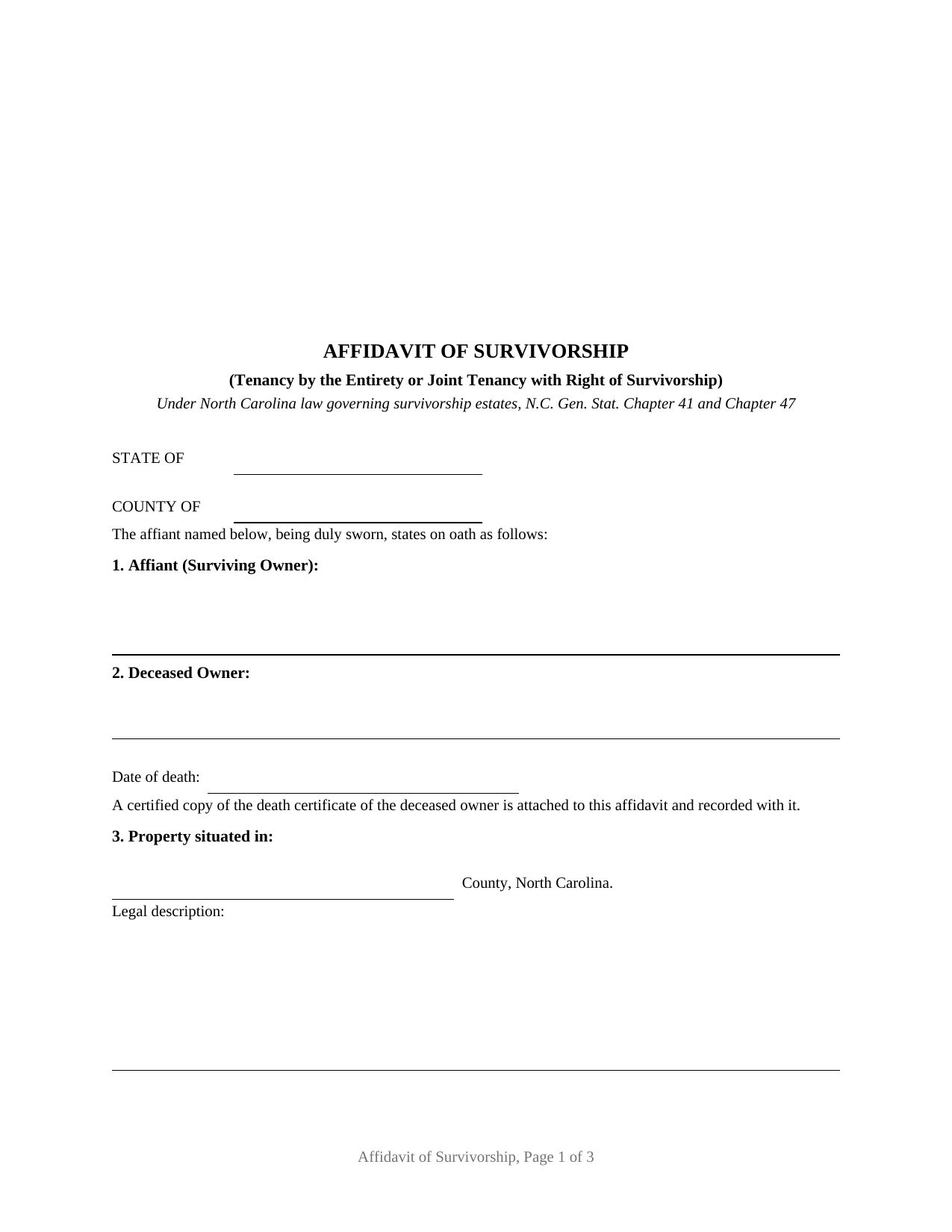
About the North Carolina Affidavit of Survivorship (Tenancy by the Entirety or Joint Tenancy with Right of Survivorship)
How to Use This Form
- Select your county from the list
- Download the county-specific form
- Fill in the required information
- Have the document notarized if required
- Record with your county recorder's office
What Others Like You Are Saying
"Worked well with clear guide!"
"amazingly fast! Thank you!"
"It was a seamless process, inexpensive, and probably saved me thousands by having an attorney draw t…"
"Very prompt response to my questions."
"It was more detailed than the forms on other website, plus cheaper. I do not have date it was record…"
4.8/5 from 4,819 reviews. Read all
When one of two North Carolina owners who held real estate with a right of survivorship dies, the survivor already owns the whole property. Title passed at the moment of death, by operation of law, without probate and without a new deed. What remains is a record-keeping step: showing that vesting in the county land records, so the next examiner or title insurer sees the surviving owner as the sole owner. This form prepares the North Carolina Affidavit of Survivorship that title practice uses for that step.
Two Survivorship Estates, One Affidavit
North Carolina recognizes two survivorship estates this affidavit reaches. Spouses usually hold as tenants by the entirety under Chapter 41, Article 5, where a conveyance to spouses vests the entirety unless the deed says otherwise. Other co-owners can hold as joint tenants with right of survivorship under Chapter 41, Article 6, but only where the deed expressly says so; under Section 41-71 a conveyance to two or more persons is a tenancy in common unless the instrument expresses survivorship intent. The form carries both recitals and asks the affiant to mark the one that matches the recorded deed.
What the Statutes Do at Death
For tenancy by the entirety, Section 41-64 provides that on the death of a spouse the property belongs to the surviving spouse by right of purchase under the original grant and by survivorship, and that the deceased spouse has no estate that is descendible or divisible. For joint tenancy with right of survivorship, Article 6 carries the survivorship and Section 41-74 applies a 120 hour survival requirement. The principal limit is the slayer rule of Section 31A-3, carried into Section 41-64(b) for the entirety; the affidavit recites that the affiant is not a slayer of the decedent.
An Affidavit, Not a Deed
The affidavit does not transfer title and does not create the survivorship; the deed and the statutes did that. It is sworn evidence, recorded for notice. The affiant, the surviving owner already named on the deed, swears before a notary that the affiant survived the decedent, that title vested in the survivor by operation of law, and that the decedent's interest did not pass through the estate. Because it is sworn, the notary completes a jurat rather than a deed acknowledgment. No enabling statute creates this affidavit; registers of deeds accept it under the general recording statutes of Chapter 47.
Recording in North Carolina
The affidavit names the parties and the date of death, describes the property by county and formal legal description, and identifies the survivorship deed by its book and page in the county public registry, the reference an examiner uses to confirm the survivorship language. It is recorded with the Register of Deeds where the property lies, together with a certified copy of the death certificate, and North Carolina records by order of registration under Chapter 47. Because the affidavit documents a transfer that occurred by operation of law and conveys nothing, it does not carry the documentary excise tax that Sections 105-228.30 and 105-228.32 impose on conveyances.
The package includes the blank fillable PDF, a completed example for a tenancy by the entirety in Mecklenburg County, and a plain-language guide covering every section, the survivorship statutes, and recording. The materials are informational and are not legal advice.
Important: County-Specific Forms
Our affidavit of survivorship (tenancy by the entirety or joint tenancy with right of survivorship) forms are specifically formatted for each of the 100 counties in North Carolina.
After selecting your county, you'll receive forms that meet all local recording requirements, ensuring your documents will be accepted without delays or rejection fees.