North Carolina Heirs and Administrator Deed
County Specific Legal Forms Validated as recently as September 29, 2026 by our Forms Development Team
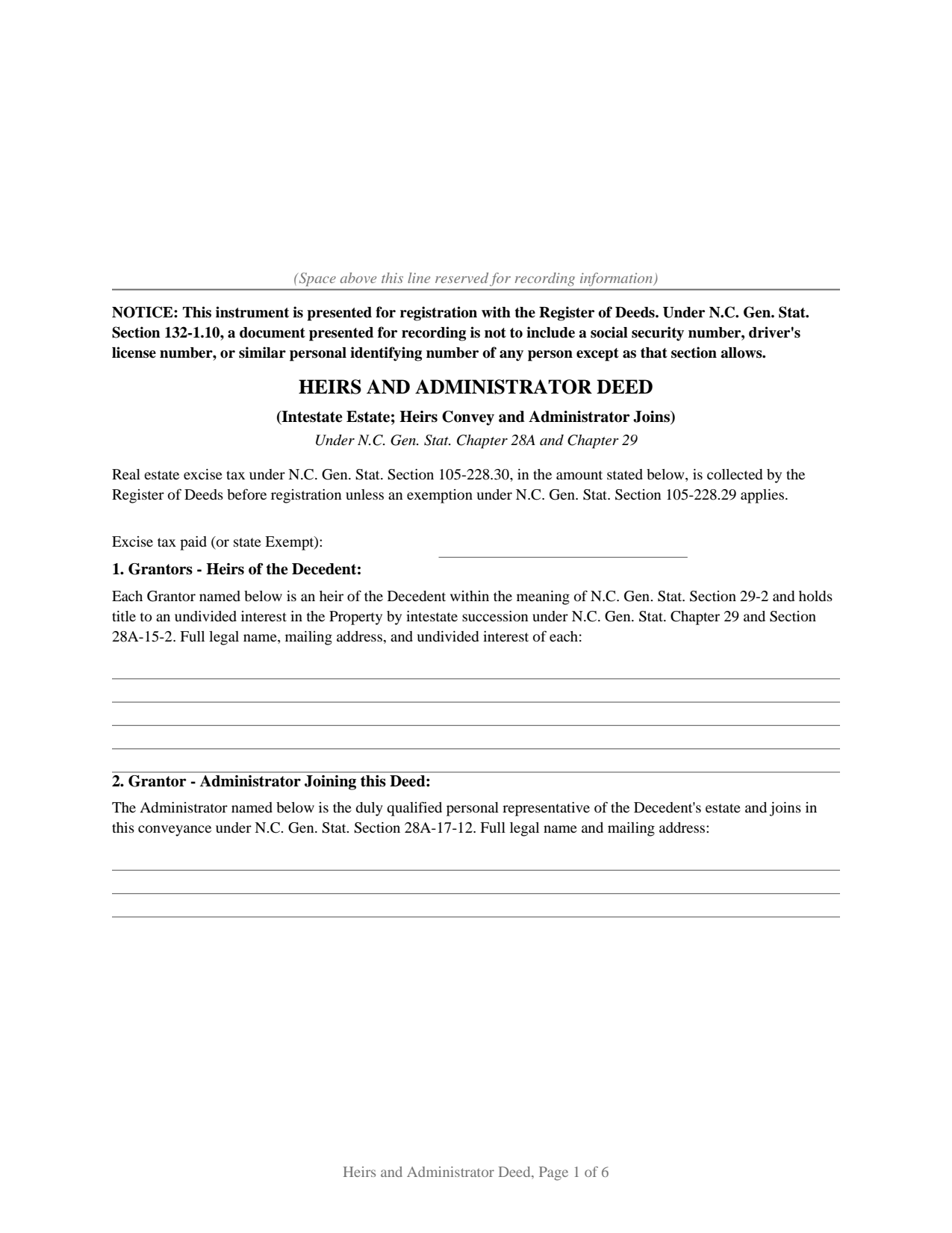
About the North Carolina Heirs and Administrator Deed
How to Use This Form
- Select your county from the list
- Download the county-specific form
- Fill in the required information
- Have the document notarized if required
- Record with your county recorder's office
What Others Like You Are Saying
"Good resource. Got what I needed easily"
"The process was straightforward, quick and reasonably priced. The agents provided updates every step…"
"Very Easy to use, especially since the county recorder's office is closed due to COVID-19"
"We were able to find deceased parents' deed."
"Review: Very user friendly and that is very important to me. Quick, easy and clear instructions. I w…"
4.8/5 from 4,820 reviews. Read all
When a North Carolina owner dies without a will, the land does not wait for probate: title vests in the heirs at the moment of death. Selling that inherited land while the estate is still open, though, takes more than the heirs' signatures. A Heirs and Administrator Deed lets the heirs convey their inherited interests while the estate's administrator joins to make the conveyance hold up against the estate's creditors.
Title Vests in the Heirs at Death
Under N.C. Gen. Stat. Section 28A-15-2(b), the title to a decedent's real property vests in the heirs as of the time of death. The heirs are the people the Intestate Succession Act, Chapter 29, says inherit, and each heir's share includes an undivided fractional interest in the land. Because the heirs already hold title, they are the grantors who convey it.
Why the Administrator Joins
Inherited title is not free of the estate. N.C. Gen. Stat. Section 29-12 makes the descent of intestate property subject to the costs of administration and other lawful claims, and the personal representative can petition to sell the real property to pay those claims. The rule that shapes this deed is Section 28A-17-12: a sale of inherited real property by the heirs while the estate is open is void as to the estate's creditors and the personal representative unless the personal representative joins in the sale, lease or mortgage. After two years from death with no notice to creditors published, a sale by the heirs alone becomes valid as to creditors. The administrator's joinder is the statute's answer for a sale during the open-estate window, which is why both the heirs and the administrator sign as grantors.
A Conveyance Without Warranty
This deed conveys the interest of the named heirs and releases the interest and claim of the decedent's estate, and it does so without covenant or warranty of title. The grantors convey what they took by descent and what the estate holds; they do not promise the title is clear or agree to defend it. A grantee who wants title covenants looks to a warranty deed, and the guide names the alternatives.
Who Signs
The form provides grantor blocks for two heirs and for the administrator, with a separate notary acknowledgment for each signer; where one person is both an heir and the administrator, that person signs in both roles. North Carolina marital rights can reach an heir's conveyance: under N.C. Gen. Stat. Section 39-7, the spouse of a married heir commonly joins the deed to waive the elective life estate, and the grantor block leaves room to name a joining spouse.
Recording in North Carolina
The deed is recorded with the Register of Deeds of the county where the property lies, and under N.C. Gen. Stat. Section 47-18 a conveyance is not valid against later purchasers or lien creditors until it is registered. The Register of Deeds collects the real estate excise tax under N.C. Gen. Stat. Section 105-228.30 before recording, at one dollar for each five hundred dollars of consideration, unless an exemption applies. The package includes the deed as a fillable PDF, a completed example built on a realistic Wake County estate, and a plain-language guide that walks through every section and the statutes behind it. The materials are informational and are not legal advice.
Important: County-Specific Forms
Our heirs and administrator deed forms are specifically formatted for each of the 100 counties in North Carolina.
After selecting your county, you'll receive forms that meet all local recording requirements, ensuring your documents will be accepted without delays or rejection fees.