North Dakota Affidavit of Death of Transferor
County Specific Legal Forms Validated as recently as November 20, 2026 by our Forms Development Team
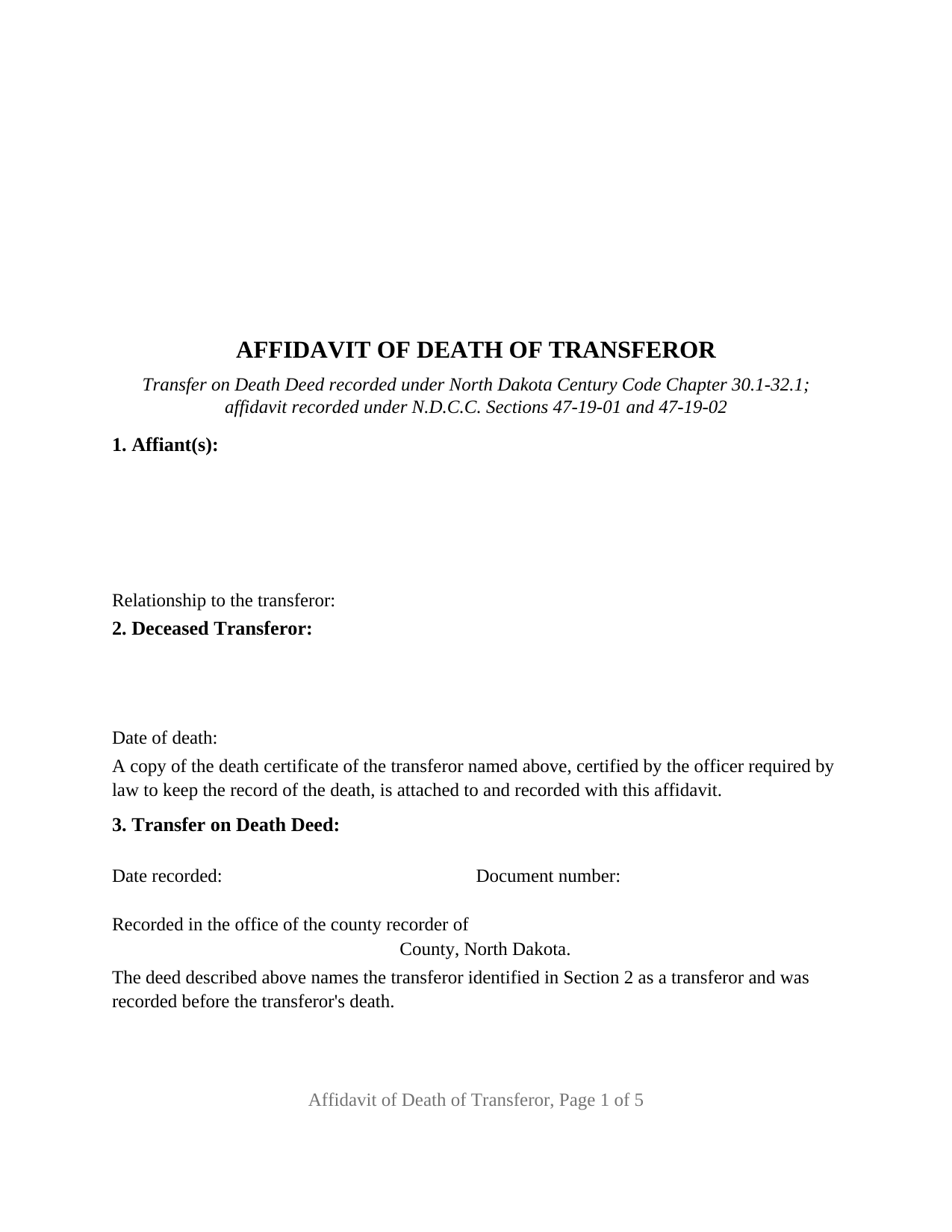
About the North Dakota Affidavit of Death of Transferor
How to Use This Form
- Select your county from the list
- Download the county-specific form
- Fill in the required information
- Have the document notarized if required
- Record with your county recorder's office
What Others Like You Are Saying
"The form was very easy to fill out. The instructions were clear. Overall, a very user friendly produ…"
"This is a great service. I submitted the information and the next day my deed had been recorded. Onl…"
"I am very pleased with your service. The document that I downloaded along with the instructions and …"
"So easy and fast. Since covid-19 is here, this option is perfect."
"Fast, easy. quickly accepted by county recorder."
4.8/5 from 4,862 reviews. Read all
When a North Dakota property owner who recorded a transfer on death deed dies, the land has already passed. North Dakota Century Code Section 30.1-32.1-10 transfers the interest to the designated beneficiary at the moment of death, by operation of the deed that was recorded while the owner was alive, and the chapter deems that deed to have been recorded at the transferor's death for purposes of the recording statutes. What the land records do not yet show is that the death occurred. The North Dakota Affidavit of Death of Transferor is the sworn instrument that puts that fact of record, with a certified copy of the death certificate attached, so that the beneficiary's interest can be traced in the chain of title without a probate proceeding.
A transfer that already happened
Chapter 30.1-32.1 of the Century Code, North Dakota's enactment of the Uniform Real Property Transfer on Death Act, makes the transfer on death deed nontestamentary and effective at death. The deed had to be recorded in the county recorder's office before the transferor died, and it had to carry the phrase transfer on death deed or the abbreviation TOD in its title. Once the transferor dies, nothing further is signed by the transferor's estate and no court order issues; the designated beneficiary who survived the transferor holds the interest the deed described, subject to every mortgage, lien, contract, and other interest that bound the property on the date of death, and without any covenant or warranty of title. The chapter prescribes no affidavit and no post-death filing. The affidavit in this package is title practice rather than a statutory form, and it is recorded under the general recording statutes: Section 47-19-01 lets any instrument affecting title be recorded, and Section 47-19-02 lists an affidavit bearing a jurat among the instruments recorded without acknowledgment.
What the affidavit swears to
The affidavit identifies the deceased transferor and the date of death, identifies the recorded transfer on death deed by its recording date, document number, and county, and carries the legal description copied from that deed. It then states the facts the chapter makes decisive. Each designated beneficiary listed as surviving is stated to have survived the transferor by one hundred twenty hours or more, the measure Section 30.1-09.1-02 applies across Title 30.1 unless the deed itself provides a different one. Any designated beneficiary who did not survive is listed, because an interest that fails to survive lapses and passes to the other concurrent beneficiaries in proportion to their shares. The affidavit also states that no transfer on death deed, instrument of revocation, or inter vivos deed revoking the deed appears of record; under Section 30.1-32.1-08 a revocation works only if it was acknowledged after the deed and recorded before the transferor's death, so the recorder's index is where a revocation would have to appear. A closing sentence states that the affidavit conveys no interest in the property, which keeps a sworn statement of facts from being read as a conveyance.
The last surviving joint owner
North Dakota spouses and other co-owners often hold title as joint tenants and sign one transfer on death deed together. Section 30.1-32.1-10(3) postpones such a deed: while another joint owner survives, the property belongs to the survivor by right of survivorship, and the deed takes effect only at the death of the last surviving joint owner. The affidavit carries a section for that pattern. It lists each joint owner of the property who died before the transferor, with the recording reference of any death certificate already of record for that person, and it states that the transferor was not survived by any joint owner. The completed example in this package shows exactly this sequence: a deed recorded by two spouses, the first spouse's death certificate recorded earlier under Section 47-19-06, and the affidavit sworn by the two children named as beneficiaries after the second spouse's death.
One affiant or two
The form is built for one or two natural persons swearing in their own right, most often the designated beneficiaries themselves, with a line for each affiant's relationship to the transferor or the property. It carries two signature blocks headed AFFIANT and SECOND AFFIANT (if applicable), each followed by its own verification on oath or affirmation in the short form Section 44-06.1-19(3) prints, so two affiants may swear on different days, before different officers, or in different states. When one person swears, the second block and its certificate are left blank. The form recites nothing about the marital status or capacity of any affiant, and no spouse signs: the affidavit conveys and encumbers nothing, so the homestead joinder rule for a married person's conveyance does not reach it. The configurations the form is not set up as are an entity or trustee affiant, an affiant signing through an attorney in fact, three or more affiants, and an affidavit proving more than one transferor's death.
Recording in the county where the deed is
The affidavit is recorded in the office of the county recorder of the county where the property is located, the office that already holds the transfer on death deed. Section 11-18-05 sets the statewide fee at twenty dollars for a document of one to six pages and sixty-five dollars for more, a page being one side of a single sheet, and reserves the top three inches of the first page for the recorder's information, which this form leaves open. Section 30.1-32.1-06(5) states that an auditor's certificate of transfer and a statement of full consideration are not required for the transfer on death deed or its revocation, and the affidavit is neither a deed nor an instrument that changes a property description. Section 11-18-23 permits a vital record that carries a social security number to be recorded with the number kept confidential, which is how the attached death certificate is handled. The guide describes the fee schedule, the format rules, the social security number rule, and the auditor's tax roll process in full.
The package includes the fillable affidavit of death of transferor, a completed example filled in for a Cass County fact pattern, and the guide that walks through each section, the jurat, and the recording steps. This description and the guide describe the form and the governing North Dakota statutes in general terms; they are not legal advice.
Important: County-Specific Forms
Our affidavit of death of transferor forms are specifically formatted for each of the 53 counties in North Dakota.
After selecting your county, you'll receive forms that meet all local recording requirements, ensuring your documents will be accepted without delays or rejection fees.