North Dakota Transfer on Death Revocation
County Specific Legal Forms Validated as recently as November 20, 2026 by our Forms Development Team
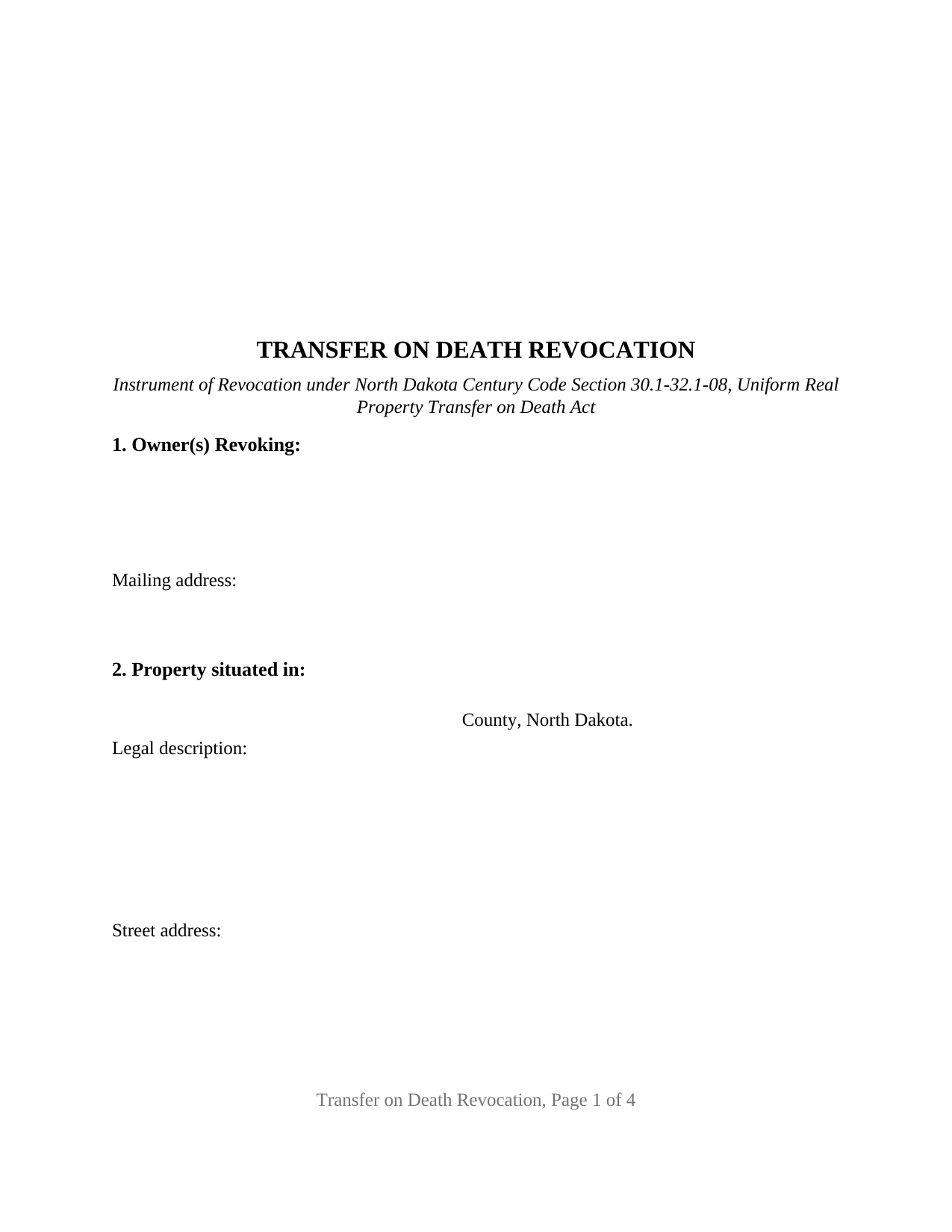
About the North Dakota Transfer on Death Revocation
How to Use This Form
- Select your county from the list
- Download the county-specific form
- Fill in the required information
- Have the document notarized if required
- Record with your county recorder's office
What Others Like You Are Saying
"Easy to purchase and a reasonable price. Documents were easy to add information. Examples proved han…"
"Great down load."
"So quick and easy! No searching for a parking place or waiting in line. Thank you!"
"My first experience with deeds.com was excellent. My task was handled promptly and efficiently. Coun…"
"It works"
4.8/5 from 4,862 reviews. Read all
A North Dakota transfer on death deed stays revocable for the owner's whole life, but the revocation takes a recorded instrument. This form prepares the instrument of revocation that Section 30.1-32.1-08 of the North Dakota Century Code names: a document the owner or owners who made the deed sign, acknowledge, and record with the county recorder where the deed is on file. It revokes a recorded transfer on death deed in its entirety as to each signing owner's interest, transfers nothing, and names no beneficiary.
Revocation happens on the record, not on the deed
North Dakota adopted the Uniform Real Property Transfer on Death Act as Chapter 30.1-32.1, and the chapter is strict about how a TOD deed, sometimes searched for as a beneficiary deed, comes out of effect. Section 30.1-32.1-08(1) lists three instruments that revoke a recorded deed: a later transfer on death deed that revokes it expressly or by inconsistency, an instrument of revocation that expressly revokes it, and an inter vivos deed that expressly revokes it. Nothing else does. Subsection 3 states that once a transfer on death deed is recorded it may not be revoked by a revocatory act on the deed, so crossing out the beneficiary, tearing up the owner's copy, or writing a contrary instruction in a will leaves the recorded deed exactly where it was. This instrument is the second item on the statute's list, written to revoke the deed expressly and with no other purpose.
Acknowledged after, recorded before
The same section attaches two timing conditions, and the form is built around both. The instrument is effective only if it is acknowledged by the transferor after the acknowledgment of the deed being revoked, and only if it is recorded before the transferor's death in the office of the county recorder of the county where the deed is recorded. Section 3 of the form therefore collects the date the original deed was acknowledged, taken from the notarial certificate on the recorded deed, beside its recording date, document number, and recording county, so the record shows the sequence the statute requires. A capital letter statement in Section 4 restates the two conditions in the statute's words on the instrument itself, because an unrecorded revocation at the owner's death revokes nothing and the deed then operates as written.
The capacity to revoke is the capacity to make a will under Section 30.1-32.1-05, and the operative paragraph recites it. The revocation leaves the property where it was during the owner's life: a transfer on death deed creates no interest in the beneficiary while the owner lives under Section 30.1-32.1-09, and revoking it simply removes the designation that would have operated at death. The owner's interest then passes under a will, by intestate succession, or under any later instrument of record.
One owner or two, each as to that owner's interest
The form recites one or two natural persons who made the deed, each signing in that person's own right. The owner block is free-form: it receives one name or two, written as they appear on the recorded deed, with whatever marital status recital the signer writes in, and nothing about status or co-ownership is preprinted. Two signature blocks and two separate acknowledgment certificates follow, so two owners can acknowledge on the same day before one notarial officer, as the completed example shows, or on different days in different places. Where one owner revokes, the second block and its certificate stay blank.
Section 30.1-32.1-08(2) decides what a signature accomplishes when a deed was made by more than one transferor: revocation by one transferor does not affect the deed as to another transferor's interest, and a deed of joint owners is revoked only if all of the living joint owners revoke it. The patterns that present this form are a sole owner revoking a deed made alone, two owners revoking a deed they made together, one of two tenants in common revoking as to that owner's share, and the last surviving joint owner revoking a deed the joint owners once made. The form is not set up as a revocation by an entity, a trustee, a person signing under a power of attorney, or three or more owners on one instrument. An owner who wants a different beneficiary rather than none records a new transfer on death deed, which is a separate instrument prepared and recorded separately and not included in this package.
No auditor stamp and no consideration statement
A deed presented for recording in North Dakota ordinarily carries the county auditor's certificate of transfer under Section 11-18-02 and a statement of full consideration under Section 11-18-02.2 on its face. Section 30.1-32.1-06(5) provides that neither is required to record a transfer on death deed or a revocation instrument, and Section 11-18-03(7) lists both instruments among those entitled to record without regard to taxes. The revocation goes directly to the recorder with the statewide fee of Section 11-18-05, twenty dollars for an instrument of one to six pages, and it is drawn to the format that section describes: letter size pages, a three inch space across the top of the first page for the recorder's information, one inch margins on every page, and twelve point body type, larger than the ten point Calibri the section names as the minimum for a form not issued by a government agency.
The package includes the fillable instrument of revocation, a completed example filled in for a Cass County fact pattern, and a guide that walks through each section, the statute, and the recording process. The example and the guide describe the form and the governing North Dakota law in general terms; they are not legal advice.
Important: County-Specific Forms
Our transfer on death revocation forms are specifically formatted for each of the 53 counties in North Dakota.
After selecting your county, you'll receive forms that meet all local recording requirements, ensuring your documents will be accepted without delays or rejection fees.