Ohio Mortgage (Promissory Note)
County Specific Legal Forms Validated as recently as November 4, 2026 by our Forms Development Team
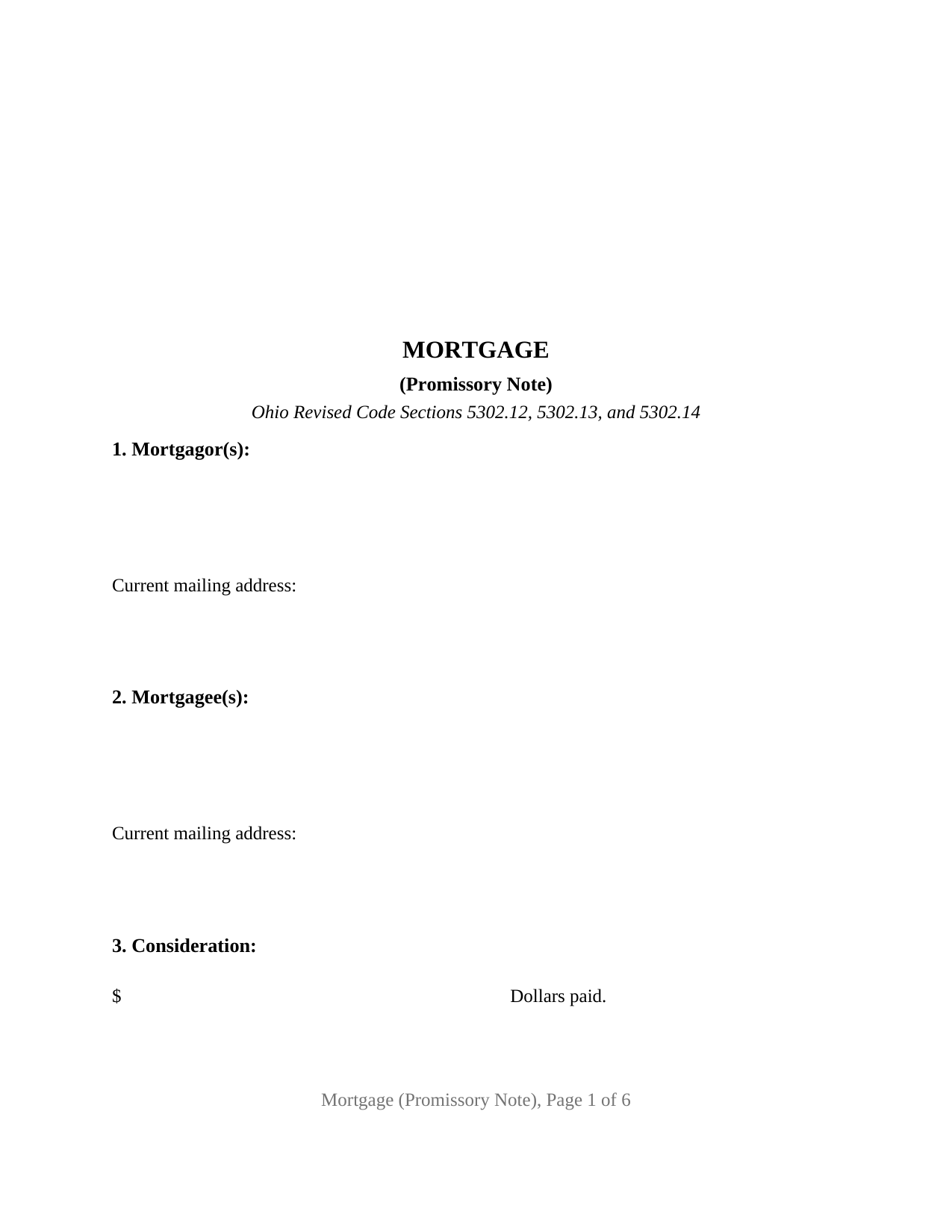
About the Ohio Mortgage (Promissory Note)
How to Use This Form
- Select your county from the list
- Download the county-specific form
- Fill in the required information
- Have the document notarized if required
- Record with your county recorder's office
What Others Like You Are Saying
"You had just what I was looking for. It was explained well and easy to find. Will recommend you."
"Great fillable form! And the separate instruction sheet was detailed and very clear. I particularly …"
"I would rate it 5 stars also. Eddie M."
"Quick and Easy. Much appreciated!"
"This service is excellent. I submitted a Quickclaim Deed so my home would be in the name of a Living…"
4.8/5 from 4,844 reviews. Read all
Private lending in Ohio runs on two documents. The promissory note creates the debt; the mortgage pledges the real estate for it. This Ohio Mortgage (Promissory Note) is the second of the two: a statutory-form mortgage by one or two individual mortgagors that secures a single promissory note payable to the mortgagee, the instrument a seller carrying back part of the price or any private lender records to hold the lien.
One note, identified on the face of the mortgage
Ohio Revised Code Section 5302.12 prints a short mortgage form whose secured-obligation sentence reads, in substance, that the mortgage is given upon the statutory condition to secure the payment of a stated sum with interest as provided in a note. This form carries that sentence and then pins the note down by its date, original principal amount, maker or makers, and final maturity date, each copied from the signed note. The note itself stays with the lender, unrecorded, so its payment terms remain private while the lien is public. Section 1343.01 caps the interest a written Ohio note may bear at eight percent per year unless one of its listed exceptions, including one for loans secured by a mortgage on real estate, applies.
Mortgage covenants and the statutory condition
Two defined phrases do the legal work. Under Section 5302.13, mortgage covenants are the mortgagor's promises of seisin in fee simple, freedom from encumbrances, good right to convey, and warranty against all claims. Under Section 5302.14, the statutory condition is the defeasance: if the mortgagor pays the note, keeps taxes and insurance current for the lender's benefit, and commits no waste, the mortgage is void. What the form omits is deliberate: no power of sale, because Section 2323.07 sends a foreclosed Ohio mortgage to a court-ordered sale, and no open-end clause, because Section 5301.232 reserves future-advance priority for a mortgage that announces itself as one.
Dower, and the third signature block
Ohio still recognizes dower. Section 2103.02 gives a spouse a life interest in one third of the real property the other spouse owned during the marriage, and a mortgage signed by the owning spouse alone leaves that interest unreleased. The statutory form answers with a sentence by which the mortgagor's wife or husband releases all rights of dower to the mortgagee; this form prints it as Section 7 with the spouse's name and the mortgagor's name as blanks, followed by a signature block and acknowledgment certificate headed SPOUSE RELEASING DOWER. Where no mortgagor has a spouse outside the mortgage, that section and block stay empty.
How the form is configured
The form recites one or two natural-person mortgagors in a free-form block, each followed by the marital status recital Ohio recording offices look for, and one or two mortgagees with the current mailing address Section 5301.23(B) requires on a mortgage presented for record. It carries a signature block and a separate acknowledgment certificate for each mortgagor, plus the third block for a releasing spouse; the mortgagee signs nothing. A seller and spouse financing a buyer, a parent lending to an adult child, and co-owners borrowing from a private investor present the patterns this mortgage recites; a corporate or trustee mortgagor, three or more mortgagors, or a mortgage securing a line of credit rather than one note is not what the form is set up as.
Signing and recording
Section 5301.01 requires the mortgagor's signature to be acknowledged before a notary public or one of the other officers it names; no witnesses are required, and each certificate carries the Ohio short form of Section 147.55(A). The mortgage is recorded with the county recorder of the county where the land lies, and under Section 5301.23(A) it takes effect, and takes its priority, when delivered to the recorder for record; it does not pass through the county auditor, whose conveyance fee and transfer stamp apply to deeds. The document meets the Section 317.114 format standard, so the recorder's twenty dollar nonstandard-format fee does not attach. When the note is paid, the lender's release of the mortgage is a separate instrument recorded apart from this package, which Section 5301.36 requires within ninety days of satisfaction.
The package includes the fillable mortgage form, a completed example filled in for a Franklin County seller-financed purchase, and the guide that explains every section and the recording process. This description and the guide describe the form and the governing Ohio statutes in general terms; they are not legal advice.
Important: County-Specific Forms
Our mortgage (promissory note) forms are specifically formatted for each of the 88 counties in Ohio.
After selecting your county, you'll receive forms that meet all local recording requirements, ensuring your documents will be accepted without delays or rejection fees.