Ohio Warranty Deed (Two Grantors)
County Specific Legal Forms Validated as recently as October 14, 2026 by our Forms Development Team
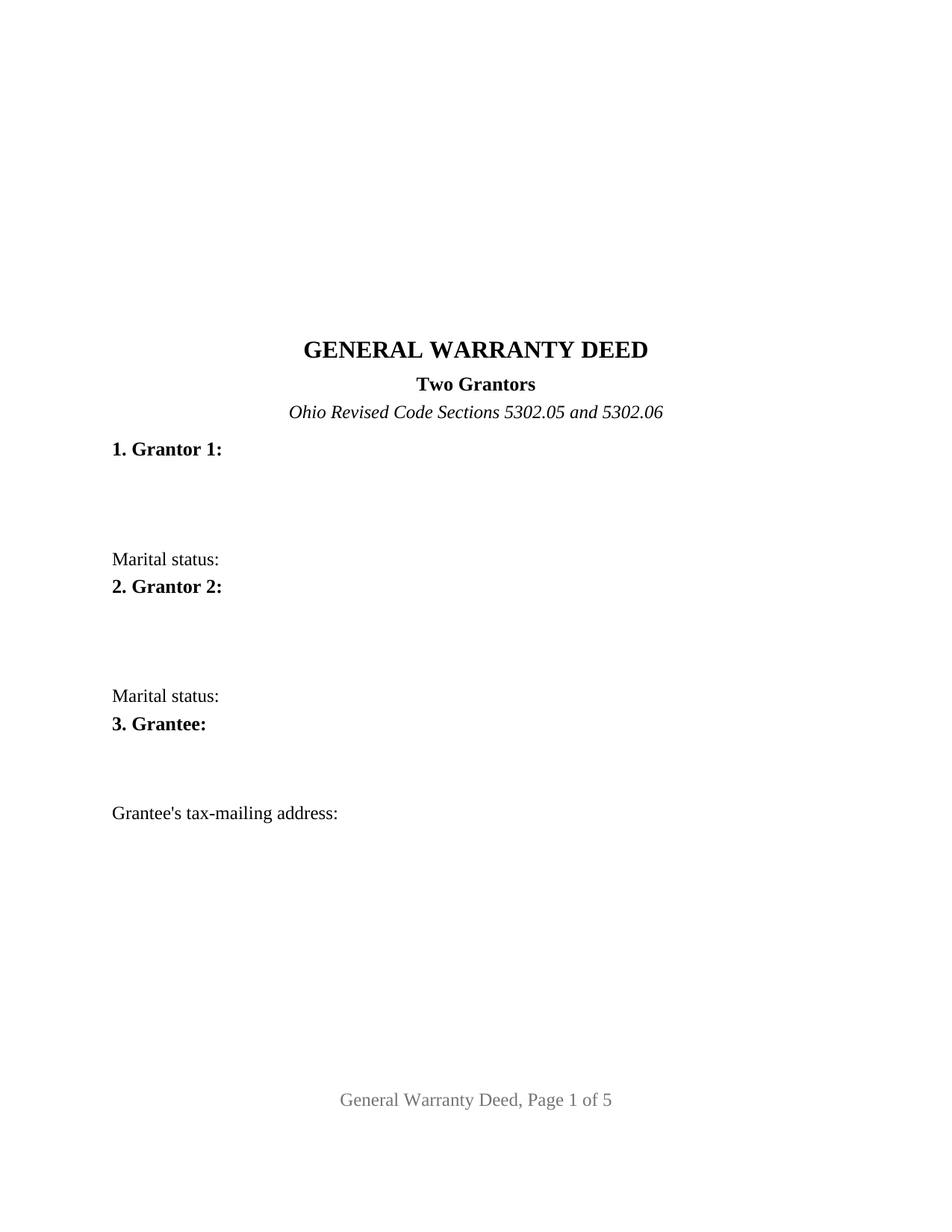
About the Ohio Warranty Deed (Two Grantors)
How to Use This Form
- Select your county from the list
- Download the county-specific form
- Fill in the required information
- Have the document notarized if required
- Record with your county recorder's office
What Others Like You Are Saying
"Form was the one I needed and the instructions along with a sample form was all I needed."
"Great instructions, samples, ease in getting the form I needed, filling it out as a PDF, and having …"
"Very easy to use and very knowledgeable. All information needed to complete the documents was provid…"
"Excellent!"
"Excellent Service. Great time savings over having to send someone to the recording office. Am planni…"
4.8/5 from 4,828 reviews. Read all
Two record owners conveying Ohio real estate together sign one instrument on this form: a general warranty deed arranged for exactly two individual grantors under Ohio Revised Code section 5302.05. Each grantor joins in the statutory covenant phrase, each states a marital status, and when the two grantors are married to each other, each releases dower in the other's interest through a sentence built into the deed.
One deed for two record owners
The form recites two individual grantors, each with a name and mailing address block and a marital status line, followed by a single grantee clause carrying the tax-mailing address line Ohio's transfer statute looks for. Both grantors sign, and the deed carries a separate acknowledgment certificate for each of them, so the two owners may appear before different notaries, on different dates, or in different states. Two patterns present this configuration in the record: spouses conveying a home the two of them own together, and co-owners who are not married to each other, such as siblings holding inherited fractional interests or former partners closing out a joint investment, conveying to a single buyer. The form recites exactly two record owners; a different grantor count presents a different configuration.
A dower release that runs in both directions
Ohio remains a dower state. Revised Code section 2103.02 gives the husband or wife of a property owner a life-estate interest, dower, in one third of the real property the owner is seized of during the marriage, and a conveyance that overlooks it leaves a cloud in the chain. When two married co-owners convey, each one is both a grantor and the other grantor's spouse, so a complete deed releases dower in both directions at once. Section 10 of this form does that in a single sentence: each grantor who is the spouse of the other grantor releases to the grantee all rights of dower in the property. Where the two grantors are not married to each other, the sentence has no one to operate on, and each grantor's own marital status line documents why. A grantor whose spouse is a third person, someone other than the co-grantor, presents a release pattern this form is not set up to carry.
Both grantors stand behind the whole title
The conveyance uses the exact phrase section 5302.05 prescribes, a grant with general warranty covenants, and section 5302.06 supplies the substance behind it: seisin in fee simple, freedom from encumbrances, good right to sell and convey, and a duty to warrant and defend against lawful claims, a promise that runs back through the entire chain of title rather than only the years these grantors held it. The deed's subject-to section states the matters meant to survive the sale, such as current taxes and recorded restrictions, so the covenants read around them rather than being broken on day one.
What the county offices read before the record
An Ohio deed is transferred before it is recorded. The county auditor looks for the grantee's tax-mailing address and the reference to the prior recorded instrument, both required by section 319.20 and both printed on this form, takes the conveyance-fee statement, and endorses the deed; section 317.22 keeps an unendorsed deed of absolute conveyance out of the record entirely. The layout tracks the statewide format statute, section 317.114, from the reserved first-page top margin down to the print size, so the statutory twenty dollar nonstandard-format fee never attaches, and the recorder's base fee schedule applies as usual.
What arrives in the download
The purchase includes the two-grantor warranty deed as a fillable PDF, a completed example prepared for a realistic Cuyahoga County sale by a married couple to a single buyer, and a plain language guide to the form's eleven sections, from the marital status lines through the acknowledgments, the auditor's endorsement, and the county recording path. The materials are informational and are not legal advice; an Ohio attorney can address a specific title or marriage.
Important: County-Specific Forms
Our warranty deed (two grantors) forms are specifically formatted for each of the 88 counties in Ohio.
After selecting your county, you'll receive forms that meet all local recording requirements, ensuring your documents will be accepted without delays or rejection fees.