Oklahoma Transfer on Death Disclaimer of Interest
County Specific Legal Forms Validated as recently as November 21, 2026 by our Forms Development Team
About the Oklahoma Transfer on Death Disclaimer of Interest
How to Use This Form
- Select your county from the list
- Download the county-specific form
- Fill in the required information
- Have the document notarized if required
- Record with your county recorder's office
What Others Like You Are Saying
"It all looked pretty easy to navigate. Forms are just now downloaded so I'll see how opening, fillin…"
"A suggestion: Include instructions on how to add your spouse to the deed, rather than transferring c…"
"Great do it yourself forms (I used the Quitclaim deed). If you think you're going to need a lot of h…"
"Very helpful and happy with my service. Thanks much!"
"I was just trying to look up a record."
4.8/5 from 4,862 reviews. Read all
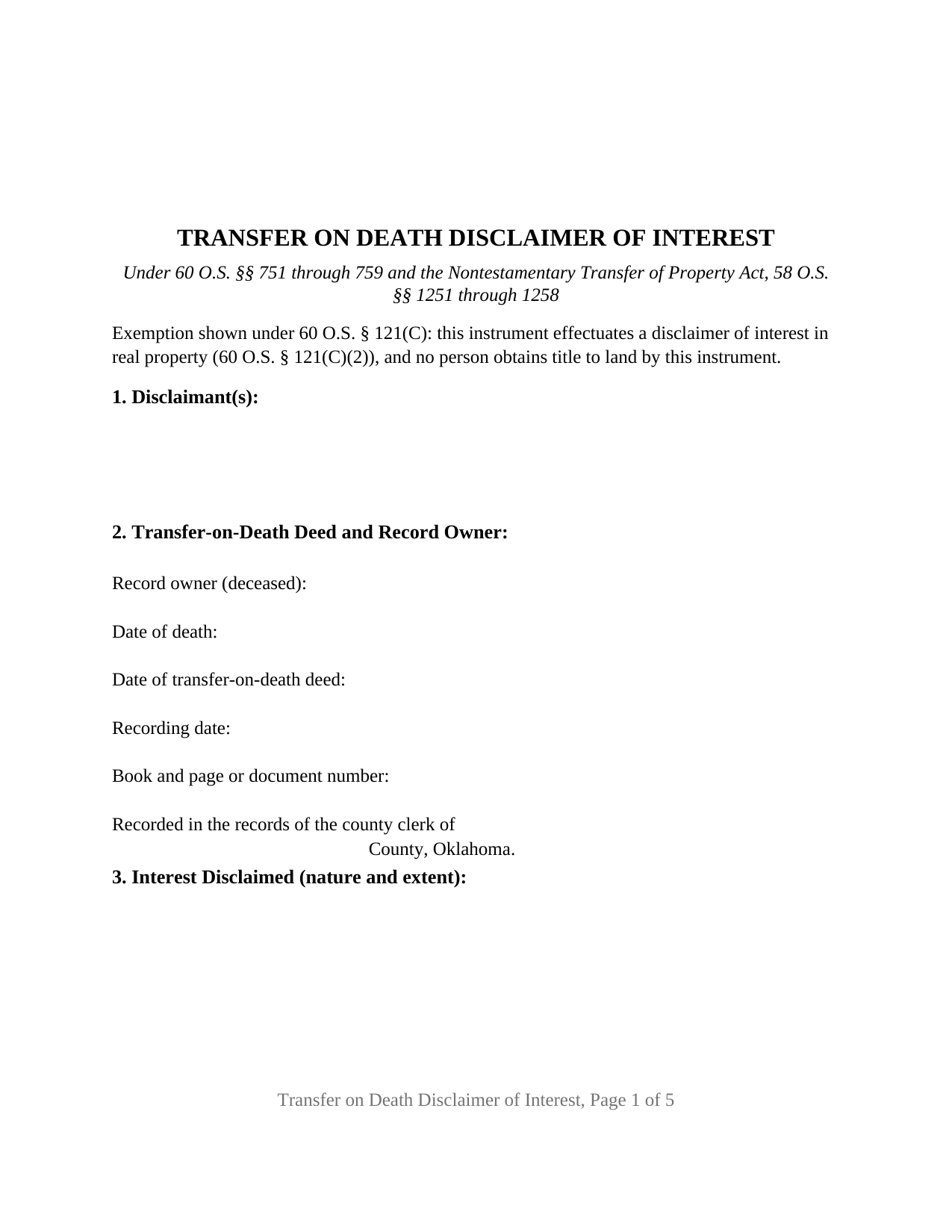
A grantee beneficiary named in a recorded Oklahoma transfer-on-death deed is not obliged to take the property when the owner dies. This Oklahoma Transfer on Death Disclaimer of Interest is the written refusal by which one or two grantee beneficiaries decline, refuse, release, and disclaim the interest a TOD deed would otherwise pass to them, under Title 60, Sections 751 through 759 of the Oklahoma Statutes, the chapter that governs disclaimers of interests created by deeds and other nontestamentary instruments.
Why a TOD beneficiary's refusal has its own chapter
Oklahoma keeps two disclaimer chapters. Interests that pass by will or intestate succession are disclaimed under Title 84. Interests that pass under a deed, an assignment, or any other nontestamentary instrument are disclaimed under Title 60, Chapter 15, and a transfer-on-death deed sits squarely there: 58 O.S. Section 1258 provides that a deed in transfer-on-death form is not a testamentary disposition, and Section 751(1) of the disclaimer chapter defines a beneficiary to include a person entitled, but for the disclaimer, to take as grantee or otherwise under any nontestamentary instrument. The Nontestamentary Transfer of Property Act itself says nothing about disclaiming; it describes acceptance, through the beneficiary affidavit of 58 O.S. Section 1252, and it leaves the refusal to the disclaimer chapter. This form is built on that chapter, element by element.
What Section 751 makes the instrument
Section 751(3) defines a disclaimer as a written instrument which declines, refuses, releases, or disclaims an interest which would otherwise be succeeded to by a beneficiary, which defines the nature and extent of the interest disclaimed, and which is signed, witnessed, and acknowledged by the disclaimant in the manner provided for deeds of real estate. The form performs the refusal in those four verbs, carries a section stating the nature and extent of the interest refused (the whole of a beneficiary's interest, or a stated part of it, since Section 752 permits either), and provides a signature line, two witness lines, and an acknowledgment certificate for each disclaimant. The certificate prints the Oklahoma short form of 49 O.S. Section 119(1), the wording 16 O.S. Section 33 accepts for an instrument affecting real estate. The operative paragraph also states what the chapter cares about: no consideration, no direction by the disclaimant as to where the interest goes, and no prior acceptance, assignment, or waiver, the acts that bar a disclaimer under Section 756.
Two filings and a nine-month clock
Section 754 makes the disclaimer effective when it is filed on the miscellaneous docket in the office of the county clerk of a county in which the district court would have jurisdiction and venue, and, because an interest in real estate is disclaimed, the original or a certified copy is also filed with the county clerk of the county where the land lies, where it is notice to all persons from the time of filing. A copy is delivered or mailed to any person holding legal title to or possession of the property. Section 753 sets the period: within nine months after the effective date of the instrument creating the interest, or nine months after the event that makes the beneficiary finally ascertained and the interest indefeasibly fixed. The instrument prints a capital-letter notice naming the Section 754 filing and the Section 753 period above the signature lines, because effectiveness depends on them.
Where the refused interest goes
The disclaimant does not choose. Section 755 disposes of the interest as if the disclaimant had died immediately before the death that fixed it, and the disclaimer relates to that date whether filed before or after. For an interest under a transfer-on-death deed, that reading runs through 58 O.S. Section 1255(B), under which the transfer to a grantee beneficiary who predeceases the grantor owner lapses, and a designation of the grantee beneficiaries as joint tenants with right of survivorship continues as to those living at the owner's death. The guide walks through those sections side by side and describes, without applying them, the beneficiary affidavit route of Section 1252 and the reversion to the owner's estate that Section 1252(E) attaches to an affidavit never recorded.
Oklahoma's recording gates, answered on the face of the form
Two statutes that stop deeds at the Oklahoma counter are addressed before the first blank. 60 O.S. Section 121(C) requires a notarized land-ownership affidavit as an exhibit to a recorded deed unless an exemption is shown on the deed's face, and paragraph 2 of that subsection exempts an instrument that effectuates a disclaimer of interest in real property; the form prints that exemption beneath its title. The documentary stamp tax of 68 O.S. Section 3201 reaches a deed conveying realty sold for more than one hundred dollars; the form states on its face that it is made without consideration, the notation the instrument carries where no stamps are presented. The page geometry follows 19 O.S. Section 298(B): two inches open at the top of every page, one inch on the other margins, dark type on letter-size paper, and the return mailing address Section 298(A) places on the instrument.
One or two disclaimants, each refusing in their own right
The form carries a free-form disclaimant block, two signature blocks captioned DISCLAIMANT and SECOND DISCLAIMANT, two witness lines under each, and a separate acknowledgment certificate for each signer, so two beneficiaries may acknowledge on different dates before different officers while one beneficiary simply leaves the second block blank. Two children named together in a parent's TOD deed who each decline their undivided half, and a single named beneficiary refusing the whole, present the patterns the form recites. The form is not set up as a disclaimer by a personal representative or guardian on a minor's or decedent's behalf, by an agent under a power of attorney, by a legal entity named as beneficiary, or by three or more disclaimants on one instrument; Section 752 recognizes the fiduciary and agent configurations, and each recites a capacity this instrument does not print. A written consent of a disclaimant's spouse, which Section 757 describes as debarring the consenting spouse from any claim in the real estate, is a separate writing and is not part of the form.
Searching for the right name
Oklahoma practitioners call this instrument a disclaimer of interest, a renunciation, or a TOD deed disclaimer; buyers also arrive searching for a beneficiary deed disclaimer, since other states use that name for the same deed. Whatever the label, the instrument is the one the Title 60 chapter defines, and the Oklahoma Transfer on Death Disclaimer of Interest in this package is drafted to that definition.
The package includes the fillable disclaimer form, a completed example filled in for a realistic Cleveland County fact pattern in which two grantee beneficiaries refuse their shares, and the guide that walks through every numbered section, the witnessing and acknowledgment formalities, the two filings, and the nine-month period. This description and the guide describe the form and the governing Oklahoma statutes in general terms; they are not legal advice.
Important: County-Specific Forms
Our transfer on death disclaimer of interest forms are specifically formatted for each of the 77 counties in Oklahoma.
After selecting your county, you'll receive forms that meet all local recording requirements, ensuring your documents will be accepted without delays or rejection fees.