Oklahoma Transfer on Death Revocation
County Specific Legal Forms Validated as recently as November 21, 2026 by our Forms Development Team
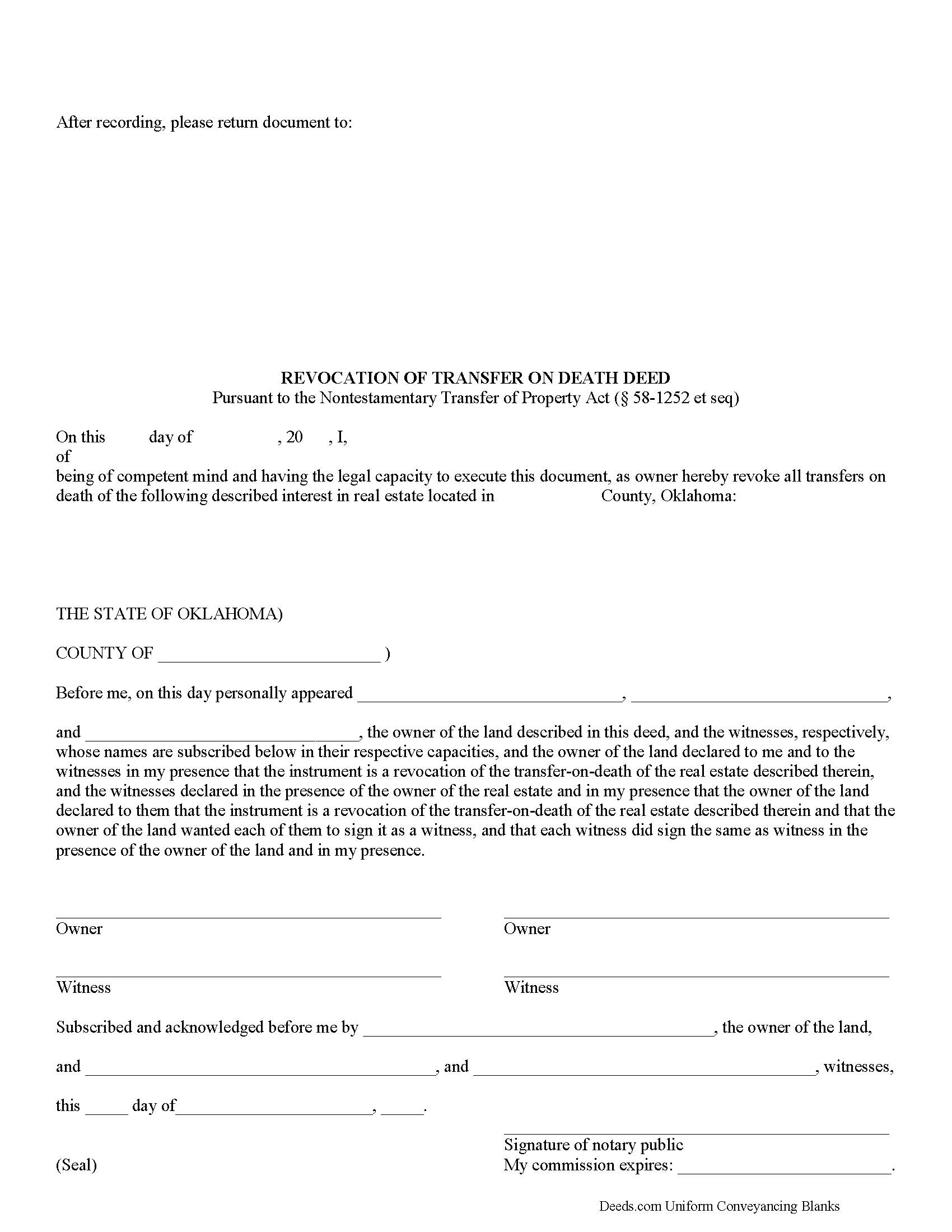
About the Oklahoma Transfer on Death Revocation
How to Use This Form
- Select your county from the list
- Download the county-specific form
- Fill in the required information
- Have the document notarized if required
- Record with your county recorder's office
What Others Like You Are Saying
"Easy to process orders."
"Good and fast service. Thank you."
"The best site ever. Easy to navigate. Love it!!"
"I filed a Mechanic's Lien in PA. I appreciate that Deeds.com charges only a one time fee. When I too…"
"Very Good Product. Provided a lot of good info to assist people to DIY various Deed"
4.8/5 from 4,867 reviews. Read all
The Oklahoma Transfer on Death Revocation is a fill-in Revocation of Transfer-on-Death Deed prepared under the Oklahoma Nontestamentary Transfer of Property Act, 58 O.S. §§1251 through 1258. It is the instrument a record owner executes, acknowledges, and records with the county clerk of the county where the real estate is located, during the owner's lifetime, to revoke the grantee beneficiary designation made in a recorded transfer-on-death deed, the method described in 58 O.S. §1254(A). Under that section the signature, consent, or agreement of the beneficiary, and notice to the beneficiary, are not required for the revocation.
What the download includes
The purchase delivers three PDF files in a single statewide package. No county-specific versions are supplied; the instrument's county entries identify the county where the real estate is located and the county whose clerk recorded the deed.
- Transfer on Death Revocation Form: a fillable PDF with a one-page instructions page, marked as not part of the recorded instrument, followed by the four-page instrument.
- Transfer on Death Revocation Guide: a six-page explanatory document keyed to the instrument.
- Completed Example: the same instrument filled in for a fictional revocation.
The revocation instrument
The instrument identifies the record owner or owners and their mailing address, the real estate by county, legal description, and street address, and the recorded transfer-on-death deed being revoked by its date, recording date, book and page or document number, and recording county. Its operative paragraph, which has no blanks, revokes in its entirety the grantee beneficiary designation made in that one identified deed as to the described real estate, and the instrument recites that it is recorded before the death of the record owner who signs it.
The form is designed for one or two natural-person record owners who executed the deed being revoked, signing in their own right: a single record owner, or two record owners who executed the same deed. It carries two owner signature blocks and a separate acknowledgment certificate for each signer, a design feature of the form rather than a statutory requirement, so two owners may acknowledge on different dates or before different officers. The guide notes that the Act states no separate rule for a revocation signed by fewer than all of the record owners who executed one deed; the completed example shows both owners signing. The instrument closes with an after-recording return address block and a preparer block, and it is laid out for white letter-size paper with the two-inch top margin and one-inch other margins that 19 O.S. §298(B) sets for documents recorded with a county clerk; its legal description box and return address correspond to content 19 O.S. §298(A) requires on instruments affecting specific real property.
What the guide clarifies
The guide walks through the instrument section by section, identifying where each entry comes from, chiefly the recorded transfer-on-death deed itself and the county clerk's recording stamp or online index, and quoting the completed example's entry alongside each explanation. It explains that the deed-identification entries and the legal description are what connect the revocation to the deed in the county records. It also covers the signing and notarization formalities, including the acknowledgment certificate wording the form uses, and recording as part of the §1254(A) method rather than a separate notice step, noting that an instrument signed and acknowledged but left unrecorded at the owner's death has not been put through that method. The guide ends with a section on what the instrument does not do and a note that it is not legal advice.
What the completed example demonstrates
The completed example shows the same form filled in for two married record owners revoking one recorded Oklahoma County transfer-on-death deed, with the legal description, deed identification, both signatures, both acknowledgment certificates, and the return and preparer blocks completed. The guide's section-by-section discussion refers back to these entries, giving a filled-in reference to compare with the blank form.
Boundaries of the supplied design
The instrument revokes only the designation in the one recorded deed it identifies. Where separate transfer-on-death deeds were recorded, the guide explains that each is a separate designation revoked by its own instrument. The form names no new beneficiary; under 58 O.S. §1254(B) a beneficiary designation is changed by executing, acknowledging, and recording a subsequent transfer-on-death deed, which is a separate instrument not included in this package.
The revocation conveys nothing, creates no lien, and changes no ownership. Under 58 O.S. §1257 a record owner who executed a transfer-on-death deed remains the legal and equitable owner during life, and the guide notes that the revocation does not sever a joint tenancy, create or end a tenancy by the entirety, or affect any mortgage, lien, lease, or other recorded interest. It is not a will and does not operate through one; under §1254(C) a transfer-on-death deed recorded in accordance with the Act may not be revoked by the provisions of a will. It is also not a beneficiary's disclaimer or the beneficiary affidavit used after the owner's death.
The form is not set up for revocation by an entity, a trustee, or an attorney-in-fact acting for the record owner, nor for three or more record owners on one instrument, and it does not address real estate held in a trust or titled by an instrument other than a transfer-on-death deed under the Act. It carries no separate spouse-joinder block; its signature blocks are for the record owners who executed the deed being revoked.
This description and the included guide are general information about the supplied materials and do not constitute legal advice.
Important: County-Specific Forms
Our transfer on death revocation forms are specifically formatted for each of the 77 counties in Oklahoma.
After selecting your county, you'll receive forms that meet all local recording requirements, ensuring your documents will be accepted without delays or rejection fees.