Oregon Transfer on Death Deed (Sole Owner, Multiple Beneficiaries (Equal Shares))
County Specific Legal Forms Validated as recently as November 22, 2026 by our Forms Development Team
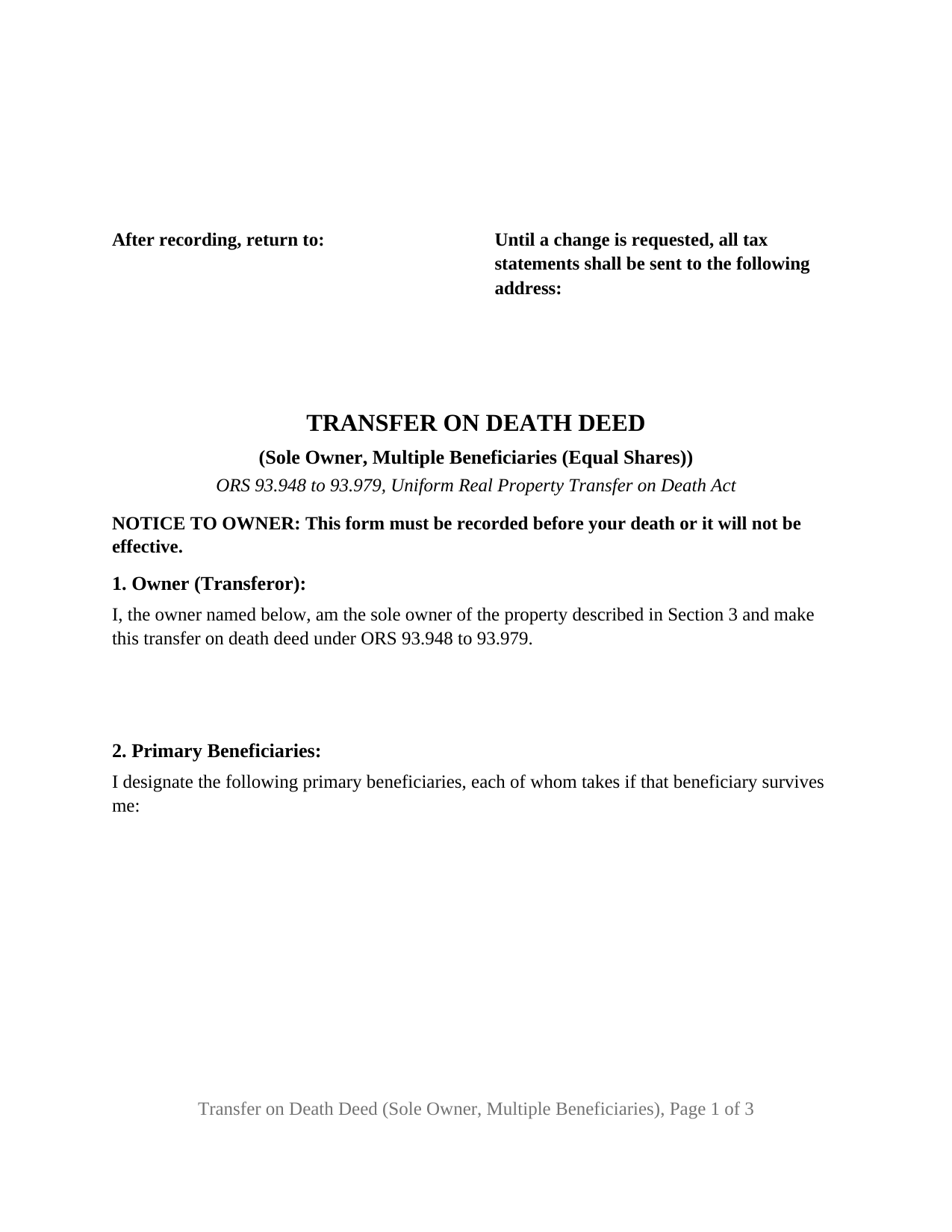
About the Oregon Transfer on Death Deed (Sole Owner, Multiple Beneficiaries (Equal Shares))
How to Use This Form
- Select your county from the list
- Download the county-specific form
- Fill in the required information
- Have the document notarized if required
- Record with your county recorder's office
What Others Like You Are Saying
"I was very pleased with the quick turn around on a response to my inquiry. Further guidance was dire…"
"Great site! I found everything I needed."
"Service was top-notch....fast, accurate, cost-effective."
"Forms were appropriately priced, easy to download"
"Ive been looking for a complete packet with all the forms needed!!"
4.8/5 from 4,862 reviews. Read all
This fillable form is an Oregon transfer on death deed, the instrument also searched as a beneficiary deed or TOD deed, set up for one owner who holds the property alone and who designates two or more primary beneficiaries to take equal and undivided shares at the owner's death. It is the Oregon transfer on death deed in the configuration a parent naming three adult children, or an owner dividing a parcel among siblings, presents in the record: one signer, several named beneficiaries, equal shares, and no probate for the property the deed covers.
Equal shares, and what happens when one beneficiary dies first
The operative section of the deed carries the statutory form's own transfer sentence from ORS 93.975 and a fixed share sentence: the primary beneficiaries who survive the owner take the owner's interest in equal and undivided shares with no right of survivorship. That is the rule ORS 93.969(1)(b) supplies where a transferor names multiple designated beneficiaries to receive concurrent interests, printed on the face of the deed so the configuration is in the record and not only in the owner's intent. The same subsection answers the question every multi-beneficiary designation raises. Under ORS 93.969(1)(a) a designated beneficiary's interest is transferred if that beneficiary survives the owner and lapses if not, and under ORS 93.969(1)(b)(B) a share that lapses or fails for any reason is transferred to the remaining designated beneficiaries in proportion to the interest of each. Three beneficiaries at one third each become two at one half each where one of them dies before the owner, with no amendment to the deed. Because the shares carry no right of survivorship, the beneficiaries who take hold as tenants in common under ORS 93.180(1)(a), each with an undivided interest that is separately alienable, devisable, and descendible.
One owner, one signature, no second signature line
The deed recites a single owner who is the sole owner of the described property, and it carries one signature block and one acknowledgment certificate. Oregon's deed execution statute, ORS 93.410, calls for the grantor's signature and an acknowledgment before a notary public or one of the judges the statute names, with no seal and no subscribing witnesses, and ORS 93.961 applies the formalities of a recordable inter vivos deed to a transfer on death deed. The owner's marital status is neither printed nor asked for. Oregon is not a community property state and abolished dower and curtesy by ORS 112.685, so a spouse who does not hold title is not a transferor under ORS 93.949(7) and has no signature line; the guide sets out the statutes behind that position. Where a spouse or anyone else shares title, ORS 93.949(3) treats a tenant by the entirety or other survivorship co-owner as a joint owner and ORS 93.969(3) governs the deed's effect, a configuration this deed does not recite.
Nothing moves until death, and nothing moves without recording
ORS 93.967 keeps the owner's position unchanged during life: the deed does not affect the owner's right to transfer or encumber the property, creates no legal or equitable interest in the beneficiaries, leaves the rights of the owner's creditors where they were, and does not affect eligibility for public or medical assistance. ORS 93.955 makes the deed revocable whatever it says, and ORS 93.965 spells out how: a later transfer on death deed, an instrument of revocation, or an ordinary deed of the property, each acknowledged after this deed and recorded before the owner's death. A will does not revoke it, and the deed grants no agent the authority ORS 93.965(2) would otherwise let it grant. The one condition that decides whether the deed works at all is recording. ORS 93.961(1)(d) makes recording before the owner's death, in the deed records of the county where the property is located, a requirement of the deed itself, and the form prints the statutory form's notice to that effect above its first section. At death the beneficiaries take subject to every mortgage, lien, and other interest then on the property, and without covenant or warranty of title, under ORS 93.969(2) and (4).
Built for the Oregon first page
Oregon's recording statute, ORS 205.234, puts named information on the first page of a recorded instrument: the name of the transaction, the names the clerk indexes, the return address, and, for instruments conveying fee title, the tax statement address of ORS 93.260. This form lays its first page out to that inventory. The return block and the tax statement block sit side by side above the title, the owner and the primary beneficiaries follow on the same page, and the top two inches stay clear for the recording label Oregon county clerks apply. The true and actual consideration statement and the land use notices that ordinary Oregon deeds carry are absent by statute, since ORS 93.030(6) and ORS 93.040(6) take a transfer on death deed out of both. Body type is 12 point, above the 10-point minimum of ORS 205.232. Recording fees are set county by county; Lane County, the county of the completed example, published $102 for a one-page document effective July 1, 2026, and each clerk's current schedule governs.
What this configuration recites
The deed recites exactly one owner, signing in that owner's own right, and a primary beneficiary section whose designation sentence and share sentence are written for two or more names. A parent naming adult children, an owner naming siblings or nieces and nephews, and an owner naming several individuals alongside a trust named through its trustee present the pattern this deed recites. ORS 93.949(4) lets a beneficiary be a natural person, a trust through its trustee, or an entity, and ORS 93.961 requires each one to be identified by name, because a designation to a class such as my children, without names, is void. The form prints no alternate beneficiary section and no special terms blank, so the chapter's own survival, lapse, and share rules apply as written; a designation that varies those rules, an alternate who takes only if no primary beneficiary survives, and two owners designating on one instrument are patterns this deed does not recite. Neither is an owner that is an entity or a trustee, or an owner signing through an attorney-in-fact.
The download contains the fillable Oregon transfer on death deed with its non-recorded instructions page, a completed example filled in for a fictional Lane County property with three beneficiaries, and a guide that walks through each section of the form and the statutes behind it. The guide and this description explain the form and the governing Oregon statutes in general terms; neither applies the law to a particular set of facts, and neither is legal advice.
Important: County-Specific Forms
Our transfer on death deed (sole owner, multiple beneficiaries (equal shares)) forms are specifically formatted for each of the 36 counties in Oregon.
After selecting your county, you'll receive forms that meet all local recording requirements, ensuring your documents will be accepted without delays or rejection fees.