Oregon Transfer on Death Deed (Sole Owner, One Individual Beneficiary)
County Specific Legal Forms Validated as recently as November 22, 2026 by our Forms Development Team
About the Oregon Transfer on Death Deed (Sole Owner, One Individual Beneficiary)
How to Use This Form
- Select your county from the list
- Download the county-specific form
- Fill in the required information
- Have the document notarized if required
- Record with your county recorder's office
What Others Like You Are Saying
"It was very easy to get the forms I needed which makes its so much easier than running back and fort…"
"Great way to do business with Dc Government! I submitted my documents and received everything back a…"
"Finding what I needed was easy. The payment process was easy. Using what I found was easy. Easy-peas…"
"Easy to set up and fast service."
"I did a Beneficiary Deed, package came with all forms and instructions. Recorder accepted first time…"
4.8/5 from 4,862 reviews. Read all
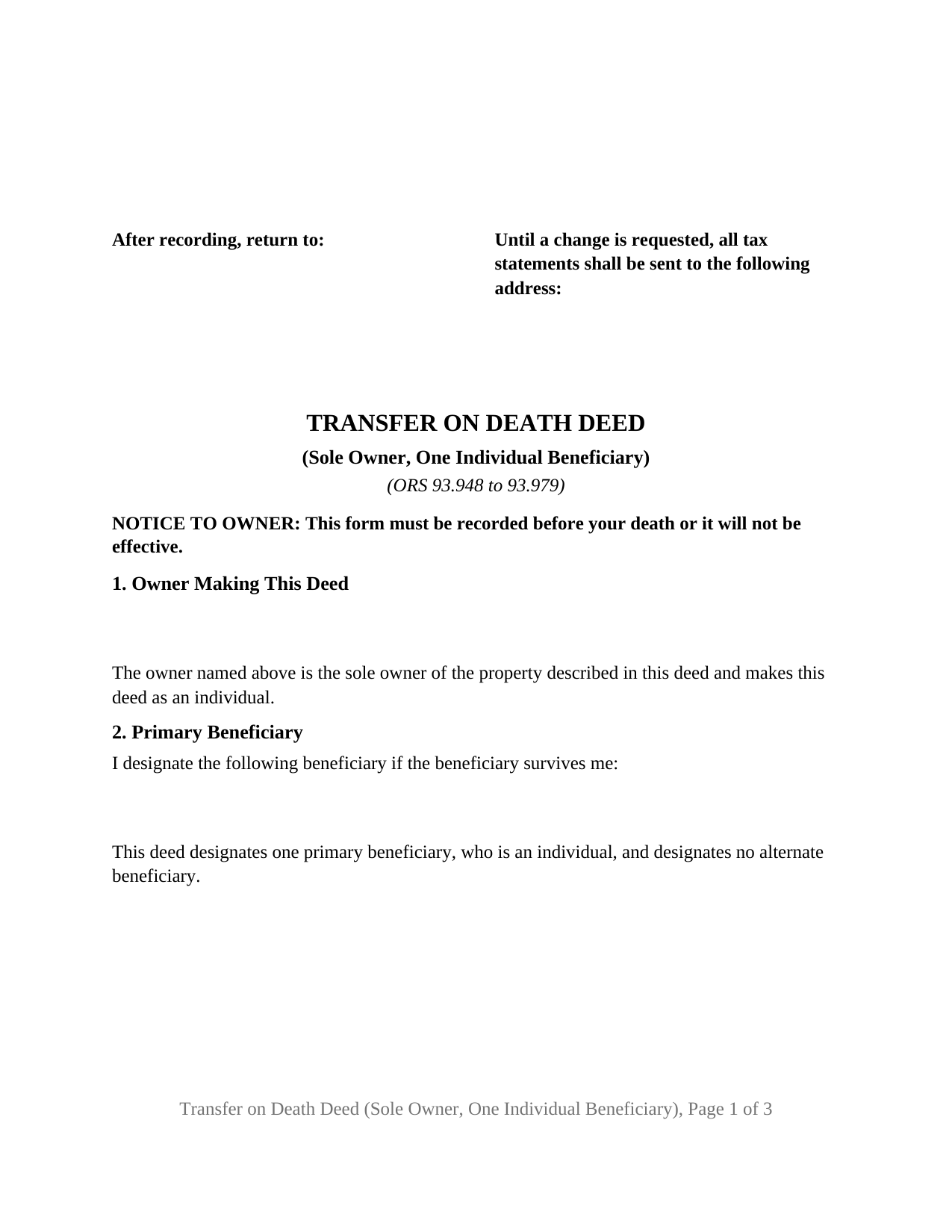
One owner, one named person, one signature: this Oregon transfer on death deed is written for the simplest designation the Uniform Real Property Transfer on Death Act allows. The form recites a single owner who holds the whole of the described Oregon property as the sole owner, and it designates exactly one primary beneficiary, a natural person identified by name, to take that property at the owner's death under ORS 93.948 to 93.979. There is no alternate beneficiary section, no second owner block, and no special terms blank on the recordable pages.
One owner, one name, one signature
The deed carries a fixed recital that the owner named in it is the sole owner of the property and makes the deed as an individual, and a fixed statement that the deed designates one primary beneficiary, who is an individual, and no alternate. The owner's name, the beneficiary's name, the county, and the legal description are the factual entries; the configuration itself is printed deed text rather than something left to a selector or a blank. An unmarried owner holding title alone, and a married owner holding title alone as separate property, both present the pattern this deed recites, because Oregon has no community property regime and ORS 112.685 abolished dower and curtesy; a spouse who is not on the title has no signature line. Spouses who took title together hold as tenants by the entirety under ORS 93.180(1)(b), which is a co-ownership and not sole ownership, so that record presents a different pattern from the one this form recites, as does any instrument with two owners, several beneficiaries, a trust or entity beneficiary, or an owner signing through an attorney in fact.
The beneficiary side is equally fixed. ORS 93.961(1)(c) requires the designated beneficiary to be identified by name, and ORS 93.961(2) voids a designation that identifies beneficiaries only as members of a class, so the beneficiary block takes a full name, with a relationship label such as my son as an optional addition, never a substitute. The designation sentence above the block is the one printed in the permissive statutory form of ORS 93.975, carried word for word: the owner designates the following beneficiary if the beneficiary survives the owner.
What a single beneficiary means at the owner's death
ORS 93.969(1)(a) supplies the survival rule: the beneficiary's interest is transferred if the beneficiary survives the owner and lapses if the beneficiary does not, and under ORS 112.578 of Oregon's Uniform Simultaneous Death Act, which ORS 112.570(2)(c) applies to a transfer on death deed, survival means surviving the owner by at least 120 hours, established by clear and convincing evidence. The statutory form prints an optional alternate beneficiary section to catch that lapse, and this form deliberately omits it. The consequence is that a lapse leaves the deed with no one to take, and the property then remains part of the owner's estate at death, to pass under the owner's will or under Oregon's intestate succession rules. The guide explains that outcome under the chapter, along with the rule of ORS 93.965 that a recorded deed is revoked only by a later acknowledged and recorded instrument, so an owner whose circumstances change replaces the designation by recording a new deed or a revoking instrument, prepared separately and not included in this package, rather than by editing the recorded one.
Nothing moves during life, and nothing moves without recording
ORS 93.967 states what the recorded deed does not do while the owner lives: it does not affect the owner's right to sell, mortgage, or otherwise deal with the property, creates no interest in the beneficiary, gives the beneficiary's creditors no reach into the property, and leaves the owner's eligibility for public or medical assistance untouched. The owner remains the taxpayer, which is why the tax statement address block on the first page, the ORS 93.260 element that ORS 205.234(1)(e) places on page one, ordinarily carries the owner's own address.
The other half of the rule is the one the form prints as its only notice: under ORS 93.961(1)(d) the deed must be recorded before the owner's death in the deed records of the county where the property is located, or it has no effect. The form carries that sentence from the statutory form at the top of the first page, directly under the title, because it is the one condition whose absence silently defeats the instrument. Recording also needs no consideration, delivery, or acceptance; ORS 93.963 makes the deed effective without any of them.
Signing and recording in Oregon
ORS 93.961(1)(a) requires the formalities of a properly recordable inter vivos deed, and ORS 93.410 supplies them for a deed executed in Oregon: the owner's signature, acknowledged before a notary public or one of the judicial officers the section names, with no witnesses and no seal. The form carries one signature block and one acknowledgment certificate using the ORS 194.285(1) short form sentence, with a reserved area for the notary's official stamp under ORS 194.280(3). An owner who is outside Oregon acknowledges before an officer of that place under ORS 194.260.
Two statements that appear on most Oregon deeds are absent here by statute. ORS 93.030(6) excludes a transfer on death deed from the true and actual consideration statement, and ORS 93.040(6) excludes it from the land use and property rights statements. What the first page does carry is what ORS 205.234(1) places there: the title, the names of the owner and the beneficiary, the return address, and the tax statement address. The body is set at 12 point type over the 10 point minimum of ORS 205.232, on letter size paper, with two inches left open at the top of page one for the clerk's recording label, and the recorded instrument runs three pages plus any exhibit. Recording fees are set county by county on the clerk's published schedule.
The download delivers the fillable transfer on death deed with its non recorded instructions cover page, a completed example filled in for a fictional Lane County owner naming her son, and a seven page guide that walks through each block of the form and the Oregon statutes behind it. The guide and this description give general information about the form and the governing law; they do not apply the law to any particular situation and are not legal advice.
Important: County-Specific Forms
Our transfer on death deed (sole owner, one individual beneficiary) forms are specifically formatted for each of the 36 counties in Oregon.
After selecting your county, you'll receive forms that meet all local recording requirements, ensuring your documents will be accepted without delays or rejection fees.