Rhode Island Grant Deed
County Specific Legal Forms Validated as recently as September 30, 2026 by our Forms Development Team
About the Rhode Island Grant Deed
How to Use This Form
- Select your county from the list
- Download the county-specific form
- Fill in the required information
- Have the document notarized if required
- Record with your county recorder's office
What Others Like You Are Saying
"Absolutely perfect! Quitclaim deed form was easy to complete and the recorder had no issues with it …"
"VERY HAPPY WITH YOUR SERVICE !"
"Both sets of deeds were complete and easy to understand. Both states accepted the forms to transfer …"
"Fast download and clear, easy-to-follow directions. A great service."
"Easy and fast. I will definitely use this service again."
4.8/5 from 4,830 reviews. Read all
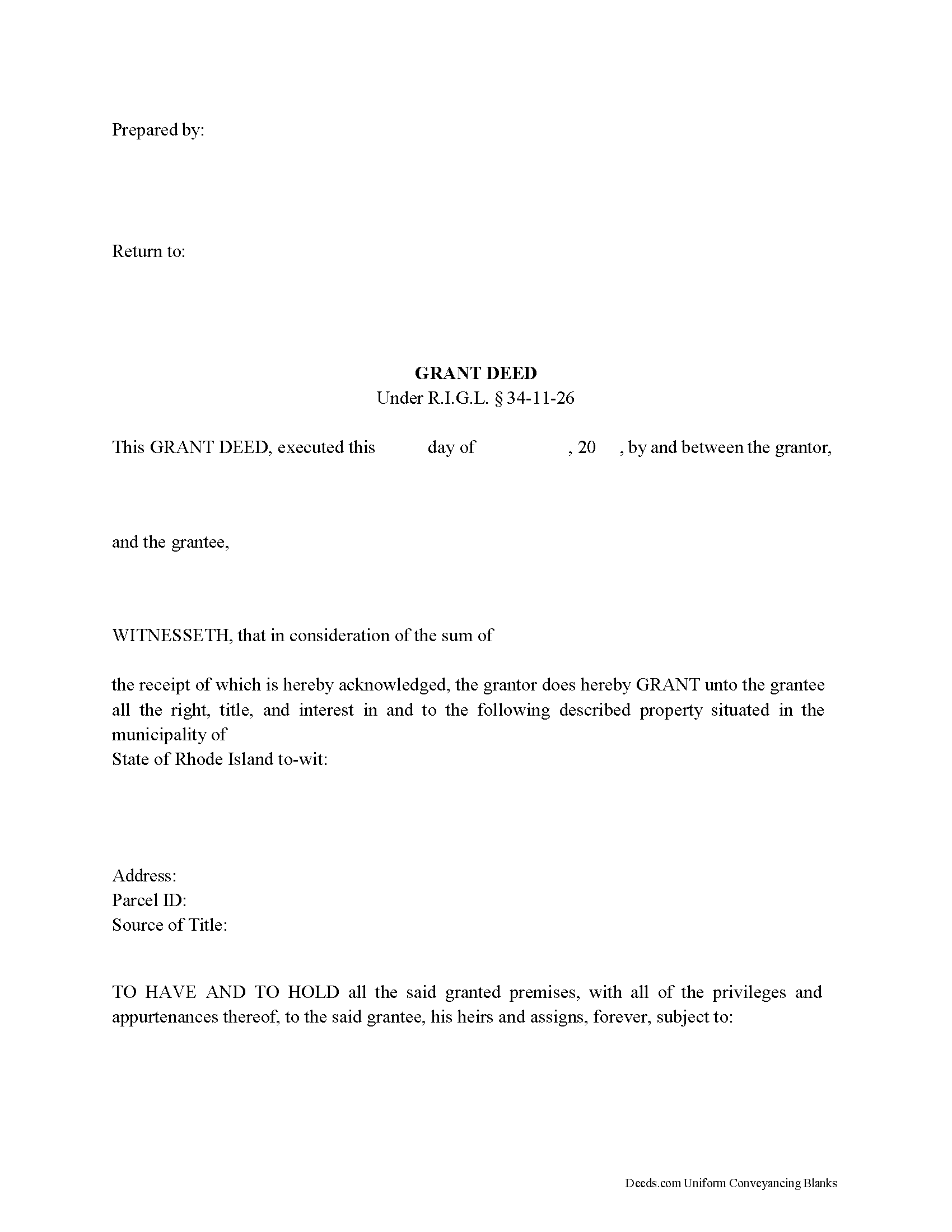
In Rhode Island, title to real property can be transferred from one party to another by executing a grant deed. Use a grant deed to transfer a fee simple interest with covenants that the title is free of any encumbrances (except for those stated in the deed) and that the grantor holds an interest in the property and is free to convey it. The word "grant" is considered a "sufficient word of conveyance" in any transfer of title in fee simple, but it does not imply any covenant or warranty (R.I.G.L. 34-11-26). Any covenants of title should be explicitly made in the form of the conveyance.
A lawful grant deed includes the grantor's full name, mailing address, and marital status; the consideration given for the transfer; and the grantee's full name, mailing address, marital status, and vesting. Vesting describes how the grantee holds title to the property. Generally, real property is owned in either sole ownership or in co-ownership. For Rhode Island residential property, the primary methods for holding title are tenancy in common, joint tenancy, and tenancy by entirety. A conveyance of real estate to two or more persons creates a tenancy in common, unless otherwise specified in the conveyance (R.I.G.L. 34-3-1).
As with any conveyance of realty, a grant deed requires a complete legal description of the parcel. Recite the prior deed reference to maintain a clear chain of title, and detail any restrictions associated with the property. Finally, the form must meet all state and local standards for recorded documents. The completed deed must be signed by the grantor (and his or her spouse, if applicable) in the presence of a notary.
The grantor must indicate their residency status on the face of the deed. A residency affidavit, completed by the grantor, is required for sales of realty by nonresidents. Transfers by nonresidents are subject to withholding of a percentage of the total payment by the grantee/buyer. Buyers may only depend on the seller's residency status by receipt of an affidavit of residency. For more on withholding of Rhode Island tax, see R.I.G.L. 44-30-71.3 and consult a lawyer with questions.
Rhode Island levies a Real Estate Conveyance Tax based on the consideration paid. This tax is due upon recording. If there is no consideration paid, the deed must include a statement to the effect that "the consideration is such that no documentary stamps are required" (R.I.G.L. 44-25-1(b)). If the transfer is exempt from the Real Estate Conveyance Tax, state the reason on the face of the deed. See R.I.G.L. 44-25-2 for a list of exemptions. A completed Form CVYT-1 (Real Estate Conveyance Tax return) is required for all transfers of real property, and should be submitted to the Rhode Island Division of Taxation.
Record the original completed deed, along with any additional materials, at the city or town clerk's office in the municipality where the property is located. (Rhode Island maintains land records at the municipal level.) Contact the same office to verify accepted forms of payment.
This article is provided for informational purposes only and is not a substitute for the advice of an attorney. Contact a lawyer with questions about grant deeds, or for any other issues related to the transfer of real property in Rhode Island.
(Rhode Island Grant Deed Package includes form, guidelines, and completed example)
Important: County-Specific Forms
Our grant deed forms are specifically formatted for each of the 5 counties in Rhode Island.
After selecting your county, you'll receive forms that meet all local recording requirements, ensuring your documents will be accepted without delays or rejection fees.