South Dakota Transfer on Death Deed (Joint Transferors with Right of Survivorship)
County Specific Legal Forms Validated as recently as October 20, 2026 by our Forms Development Team
About the South Dakota Transfer on Death Deed (Joint Transferors with Right of Survivorship)
How to Use This Form
- Select your county from the list
- Download the county-specific form
- Fill in the required information
- Have the document notarized if required
- Record with your county recorder's office
What Others Like You Are Saying
"Very simple and made recording a breeze. Worth the fee!"
"All instructions and forms are very easy to read and fill-out. Thank you"
"I believe this is great! It protects the residents from theft of property. Proud of what Wayne Count…"
"This is the best thing I have ever done with this being my first time doing a quick claim. This has …"
"I requested a copy of some documents and within the hour, they were waiting for me in PDF form. It w…"
4.8/5 from 4,836 reviews. Read all
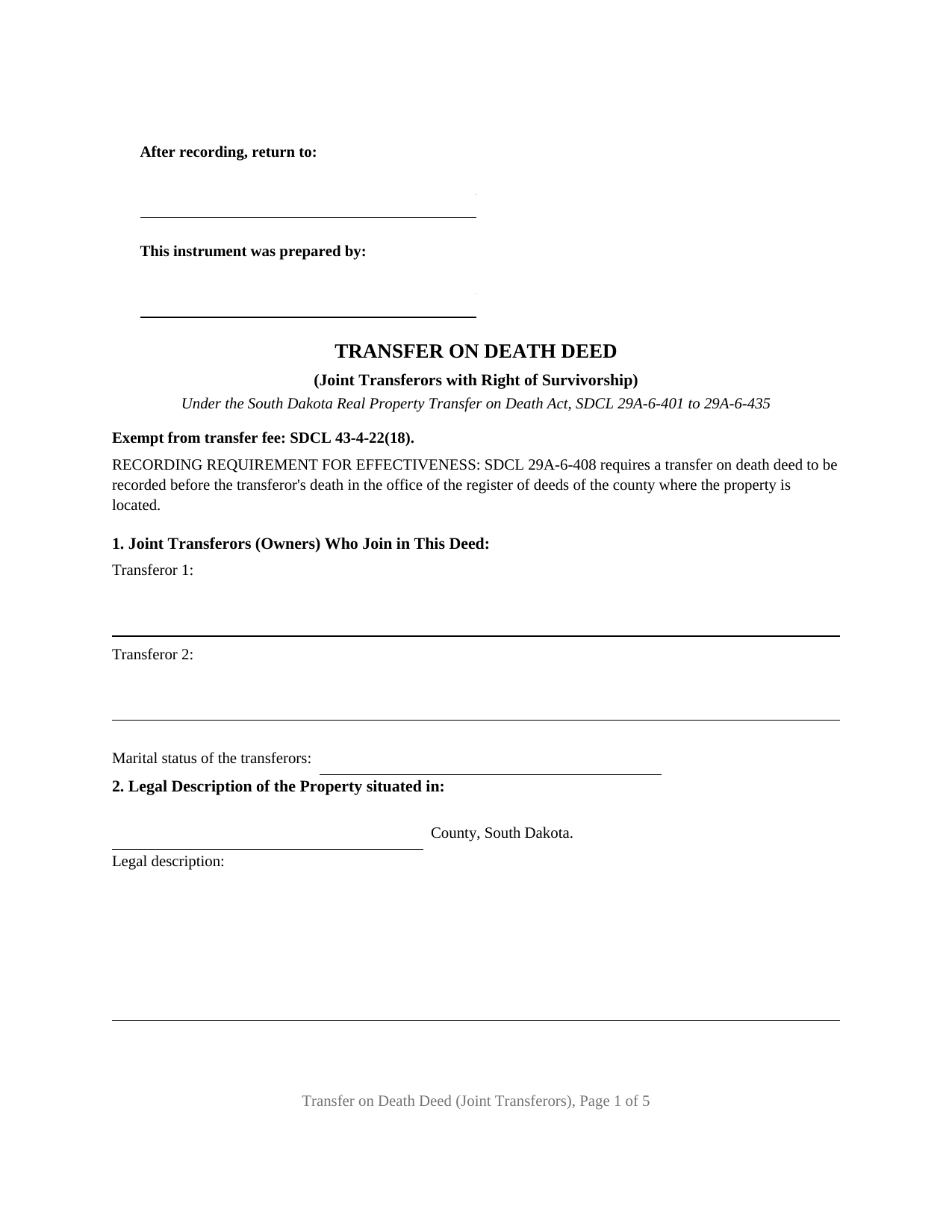
One recorded deed can carry the whole succession plan for South Dakota property that two people own as joint tenants with right of survivorship. This fillable transfer on death deed is built for exactly that title: both joint owners sign it together, the survivorship between them keeps working exactly as before, and the beneficiaries the deed names receive the property only after the second owner has died, outside probate.
Built for two joint tenants, not two separate deeds
The form recites two record owners as joint transferors, with the marital status line drawn from the optional statutory form, a signature line for each owner, and a separate acknowledgment certificate for each, so the two may sign on different days or before different notaries. A married couple holding the family home with survivorship language, and unmarried co-owners such as siblings or partners whose vesting deed declares a joint tenancy, present the two-owner pattern this deed recites. A sole owner's beneficiary deed, a tenancy in common, and a group of three or more owners each follow a different pattern, and this form does not recite them. South Dakota joint tenancy exists only where the vesting instrument declares it expressly (SDCL 43-2-12; a grant without that declaration takes the tenancy in common default of SDCL 43-2-12), so the form's source of title section points to the recorded deed that carries the survivorship words.
The deed that waits for the second death
SDCL 29A-6-417 supplies the rule the whole form is organized around: while a deceased transferor is survived by the other joint owner, the property simply belongs to the survivor with right of survivorship, and the transfer on death deed becomes effective when the last surviving joint owner dies. During both lifetimes nothing moves. The owners keep every right to sell, mortgage, lease, or partition, and the designated beneficiaries hold no interest of any kind (SDCL 29A-6-414). The beneficiary section names one or more primary designated beneficiaries with mailing addresses, taking, unless the deed says otherwise, in equal shares as tenants in common; a contingent section covers the possibility that no primary beneficiary survives; and the survival requirement election from SDCL 29A-6-430 appears in its own section, with the one hundred twenty hour period measured on this form from the death of the last surviving transferor.
Revoked only together, recorded before death
Two multi-transferor rules separate this deed from a single-owner beneficiary deed. Under SDCL 29A-6-411, revocation by one transferor does not affect the deed as to the other transferor's interest, and a transfer on death deed made by joint owners is revoked only if all living joint owners revoke it; the last survivor may then act alone. Tearing up the paper accomplishes nothing once the deed is on record (SDCL 29A-6-412). Recording is itself the effectiveness condition: the deed goes on record with the register of deeds in the property's county during the owners' lives, and a signed deed that never reaches the record transfers nothing (SDCL 29A-6-408).
At the register of deeds counter
The document is formatted to South Dakota's recording standards in SDCL 43-28-23, with the three inch blank space across the top of the first page and the preparer statement SDCL 43-28-23 requires placed in its left half. The statewide recording fee is thirty dollars for a document of this length (SDCL 7-9-15). A transfer on death deed is exempt from the certificate of real estate value under SDCL 7-9-7(5), and the first page carries the exemption statement that county intake practice requires for the transfer fee, citing SDCL 43-4-22(18). The deed passes whatever interest the last transferor owns at death, subject to mortgages, liens, and other recorded interests (SDCL 29A-6-416), and without covenant or warranty of title (SDCL 29A-6-418). After the second death, the beneficiary records the affidavit of confirmation described in SDCL 29A-6-427 to 29A-6-432 with a certified death certificate; that affidavit is prepared and recorded separately and is not included in this package.
The download contains the blank two-transferor deed as a fillable PDF, a completed example showing a Minnehaha County married-couple fact pattern carried through every section and both notary blocks, and a plain language guide to the statutes, the entries, and the recording steps. The materials are informational and are not legal advice.
Important: County-Specific Forms
Our transfer on death deed (joint transferors with right of survivorship) forms are specifically formatted for each of the 66 counties in South Dakota.
After selecting your county, you'll receive forms that meet all local recording requirements, ensuring your documents will be accepted without delays or rejection fees.