Texas Affidavit of Heirship
County Specific Legal Forms Validated as recently as September 23, 2026 by our Forms Development Team
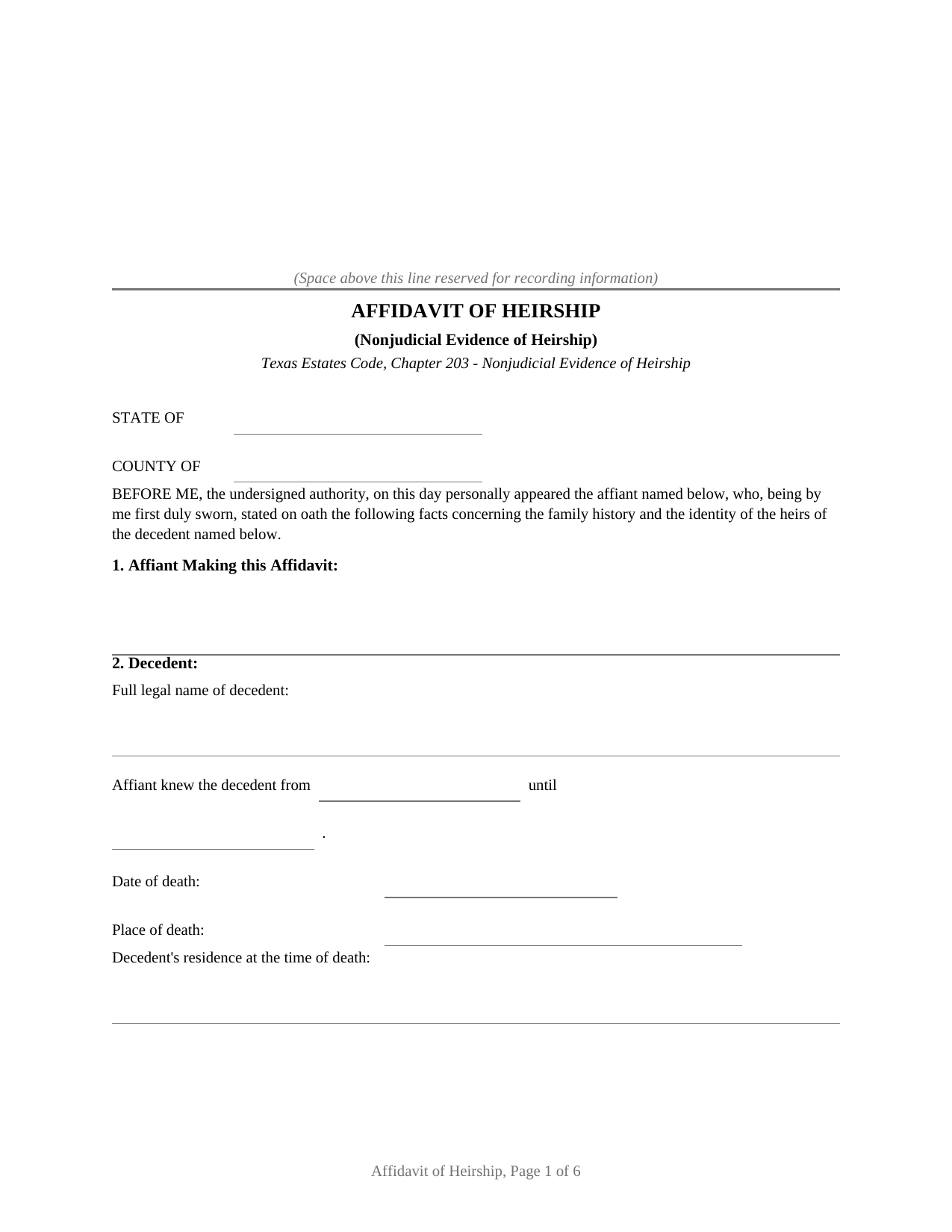
About the Texas Affidavit of Heirship
How to Use This Form
- Select your county from the list
- Download the county-specific form
- Fill in the required information
- Have the document notarized if required
- Record with your county recorder's office
What Others Like You Are Saying
"They had everything for a living trust but the form to transfer your house into the living trust"
"This site was easy to use for access to State forms for filing in Montmorency County clerks office. …"
"excellent"
"Awesome service, I don’t know how much it saved me but I know it was a lot cheaper than going to a l…"
"Exceptional service. Thank you for your assistance."
4.8/5 from 4,828 reviews. Read all
When a Texas owner dies without a will and the main thing left behind is real estate, the title sits in a deceased person's name with no recorded account of who now owns it. A Texas affidavit of heirship is the instrument that fills that gap: a sworn statement of the decedent's family history and heirs, recorded in the county deed records, that lets the chain of title catch up with the family. This form prepares that affidavit under Chapter 203 of the Texas Estates Code, the chapter on nonjudicial evidence of heirship.
Evidence That Strengthens With Time
The defining feature of the affidavit of heirship is written into Section 203.001. A court receives the statement of facts in a recorded affidavit as prima facie evidence of heirship, in a proceeding to declare heirship or a suit involving title to property, once the affidavit has been of record for five years or more in the county where the property is located. Before that five year mark the affidavit is still recorded and still part of the chain of title; what arrives at five years is the statutory presumption that the recited facts are correct unless someone comes forward to contradict them. That growing weight is why families record the affidavit promptly even though it changes nothing on its face the day it is filed.
What the Affidavit Records
Heirship in Texas is set by the laws of descent and distribution in Chapter 201, not by the affidavit. The affidavit's job is to record the family facts that, applied to those laws, identify the heirs. Following the suggested form in Section 203.002, it states the decedent's marital history, the children and their descendants, the parents and siblings where the decedent left no descendants, the persons who know the family, and the absence of a will, of an estate administration, and of unpaid debts and taxes. It identifies the real property by legal description and source of title, then names the heirs and the share each one takes. Because Texas is a community property state, a full marital history matters: even a long ago marriage can change who inherits, so the form gives that history its own section.
Sworn by an Affiant and Two Disinterested Witnesses
This is an affidavit, so the people who sign it swear to the facts before a notary, who completes a jurat rather than the acknowledgment found on a deed. Chapter 203 does not by its own terms require witnesses, but the title companies whose acceptance gives the affidavit its practical value routinely ask that the statement be sworn by the affiant and corroborated by two disinterested witnesses, people who knew the decedent and the family well but take nothing from the estate. The form provides one affiant block, two witness blocks, and a separate jurat for each signer, so they can swear on different dates or before different notaries.
What It Does Not Do
An affidavit of heirship does not transfer or convey title the way a deed does, and the form says so plainly. Section 203.001 also preserves the rights of an omitted heir and of a creditor of the decedent, so the affidavit records facts rather than cutting off claims. A title company evaluates it through its own underwriting and may accept it, ask for more, or require that all heirs join in a deed or that a court determine heirship; legal validity and title insurability are not the same thing. The guide describes those limits, including how homestead occupancy rights and estate claims operate independently of the affidavit.
In the Package
The package centers on the fillable affidavit, which can be typed on screen or printed and completed by hand. A section-by-section guide explains, for each numbered part, what the blank is asking for, which document or witness it comes from, and what a complete entry reads like, and a fully filled completed example carries one realistic Travis County fact pattern from the venue lines through the witness jurats. The affidavit is laid out for the county clerk: letter size pages within the dimensions of Local Government Code Section 191.007, body type well above the eight point floor, and the top of the first page kept clear for the recording stamp. Because an affidavit of heirship moves no interest in land, it carries none of the confidentiality notice a deed must show. These materials are informational and are not legal advice.
Related Texas Forms
Where the owner is still living, the Texas Transfer on Death Deed names who receives the property at death without probate, and the Texas Affidavit of Death (Transfer on Death Deed Beneficiary) is what a beneficiary records after that owner's death. Once heirship is established, the heirs commonly convey by a Texas General Warranty Deed or a Texas Deed Without Warranty. Where a court order rather than a recorded affidavit is needed, a judicial proceeding to declare heirship is the path Texas law provides.
Important: County-Specific Forms
Our affidavit of heirship forms are specifically formatted for each of the 254 counties in Texas.
After selecting your county, you'll receive forms that meet all local recording requirements, ensuring your documents will be accepted without delays or rejection fees.