Dallam County Revocation of Transfer on Death Deed (Individual) Form
Last validated October 8, 2026 by our Forms Development TeamFormatted for recording in Dallam County, for property anywhere in the county: rural and unincorporated areas as well as Dalhart, Kerrick, Texline.
- 3 documents included
- Immediate PDF download
- Formatting guarantee
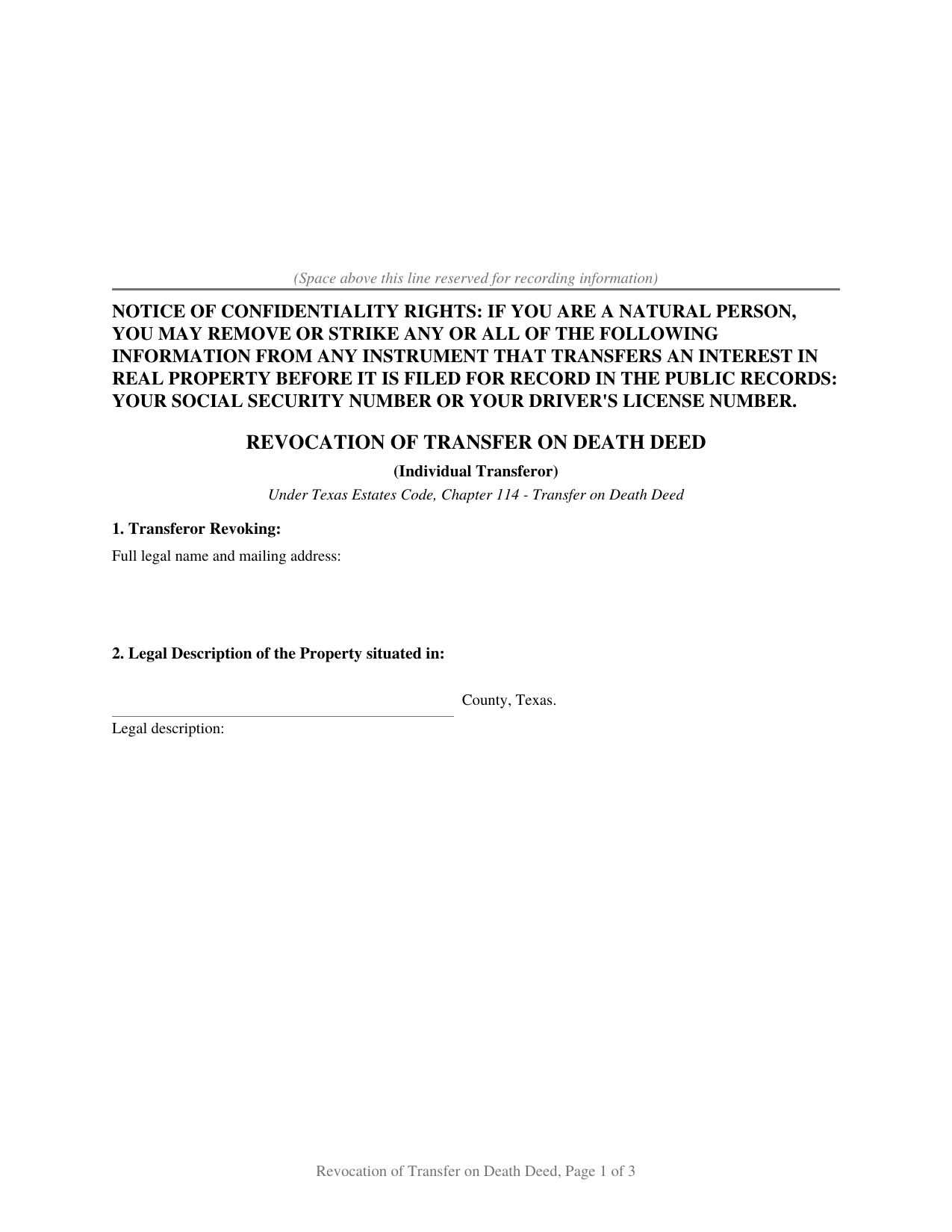
Dallam County Revocation of Transfer on Death Deed (Individual) Form
Fill in the blank Revocation of Transfer on Death Deed (Individual) form formatted to comply with all Texas recording and content requirements.
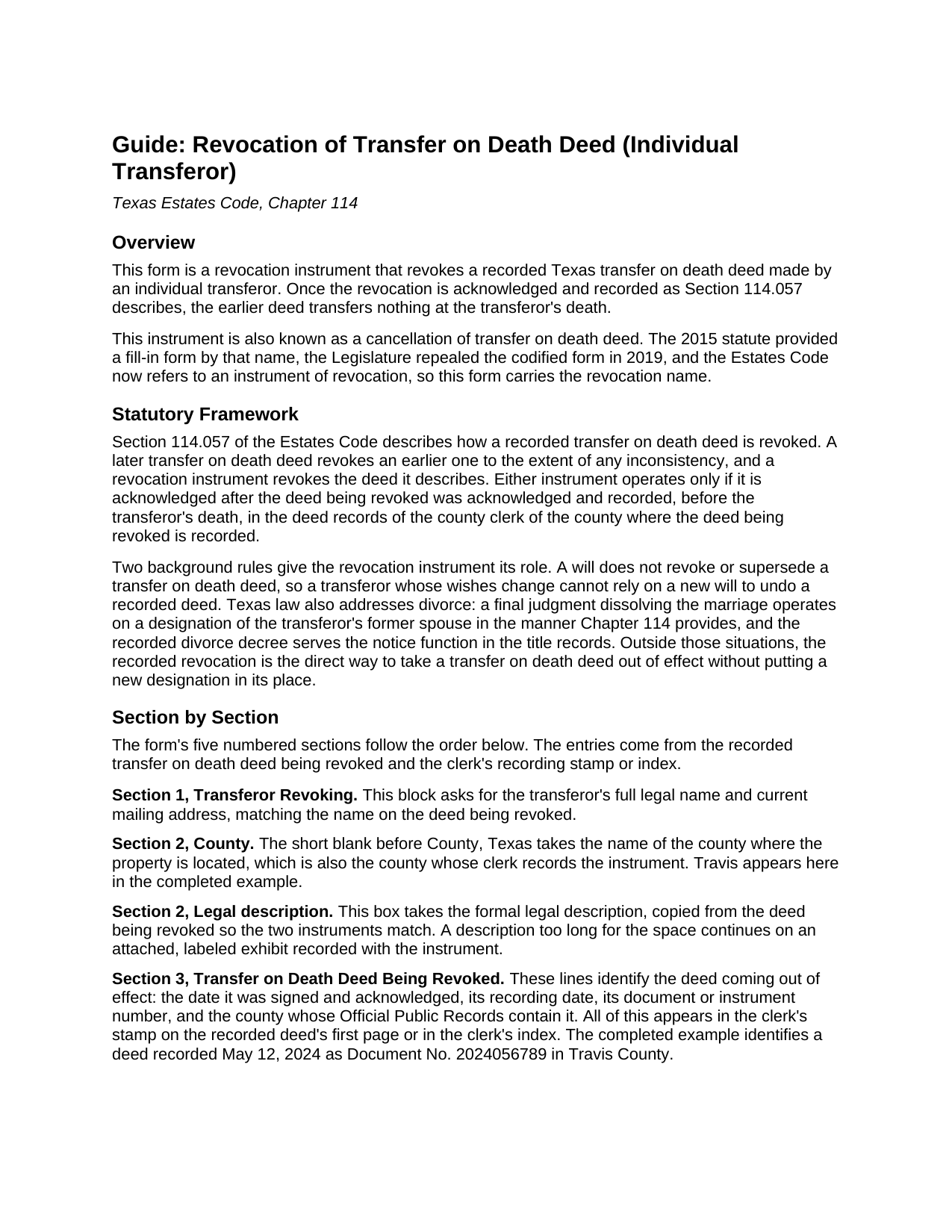
Dallam County Revocation of Transfer on Death Deed (Individual) Guide
Line by line guide explaining every blank on the Revocation of Transfer on Death Deed (Individual) form.
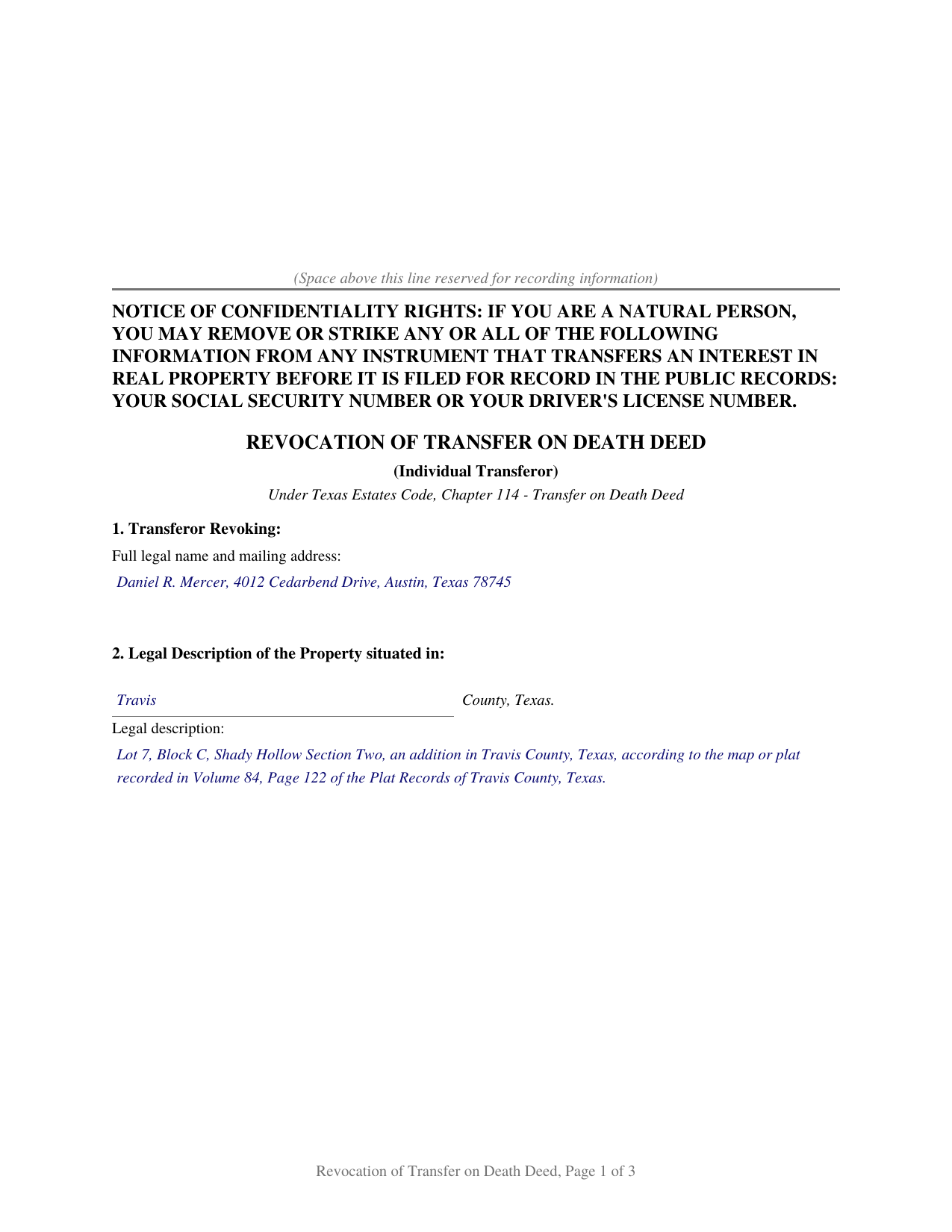
Dallam County Completed Example of the Revocation of Transfer on Death Deed (Individual) Document
Example of a properly completed Texas Revocation of Transfer on Death Deed (Individual) document for reference.
All 3 documents above included • One-time purchase • No recurring fees
Immediate Download • Secure Checkout
Additional Texas and Dallam County documents included at no extra charge:
Where to Record Your Documents
Dallam County Clerk
Dalhart, Texas 79022
Hours: Monday - Friday 8:30 am - 5:00 pm
Phone: (806) 244-4751
Recording Tips for Dallam County:
- Bring your driver's license or state-issued photo ID
- Ensure all signatures are in blue or black ink
- Ask if they accept credit cards - many offices are cash/check only
- Check that your notary's commission hasn't expired
- Documents must be on 8.5 x 11 inch white paper
Cities and Jurisdictions in Dallam County
Properties in any of these areas use Dallam County forms:
- Dalhart
- Kerrick
- Texline
Hours, fees, requirements, and more for Dallam County
How do I get my forms?
Forms are available for immediate download after payment. The Dallam County forms will be in your account ready to download to your computer. An account is created for you during checkout if you don't have one. Forms are NOT emailed.
Are these forms guaranteed to be recordable in Dallam County?
Yes. Our form blanks are guaranteed to meet or exceed the applicable formatting requirements used for recording in Dallam County, including margin requirements, font requirements, and other layout standards. This guarantee applies to formatting, not to the legal sufficiency of information entered by the user or the suitability of a form for a particular transaction.
Can I reuse these forms?
Yes. You can reuse the forms for your personal use. For example, if you have multiple properties in Dallam County you only need to order once.
What do I need to use these forms?
The forms are PDFs that you fill out on your computer. The free Adobe Acrobat Reader is recommended, and most PDF apps also work. You do NOT enter your property information online - you download the blank forms and complete them privately on your own computer.
Are there any recurring fees?
No. This is a one-time purchase. Nothing to cancel, no memberships, no recurring fees.
How much does it cost to record in Dallam County?
Recording fees in Dallam County vary. Contact the recorder's office at (806) 244-4751 for current fees.
Questions answered? Let's get started!
A Texas transfer on death deed is revocable for the owner's entire life, but revoking one takes a recorded instrument, not a new will and not a note in a drawer. This form prepares the revocation instrument that Section 114.057 of the Texas Estates Code describes, for a deed made by a single transferor. The same instrument is also commonly called a cancellation of transfer on death deed.
How Revocation Works in Texas
Section 114.057 recognizes two recorded paths: a new transfer on death deed that revokes an earlier one to the extent of any inconsistency, and a separate revocation instrument that revokes the deed it describes. A will does not revoke or supersede a transfer on death deed, so a recorded deed left in place controls over a later will that says something different.
The revocation carries its own timing rules. It operates only if it is acknowledged after the deed being revoked was acknowledged, and recorded before the transferor's death in the deed records of the county where the deed being revoked is recorded. A signed revocation left in a drawer at the owner's death revokes nothing, and the form states these requirements in capital letters above the signature line.
What the Form Asks For
The revocation identifies the transferor, the property by county and formal legal description, and the deed being revoked by its date, recording date, document or instrument number, and recording county, all taken from the clerk's stamp on the recorded deed or the clerk's online index. The guide shows where each item appears, and the completed example documents a realistic revocation from start to finish.
What a Revocation Does and Leaves in Place
A revocation takes the deed out of effect without putting a new designation in its place, so the property returns to passing under the owner's will or by intestacy. A new transfer on death deed naming different beneficiaries is the other recorded path, and it revokes an inconsistent earlier deed on its own. The guide describes both paths.
What Is Included
- The blank form as a fillable PDF, completed on screen or printed and filled in by hand
- A plain language guide covering every numbered section, what each blank asks, and where the information comes from
- A completed example showing the whole document filled in for a realistic Texas fact pattern
Texas Recording Compliance
The document is formatted for Texas recording standards: letter size pages within the dimensions of Local Government Code Section 191.007, the notice of confidentiality rights required by Property Code Section 11.008 in 12 point boldfaced capitals at the top of the first page, and reserved space on page one for the county clerk's recording stamp. A separate instructions page at the front of the file, not part of the recorded instrument, explains how an entry that outgrows its space continues on a recorded exhibit page. Senate Bill 16, enacted in 2025, also requires a person who presents a document in person for filing in the real property records to present a photo identification to the county clerk, and the guide covers that step in its recording section.
Related Texas Forms
This form pairs with the Texas Transfer on Death Deed (Individual). A deed made by joint owners with right of survivorship follows a stricter signing rule and is revoked with the Texas Revocation of Transfer on Death Deed (Joint Owners).
Important: Your property must be located in Dallam County to use these forms. Documents should be recorded at the county recording office listed above.
This Revocation of Transfer on Death Deed (Individual) meets all recording requirements specific to Dallam County.
Our Promise
The documents you receive here are guaranteed to meet or exceed the applicable Dallam County recording format requirements. If there is a rejection caused by our formatting, we will correct the issue or refund your payment. This guarantee applies to document formatting only and does not extend to information entered by the user, the selection of the form, or the legal effect of the completed document.
Save Time and Money
Get your Dallam County Revocation of Transfer on Death Deed (Individual) form done right the first time with Deeds.com Uniform Conveyancing Blanks. At Deeds.com, we understand that your time and money are valuable resources, and we don't want you to face a penalty fee or rejection imposed by a county recorder for submitting nonstandard documents. We constantly review and update our forms to meet rapidly changing state and county recording requirements for roughly 3,500 counties and local jurisdictions.
4.8 out of 5 - ( 4,823 Reviews )
Debra K. 5 out of 5 stars
Very happy with forms downloaded. Well worth the price. Could not find them anywhere else on the web. Also had easy to understand instructions and a demo form as a guide
Thank you Debra, we appreciate your feedback. Have a wonderful day!
Heidi S. 5 out of 5 stars
I had prompt service thank you
Thank you!
Joanne W. 5 out of 5 stars
I was very pleased to find this service, as (another website) charges about $40 for the same service, so yours was a bargain.
Thank you!
randall a. 4 out of 5 stars
As advertised. good value.
Thank you for your feedback. We really appreciate it. Have a great day!
Rebecca M. 5 out of 5 stars
I found the process of uploading documentation / deeds simple and easy. Will use this service again!
Thank you for your positive words! We’re thrilled to hear about your experience.
Mary G. 5 out of 5 stars
Deeds.com was a fast and easy site to use the staff answered my questions online efficiently
Thank you!
ROBIN C. 5 out of 5 stars
The process was very easy but I did not realize before I paid to get this form , that I could have gotten it free from Tulsa county clerks office. Other than that, it was fine.
Thank you for the honest feedback, Robin, and we're glad the process was easy for you. You're right that the Tulsa County Clerk publishes a free transfer on death deed form, and we'd never want anyone to feel they overpaid. Our version isn't that same blank, though: it adds an alternate beneficiary designation so the property still passes as you intend if your first choice doesn't survive you, it's built to handle one or two owners, and it comes with a plain-language guide and a completed example. We appreciate your business.
Martin B. 5 out of 5 stars
Excellent Detailed and clear Easy to use
We appreciate your business and value your feedback. Thank you. Have a wonderful day!
Donald H. 5 out of 5 stars
EXCELLENT,,super good. Quick & easy
Thank you!
Sarjit K. 5 out of 5 stars
excellent
Thank you!
Dean S. 5 out of 5 stars
Couldn't be happier, great documents, easy to understand and complete.
We appreciate your business and value your feedback. Thank you. Have a wonderful day!
Richard E. 4 out of 5 stars
Very easy. I copied each doc separately. Is there a way to copy the all docs at once into a folder? Thanks for being there. Rich
Thank you for the feedback Richard. Currently there is no way to download all of the documents at once but we'll definitely look into it. Have a great day!
Justin H. 1 out of 5 stars
Couldn't pull a simple deed for a legal description.
Thank you for your feedback Justin. We do hope that you were able to find something more suitable to your needs elsewhere. Have a wonderful day.
Eric G. 3 out of 5 stars
Need to offer option to download ALL forms as a single (bookmarked) PDF, rather than as separates... Quite inefficient as is.
Thank you for your feedback. We really appreciate it. Have a great day!
Nancy B. 5 out of 5 stars
Very user-friendly. Looks like everything I needed in one place. Great job.
We appreciate your business and value your feedback. Thank you. Have a wonderful day!