Texas Revocation of Transfer on Death Deed (Individual)
County Specific Legal Forms Validated as recently as October 15, 2026 by our Forms Development Team
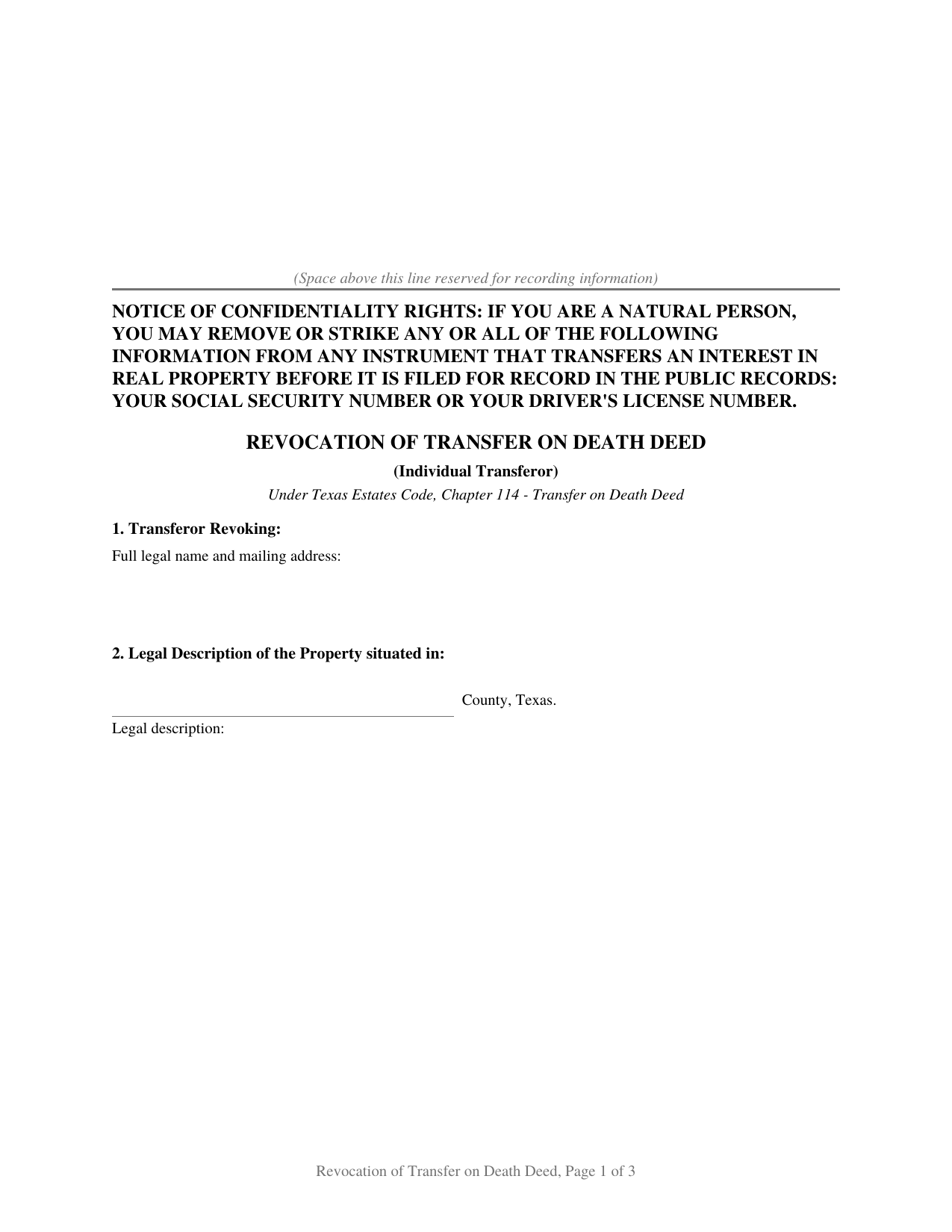
About the Texas Revocation of Transfer on Death Deed (Individual)
How to Use This Form
- Select your county from the list
- Download the county-specific form
- Fill in the required information
- Have the document notarized if required
- Record with your county recorder's office
What Others Like You Are Saying
"Amazing fast service. From the U.K. I was unable to get a check in U.S. dollars. This solved my prob…"
"User friendly website and deeds are very easy to maneuver. I'm very happy with everything Deeds.com …"
"This is so amazing and I truly thank you for what I needed for my documents. This is a great company…"
"Excellent and easy process to use the online fill in the blank sections, especially when you provide…"
"So very easy to follow & the cost of the packet was reasonable."
4.8/5 from 4,828 reviews. Read all
When one Texas property owner recorded a transfer on death deed alone, that same owner alone can take it back, and the instrument that does it is short: one transferor, one signature, one acknowledgment certificate. This form prepares that instrument of revocation under Section 114.057 of the Texas Estates Code for a TOD deed that one person signed by themselves. The document is known to many as a cancellation of transfer on death deed, the title the repealed 2015 statutory form carried.
The acknowledgment date is the clock
Section 114.057 does not ask whether the revocation was signed after the deed. It asks whether the revocation was acknowledged after the acknowledgment of the deed being revoked, so the form's third section collects the date of the deed as signed and acknowledged beside its recording date and instrument number. The second condition is recording: the revocation operates only if it reaches the deed records of the county where the original deed is recorded before the transferor dies. The form prints both conditions in capital letters above the signature line, because a signed revocation found in a drawer after death changes nothing.
One transferor, revoking the whole deed
The form recites exactly one transferor and identifies that person as the sole transferor under the deed being revoked. It revokes the deed in its entirety, every beneficiary and every alternate, rather than editing a single designation; the statute allows an instrument to revoke part of a deed, but a partial revocation depends on drafting this form does not supply. The operative paragraph recites the capacity standard of Section 114.054, the capacity required to make a contract, and states that the transferor acts personally. One signature block and one acknowledgment certificate, in the natural person short form of Civil Practice and Remedies Code Section 121.008, follow.
An owner whose named beneficiary has died, an owner who has moved the property into a different estate plan, and an owner who has changed course about who takes the home all present the single-transferor pattern this instrument recites. The form is not set up as a revocation by joint owners with right of survivorship, where the statute makes every living owner's joinder the condition, nor as a revocation by one of two spouses who signed a community property deed together, where one spouse's revocation reaches only that spouse's interest. Those deeds carry two transferors; this instrument recites one, and asks for no marital status.
What a will cannot do, and what a new deed can
Section 114.057(b) provides that a will may not revoke or supersede a transfer on death deed, so a later will that leaves the home to someone else loses to the recorded beneficiary deed. Two recorded instruments qualify instead. A later transfer on death deed revokes an earlier one to the extent the two are inconsistent, and an instrument of revocation like this one clears the designation without naming a replacement, so that after recording the property passes under the owner's will or by intestacy unless a new deed is recorded before death. Divorce travels its own route under Section 114.057(c): a final decree revokes the deed as to a former spouse once notice of the judgment is recorded before the transferor's death, and reaches no other beneficiary.
Drawn for the Texas county clerk
Texas attaches a double filing fee to a nonconforming page rather than refusing it, so the form is drawn inside Local Government Code Section 191.007 from the start: letter size, 12 point body text well above the 8 point minimum, an identifying heading at the top of page one, and a reserved band for the clerk's file stamp. The Property Code Section 11.008 notice of confidentiality rights heads the first page in bold capitals, and because a revocation names no grantee, the grantee address rule that raises the fee on an ordinary deed has nothing to attach to. An instructions page at the front of the PDF, removed before recording, covers how an entry that outgrows its box continues on a recorded exhibit page, and the guide describes the in-person photo identification step Senate Bill 16 added at the recording counter in December 2025.
The package contains the revocation as a fillable PDF, a completed example showing a Tarrant County transferor revoking a 2024 deed, and a plain language guide to each numbered section, the acknowledgment, and recording. The form, the example, and the guide describe the instrument and its statutes in general terms and are not legal advice.
Important: County-Specific Forms
Our revocation of transfer on death deed (individual) forms are specifically formatted for each of the 254 counties in Texas.
After selecting your county, you'll receive forms that meet all local recording requirements, ensuring your documents will be accepted without delays or rejection fees.