Hunt County Transfer on Death Deed (Community Property, Individual Beneficiaries) Form
Last validated October 15, 2026 by our Forms Development TeamFormatted for recording in Hunt County, for property anywhere in the county: rural and unincorporated areas as well as Caddo Mills, Campbell, Celeste, Commerce, Greenville, Lone Oak, Merit, Quinlan and 1 more.
- 3 documents included
- Immediate PDF download
- Formatting guarantee
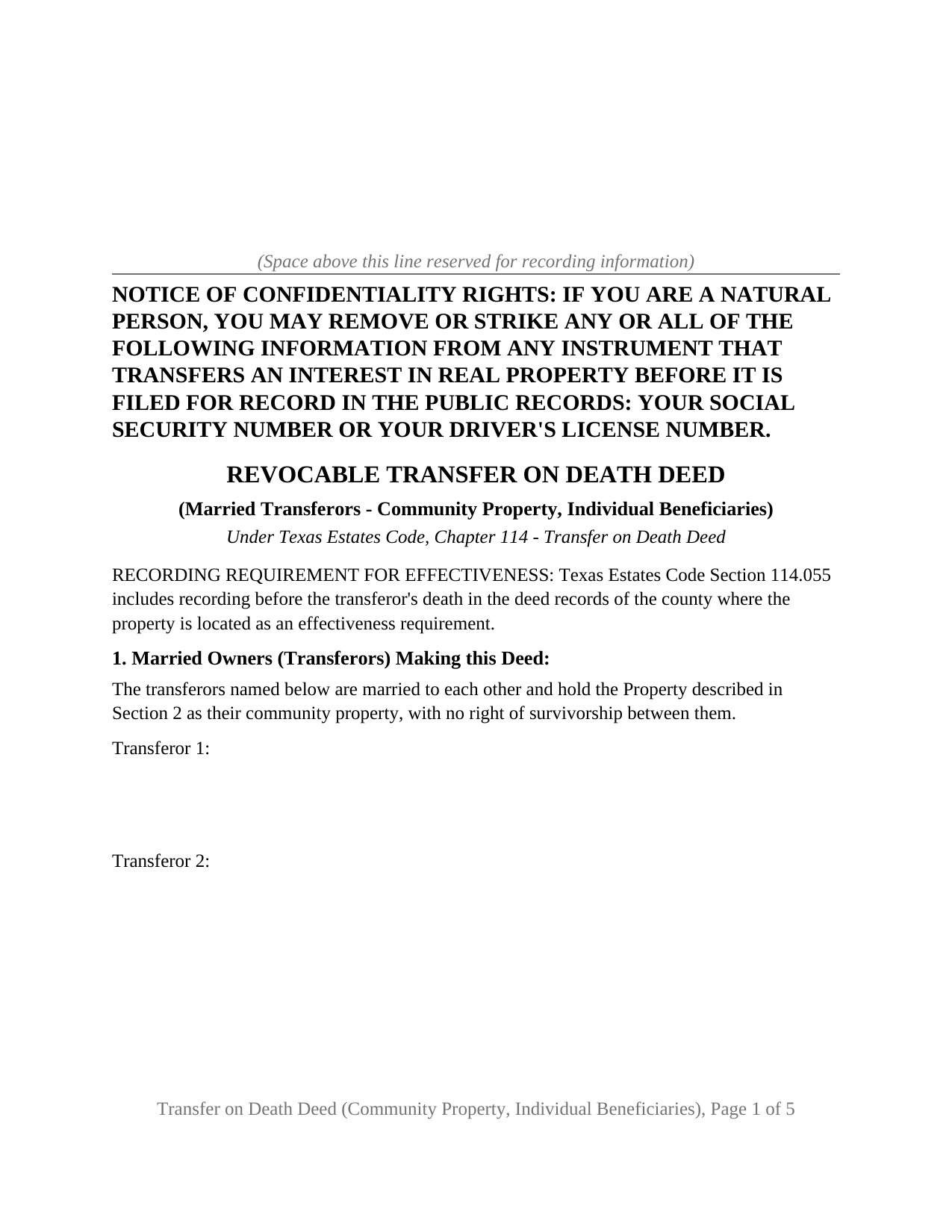
Hunt County Transfer on Death Deed (Community Property, Individual Beneficiaries) Form
Fill in the blank Transfer on Death Deed (Community Property, Individual Beneficiaries) form formatted to comply with all Texas recording and content requirements.
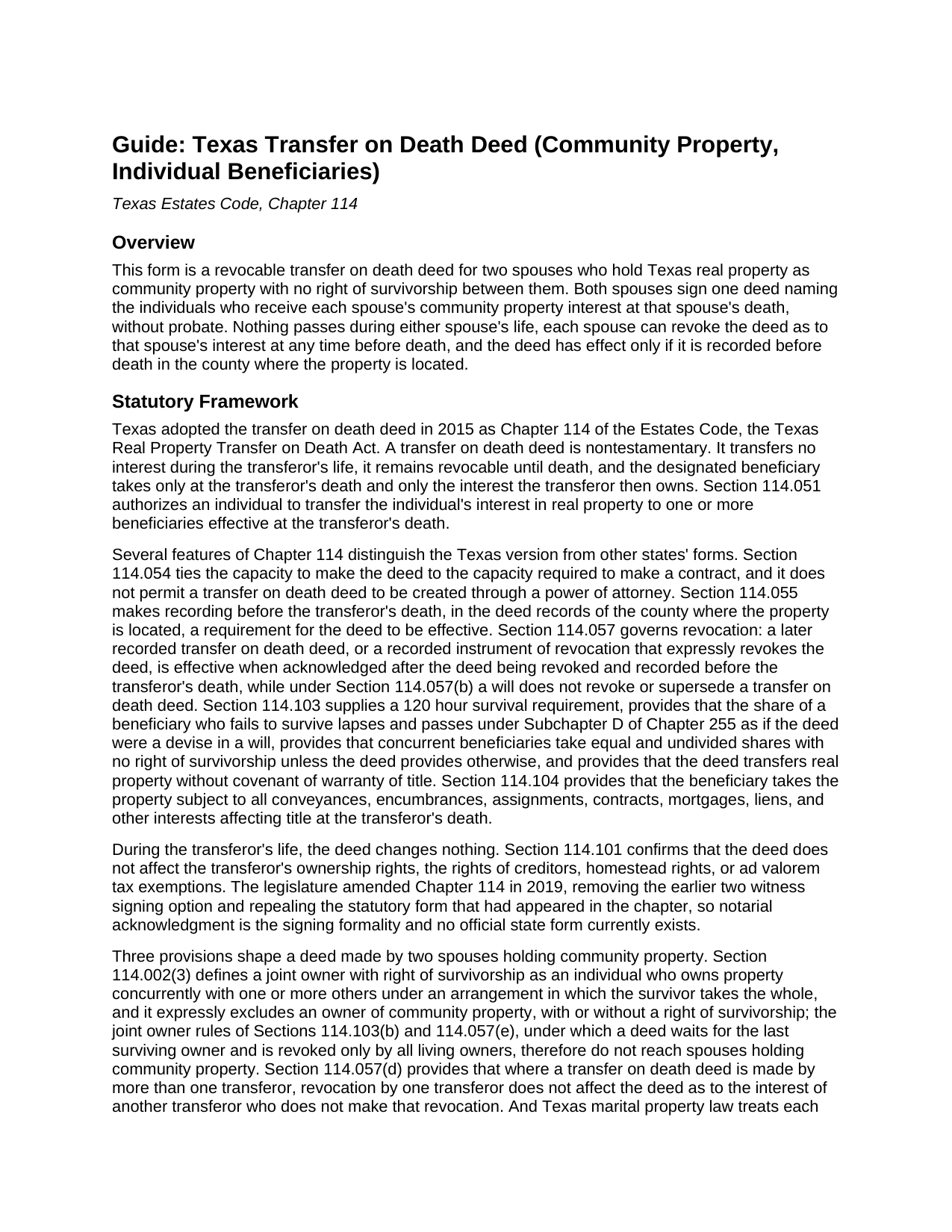
Hunt County Transfer on Death Deed (Community Property, Individual Beneficiaries) Guide
Line by line guide explaining every blank on the Transfer on Death Deed (Community Property, Individual Beneficiaries) form.
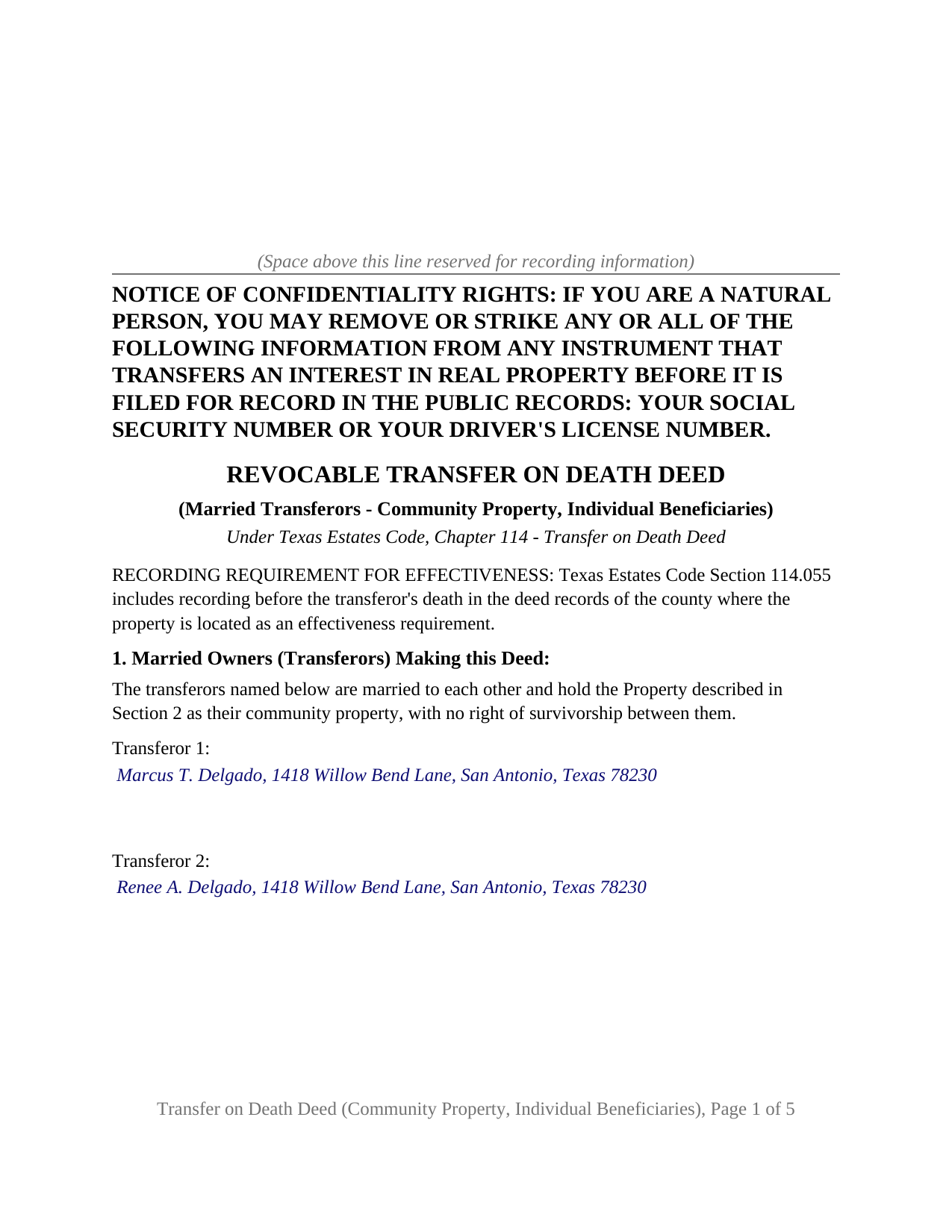
Hunt County Completed Example of the Transfer on Death Deed (Community Property, Individual Beneficiaries) Document
Example of a properly completed Texas Transfer on Death Deed (Community Property, Individual Beneficiaries) document for reference.
All 3 documents above included • One-time purchase • No recurring fees
Immediate Download • Secure Checkout
Additional Texas and Hunt County documents included at no extra charge:
Where to Record Your Documents
Hunt County Clerk
Greenville, Texas 75401
Hours: Monday - Friday 8:00am - 4:30pm
Phone: (903) 408-4130
Recording Tips for Hunt County:
- Bring your driver's license or state-issued photo ID
- Ensure all signatures are in blue or black ink
- Verify all names are spelled correctly before recording
- White-out or correction fluid may cause rejection
- Ask about their eRecording option for future transactions
Cities and Jurisdictions in Hunt County
Properties in any of these areas use Hunt County forms:
- Caddo Mills
- Campbell
- Celeste
- Commerce
- Greenville
- Lone Oak
- Merit
- Quinlan
- Wolfe City
Hours, fees, requirements, and more for Hunt County
How do I get my forms?
Forms are available for immediate download after payment. The Hunt County forms will be in your account ready to download to your computer. An account is created for you during checkout if you don't have one. Forms are NOT emailed.
Are these forms guaranteed to be recordable in Hunt County?
Yes. Our form blanks are guaranteed to meet or exceed the applicable formatting requirements used for recording in Hunt County, including margin requirements, font requirements, and other layout standards. This guarantee applies to formatting, not to the legal sufficiency of information entered by the user or the suitability of a form for a particular transaction.
Can I reuse these forms?
Yes. You can reuse the forms for your personal use. For example, if you have multiple properties in Hunt County you only need to order once.
What do I need to use these forms?
The forms are PDFs that you fill out on your computer. The free Adobe Acrobat Reader is recommended, and most PDF apps also work. You do NOT enter your property information online - you download the blank forms and complete them privately on your own computer.
Are there any recurring fees?
No. This is a one-time purchase. Nothing to cancel, no memberships, no recurring fees.
How much does it cost to record in Hunt County?
Recording fees in Hunt County vary. Contact the recorder's office at (903) 408-4130 for current fees.
Questions answered? Let's get started!
Two Texas spouses who hold their real estate as community property can sign one transfer on death deed that operates twice: at each spouse's death, that spouse's community property half passes to the individuals named in the deed, outside probate. This Texas transfer on death deed form is built for that configuration under Chapter 114 of the Texas Estates Code, for a married couple holding community property with no right of survivorship between them and naming individual beneficiaries.
A Deed That Operates at Each Spouse's Death
Texas community property is owned in undivided halves, and nothing in the community property system sends the deceased spouse's half to the survivor automatically; a will or intestacy ordinarily moves it. When the first spouse dies, that spouse's half transfers to the named beneficiaries, who then hold it together with the surviving spouse. The surviving spouse's half is untouched: it stays the survivor's property and transfers under the same deed only at the survivor's death. The form says so in its operative section, and its survival requirement is measured against the spouse whose interest is passing, so a beneficiary qualifies at each death by surviving that spouse by 120 hours.
What This Configuration Recites
The form recites exactly two transferors who are married to each other and hold the property as their community property with no right of survivorship between them; both spouses sign, each over a separate notary certificate, and each spouse's community interest transfers at the death of the spouse who owns it. The deed also recites that every designated beneficiary is an individual, a natural person named with a mailing address, with the same primary and alternate designation applying to each spouse's half. Chapter 114 supports this shape directly: Section 114.002(3) keeps community property outside the statutory joint owner definition, so the chapter's last surviving owner rule does not apply to these spouses, and Section 114.057(d) lets one of two transferors revoke as to that transferor's own interest without disturbing the other's designation. The form prints that rule in capital letters beside the statement that it creates no survivorship between the spouses.
Spouses who hold their home as plain community property and send each half directly to the same children, and a blended family in which each spouse's half goes by name to the same individuals rather than through the survivor's estate, present the two spouse pattern this deed recites. The form is not set up as a one transferor designation, as a designation that waits for the second death under a survivorship agreement, or as a designation in favor of a trust or an entity; each of those is a different configuration of the Texas TOD deed.
The Surviving Spouse and the Homestead
A first death under this deed leaves the surviving spouse and the beneficiaries as co-owners of the property, which raises the question of who lives there. Texas answers it in the constitution. Article XVI, Section 52 gives the surviving spouse the right to occupy the homestead for life, a right that arises automatically at death and operates independently of any deed. Beneficiaries who take the deceased spouse's half under this form take it subject to that occupancy right for as long as the survivor elects to use or occupy the property as a homestead. During life the deed changes nothing about homestead status or tax exemptions, as Section 114.101 provides.
Recording Before Either Death
Recording is an effectiveness requirement under Section 114.055: the deed must be recorded before the transferor's death in the deed records of the county where the property is located. Because this deed carries two designations, recording promptly after both spouses sign, while both are living, places both designations of record. The notice of confidentiality rights required by Property Code Section 11.008 appears at the top of the first page in 12 point boldfaced capitals. A beneficiary deed of this kind transfers each spouse's interest without covenant of warranty of title under Section 114.103(d), and the beneficiaries take subject to any mortgage or other matter affecting title at the transferor's death.
The package contains the fillable form as a PDF, completed on screen or printed and completed by hand, a completed example filled in for a realistic Texas fact pattern, and a plain language guide that walks through every numbered section, the community property rules the deed relies on, and the recording process. This description and the guide describe the form and the governing statutes in general terms; they are not legal advice.
Important: Your property must be located in Hunt County to use these forms. Documents should be recorded at the county recording office listed above.
This Transfer on Death Deed (Community Property, Individual Beneficiaries) meets all recording requirements specific to Hunt County.
Our Promise
The documents you receive here are guaranteed to meet or exceed the applicable Hunt County recording format requirements. If there is a rejection caused by our formatting, we will correct the issue or refund your payment. This guarantee applies to document formatting only and does not extend to information entered by the user, the selection of the form, or the legal effect of the completed document.
Save Time and Money
Get your Hunt County Transfer on Death Deed (Community Property, Individual Beneficiaries) form done right the first time with Deeds.com Uniform Conveyancing Blanks. At Deeds.com, we understand that your time and money are valuable resources, and we don't want you to face a penalty fee or rejection imposed by a county recorder for submitting nonstandard documents. We constantly review and update our forms to meet rapidly changing state and county recording requirements for roughly 3,500 counties and local jurisdictions.
4.8 out of 5 - ( 4,828 Reviews )
Scott M. 5 out of 5 stars
Complete Package don't spend good money for a title co. to do this
Thank you for your feedback. We really appreciate it. Have a great day!
Charlotte H. 5 out of 5 stars
Easy to use and download. Everything we needed with a guide for accuracy.
Thank you!
Cynthia N. 5 out of 5 stars
great service, quick and easy!
Thank you!
Eldridge S. 5 out of 5 stars
very pleased to attain this important document
We appreciate your business and value your feedback. Thank you. Have a wonderful day!
Robin G. 5 out of 5 stars
Very responsive and helpful.
Thank you!
kevin d. 5 out of 5 stars
the quitclaim form worked well with the Nevada Recorders office. Tried other vendors, theirs were rejected.
We appreciate your business and value your feedback. Thank you. Have a wonderful day!
Cindy A. 5 out of 5 stars
Easy to understand and use. However, need to add line for phone number for preparer - Thanks
Thank you for your feedback. We really appreciate it. Have a great day!
Kyle K. 5 out of 5 stars
Deeds is extremely helpful and cost effective for small and large businesses. Saves me time to do more valuable tasks.
Thank you for your feedback. We really appreciate it. Have a great day!
Delba O. 5 out of 5 stars
This was the easiest process ever. Thank you for making this so easy. No hassle, just upload your docs, pay the invoice and done. It didn't even take 2 business days to get my deed recorded. If I ever need to record anything I will definitely use your services again.
We appreciate your business and value your feedback. Thank you. Have a wonderful day!
Dee W. 5 out of 5 stars
Easy process! Submit payment, fill out forms using the document guide provided, and print!
We appreciate your business and value your feedback. Thank you. Have a wonderful day!
Tyler B. 5 out of 5 stars
Great!
Thank you!
Shirley W. 5 out of 5 stars
I found the form easy to file out. But everything else was confusing with very little direction and help.
Thank you!
Kimberly C. 5 out of 5 stars
Very straight forward easy to use. No need to hunt for the information or forms you ate looking for, every thing is right there just click on the link and voila!
Thank you for your feedback. We really appreciate it. Have a great day!
Charlie T. 5 out of 5 stars
I really like the service and will be definitely be using it again to submit future deeds.
Thank you!
Laurie F. 5 out of 5 stars
I am so glad I found Deeds.com. You had exactly what I needed and made it easy to download. I have bookmarked you in the event of further inquiry. Thank you.
We appreciate your business and value your feedback. Thank you. Have a wonderful day!