Walker County Transfer on Death Deed (Community Property, Individual Beneficiaries) Form
Last validated November 6, 2026 by our Forms Development TeamFormatted for recording in Walker County, for property anywhere in the county: rural and unincorporated areas as well as Dodge, Huntsville, New Waverly, Riverside.
- 3 documents included
- Immediate PDF download
- Formatting guarantee
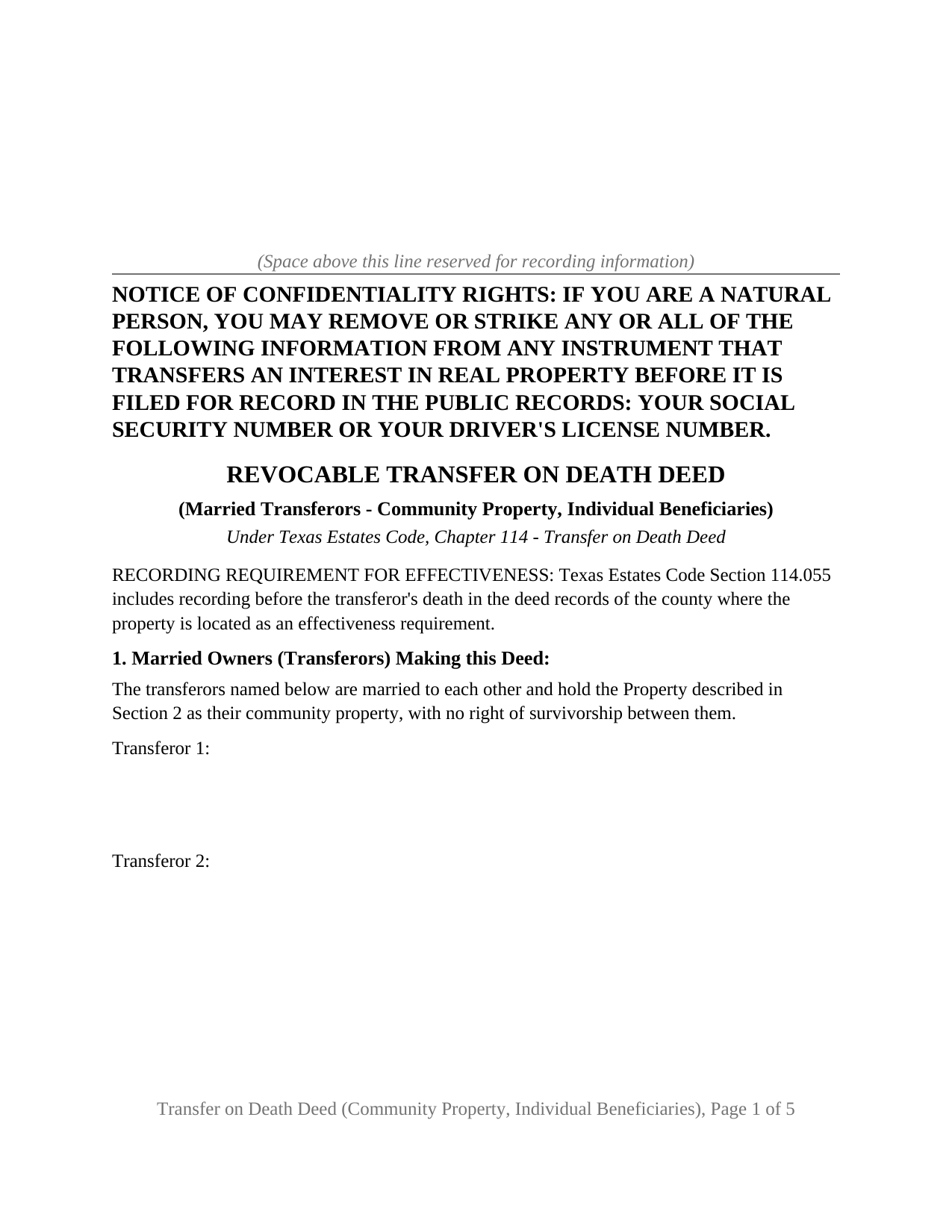
Walker County Transfer on Death Deed (Community Property, Individual Beneficiaries) Form
Fill in the blank Transfer on Death Deed (Community Property, Individual Beneficiaries) form formatted to comply with all Texas recording and content requirements.
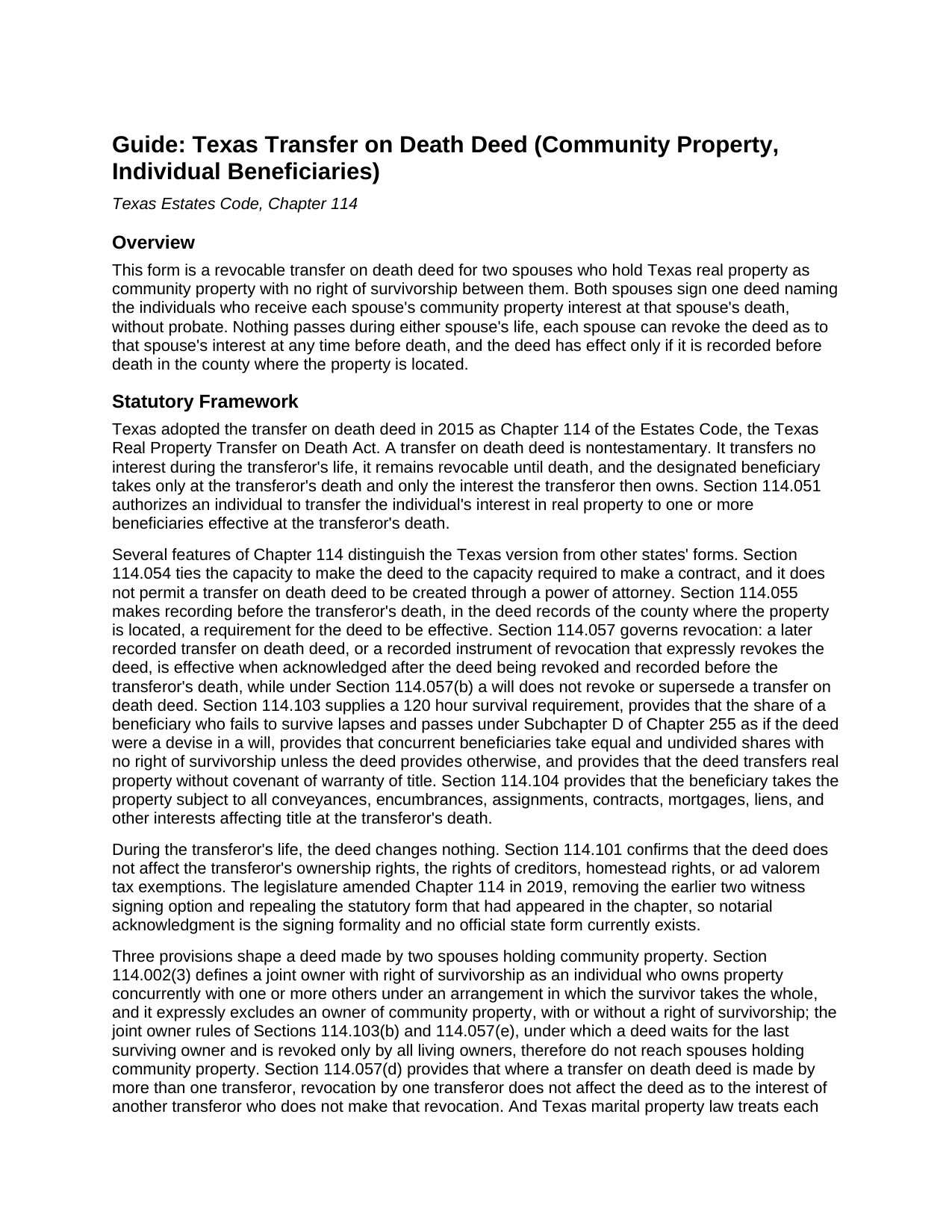
Walker County Transfer on Death Deed (Community Property, Individual Beneficiaries) Guide
Line by line guide explaining every blank on the Transfer on Death Deed (Community Property, Individual Beneficiaries) form.
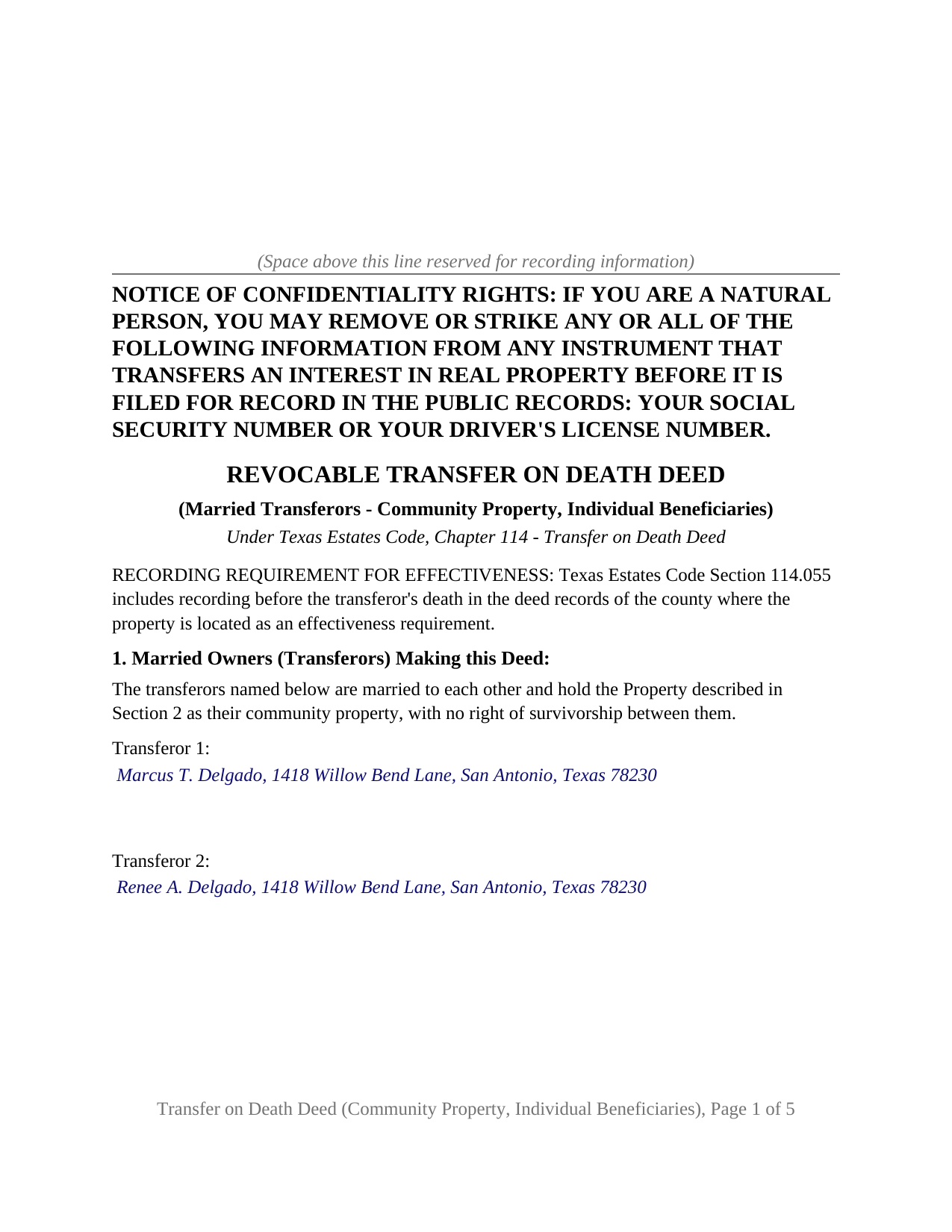
Walker County Completed Example of the Transfer on Death Deed (Community Property, Individual Beneficiaries) Document
Example of a properly completed Texas Transfer on Death Deed (Community Property, Individual Beneficiaries) document for reference.
All 3 documents above included • One-time purchase • No recurring fees
Immediate Download • Secure Checkout
Additional Texas and Walker County documents included at no extra charge:
Where to Record Your Documents
County Clerk: Recording Division
Huntsville, Texas 77320
Hours: Monday - Friday 8:00am - 12:00 & 1:00 - 4:30pm
Phone: (936) 436-4903
Recording Tips for Walker County:
- Bring your driver's license or state-issued photo ID
- Ensure all signatures are in blue or black ink
- Documents must be on 8.5 x 11 inch white paper
- Double-check legal descriptions match your existing deed
- Verify all names are spelled correctly before recording
Cities and Jurisdictions in Walker County
Properties in any of these areas use Walker County forms:
- Dodge
- Huntsville
- New Waverly
- Riverside
Hours, fees, requirements, and more for Walker County
How do I get my forms?
Forms are available for immediate download after payment. The Walker County forms will be in your account ready to download to your computer. An account is created for you during checkout if you don't have one. Forms are NOT emailed.
Are these forms guaranteed to be recordable in Walker County?
Yes. Our form blanks are guaranteed to meet or exceed the applicable formatting requirements used for recording in Walker County, including margin requirements, font requirements, and other layout standards. This guarantee applies to formatting, not to the legal sufficiency of information entered by the user or the suitability of a form for a particular transaction.
Can I reuse these forms?
Yes. You can reuse the forms for your personal use. For example, if you have multiple properties in Walker County you only need to order once.
What do I need to use these forms?
The forms are PDFs that you fill out on your computer. The free Adobe Acrobat Reader is recommended, and most PDF apps also work. You do NOT enter your property information online - you download the blank forms and complete them privately on your own computer.
Are there any recurring fees?
No. This is a one-time purchase. Nothing to cancel, no memberships, no recurring fees.
How much does it cost to record in Walker County?
Recording fees in Walker County vary. Contact the recorder's office at (936) 436-4903 for current fees.
Questions answered? Let's get started!
Two Texas spouses who hold their real estate as community property can sign one transfer on death deed that operates twice: at each spouse's death, that spouse's community property half passes to the individuals named in the deed, outside probate. This Texas transfer on death deed form is built for that configuration under Chapter 114 of the Texas Estates Code, for a married couple holding community property with no right of survivorship between them and naming individual beneficiaries.
A Deed That Operates at Each Spouse's Death
Texas community property is owned in undivided halves, and nothing in the community property system sends the deceased spouse's half to the survivor automatically; a will or intestacy ordinarily moves it. When the first spouse dies, that spouse's half transfers to the named beneficiaries, who then hold it together with the surviving spouse. The surviving spouse's half is untouched: it stays the survivor's property and transfers under the same deed only at the survivor's death. The form says so in its operative section, and its survival requirement is measured against the spouse whose interest is passing, so a beneficiary qualifies at each death by surviving that spouse by 120 hours.
What This Configuration Recites
The form recites exactly two transferors who are married to each other and hold the property as their community property with no right of survivorship between them; both spouses sign, each over a separate notary certificate, and each spouse's community interest transfers at the death of the spouse who owns it. The deed also recites that every designated beneficiary is an individual, a natural person named with a mailing address, with the same primary and alternate designation applying to each spouse's half. Chapter 114 supports this shape directly: Section 114.002(3) keeps community property outside the statutory joint owner definition, so the chapter's last surviving owner rule does not apply to these spouses, and Section 114.057(d) lets one of two transferors revoke as to that transferor's own interest without disturbing the other's designation. The form prints that rule in capital letters beside the statement that it creates no survivorship between the spouses.
Spouses who hold their home as plain community property and send each half directly to the same children, and a blended family in which each spouse's half goes by name to the same individuals rather than through the survivor's estate, present the two spouse pattern this deed recites. The form is not set up as a one transferor designation, as a designation that waits for the second death under a survivorship agreement, or as a designation in favor of a trust or an entity; each of those is a different configuration of the Texas TOD deed.
The Surviving Spouse and the Homestead
A first death under this deed leaves the surviving spouse and the beneficiaries as co-owners of the property, which raises the question of who lives there. Texas answers it in the constitution. Article XVI, Section 52 gives the surviving spouse the right to occupy the homestead for life, a right that arises automatically at death and operates independently of any deed. Beneficiaries who take the deceased spouse's half under this form take it subject to that occupancy right for as long as the survivor elects to use or occupy the property as a homestead. During life the deed changes nothing about homestead status or tax exemptions, as Section 114.101 provides.
Recording Before Either Death
Recording is an effectiveness requirement under Section 114.055: the deed must be recorded before the transferor's death in the deed records of the county where the property is located. Because this deed carries two designations, recording promptly after both spouses sign, while both are living, places both designations of record. The notice of confidentiality rights required by Property Code Section 11.008 appears at the top of the first page in 12 point boldfaced capitals. A beneficiary deed of this kind transfers each spouse's interest without covenant of warranty of title under Section 114.103(d), and the beneficiaries take subject to any mortgage or other matter affecting title at the transferor's death.
The package contains the fillable form as a PDF, completed on screen or printed and completed by hand, a completed example filled in for a realistic Texas fact pattern, and a plain language guide that walks through every numbered section, the community property rules the deed relies on, and the recording process. This description and the guide describe the form and the governing statutes in general terms; they are not legal advice.
Important: Your property must be located in Walker County to use these forms. Documents should be recorded at the county recording office listed above.
This Transfer on Death Deed (Community Property, Individual Beneficiaries) meets all recording requirements specific to Walker County.
Our Promise
The documents you receive here are guaranteed to meet or exceed the applicable Walker County recording format requirements. If there is a rejection caused by our formatting, we will correct the issue or refund your payment. This guarantee applies to document formatting only and does not extend to information entered by the user, the selection of the form, or the legal effect of the completed document.
Save Time and Money
Get your Walker County Transfer on Death Deed (Community Property, Individual Beneficiaries) form done right the first time with Deeds.com Uniform Conveyancing Blanks. At Deeds.com, we understand that your time and money are valuable resources, and we don't want you to face a penalty fee or rejection imposed by a county recorder for submitting nonstandard documents. We constantly review and update our forms to meet rapidly changing state and county recording requirements for roughly 3,500 counties and local jurisdictions.
4.8 out of 5 - ( 4,865 Reviews )
Sharon C. 4 out of 5 stars
I purchased a beneficiary deed form but some additional information was required by my county. I had to hand write a few changes, but otherwise the form worked well for me.
Your feedback means a lot to us. Thank you.
STACIA V. 4 out of 5 stars
I filled out the forms that were somewhat easy. I was surprised that it was recorded by the county recording office. I just hope that it really worked. I think it did. I will find out later this year.
Thank you!
dill h. 5 out of 5 stars
easy-peasy
We appreciate your business and value your feedback. Thank you. Have a wonderful day!
Betty B. 5 out of 5 stars
Thank you . I appreciate your assistance Once again thanks
Thank you!
Pam G. 5 out of 5 stars
Loved the ease of use, the very helpful instructions, and samples to go along with the documents I needed to create.
Your feedback is valuable to us and helps us improve. Thank you for sharing your thoughts!
Laurie K. 5 out of 5 stars
Very easy to use.
Thank you — we appreciate you taking the time to leave a review.
Jim H. 5 out of 5 stars
Well written form, and the guidance document and example supplied were very helpful.
Thank you!
Donald W. 5 out of 5 stars
Could not have been any easier to download the quit claim forms. The provided instructions and samples look to be helpful. Only have to set aside the time to fill out. Thanks
Thank you!
Stephen S. 5 out of 5 stars
This is awesome. Making sure not only that everything is worded correctly but also formatted correctly is great. Thank you.
Thank you for your feedback. We really appreciate it. Have a great day!
Shelby D. 1 out of 5 stars
Not very helpful since I am married and the example provided is for single person. Nevada homestead requires spouse to sign off on quit claim deed but no guidance provided as to where this acknowledgment is placed on template form. There should be example for married person as well. Had to use another service. Waste of $21.
Thank you for your feedback. We really appreciate it. Have a great day!
Cynthia H. 5 out of 5 stars
No review provided.
Thank you!
Ronald B. 5 out of 5 stars
Simple to use, download, fill-in and print.
We appreciate your business and value your feedback. Thank you. Have a wonderful day!
Jayne C. 5 out of 5 stars
It was very easy to navigate and find what I needed. Very happy with the app.
Thank you for your feedback. We really appreciate it. Have a great day!
David S. 3 out of 5 stars
I downloaded the quit claim deed form and saved it on my computer. I opened it with Adobe and filled it out. The space for the legal description was too small (2 lines only) which did not allow enough room for the long property description that I had.
Thank you for your feedback. We really appreciate it. Have a great day!
Alberta W. 5 out of 5 stars
Deeds.com was user-friendly, clear, specific and complete. I used the site to create and submit a Notice of Termination form, and was able to walk it to my local county court with no major issues. It worked out perfectly.
We appreciate your business and value your feedback. Thank you. Have a wonderful day!