Vermont Power of Attorney (Seller)
County Specific Legal Forms Validated as recently as September 17, 2026 by our Forms Development Team
About the Vermont Power of Attorney (Seller)
How to Use This Form
- Select your county from the list
- Download the county-specific form
- Fill in the required information
- Have the document notarized if required
- Record with your county recorder's office
What Others Like You Are Saying
"So far help has been good given some of the information you don't have as far as making corrections.…"
"I highly recommend this website. It was quick and easy with very helpful guides and examples! I am s…"
"Easy to use and very straight forward. Glad I used Deeds.com"
"The three people we dealt with were courteous and helpful."
"The form was very easy to fill out. The instructions were clear. Overall, a very user friendly produ…"
4.8/5 from 4,820 reviews. Read all
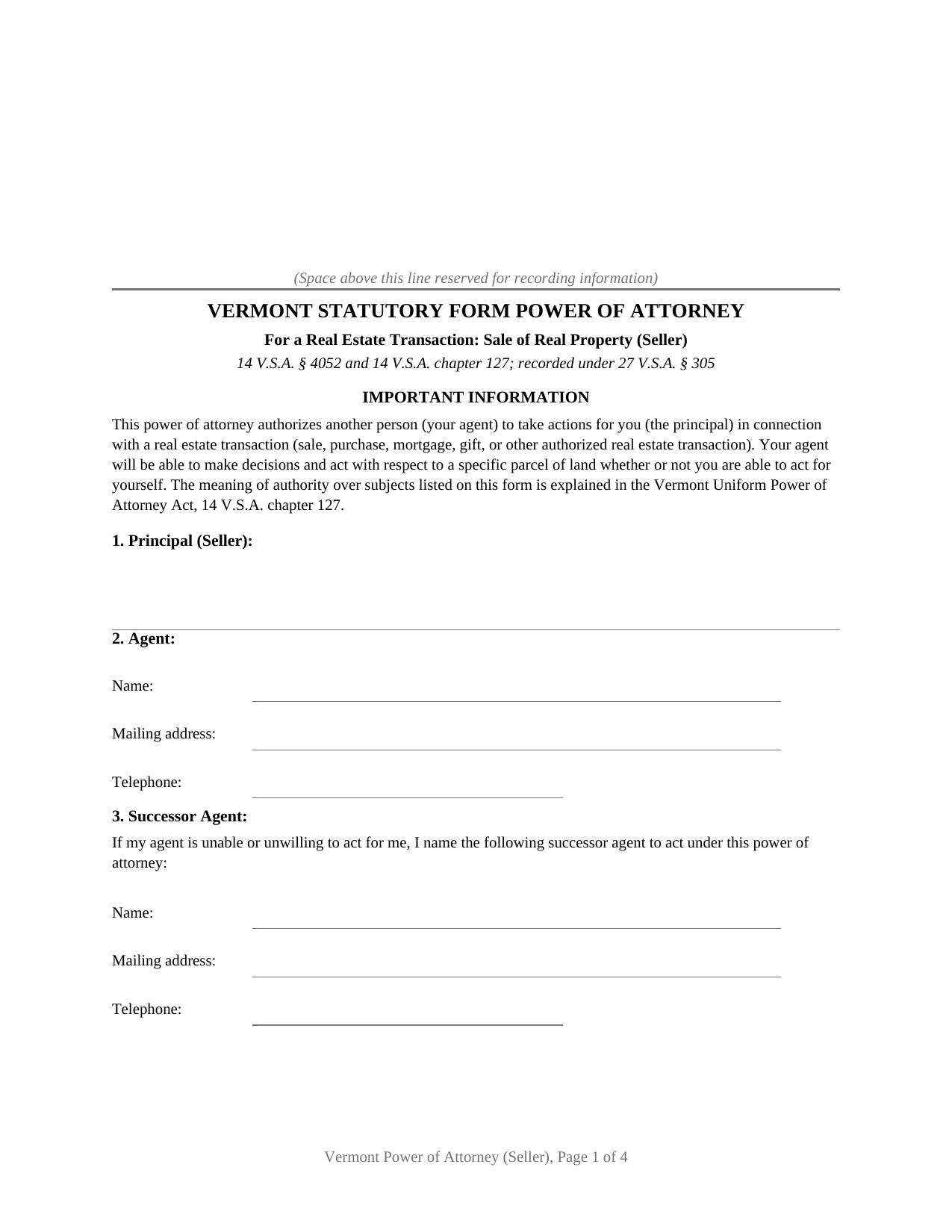
When the seller of a Vermont property cannot be at the closing table, the closing can still happen: Vermont law lets the seller appoint an agent, in a recorded power of attorney, to sign the deed and the closing papers in the seller's place. This fillable form is that instrument, a Vermont power of attorney for a real estate transaction built on the statutory short form in 14 V.S.A. § 4052 and completed for the sale of one described property by the principal as seller.
A statutory short form, not a general grant
The Vermont Uniform Power of Attorney Act, 14 V.S.A. chapter 127, adopted in 2023, publishes two fill-in forms: a general statutory form and a short form written for real estate transactions. A document substantially in the § 4052 short form confers the real property powers of 14 V.S.A. § 4034(2), (3), and (4), the statutory catalog that includes selling, conveying with or without covenants, releasing, and satisfying mortgages, together with the incidental powers of § 4033. The grant printed in this form follows the statutory wording and then names its transaction plainly: the sale of the described property by the principal as seller, including signing the deed of conveyance, signing the Vermont Property Transfer Tax Return, and receiving the sale proceeds on the principal's behalf.
The statutory design keeps the authority transaction-bound. The power commences when fully executed and continues until the real estate transaction for which it was given is complete, in the words the statute supplies. It is durable by default under 14 V.S.A. § 4004, so a principal's later incapacity does not strand a pending sale, and it ends at the principal's death, on revocation, and when the closing is done.
The seller configuration
The form recites exactly one principal, the record owner selling the property; one agent, sometimes called an attorney-in-fact; and an optional successor agent who acts when the first agent is unable or unwilling. Only the principal signs, before a notary public, and the form carries a single acknowledgment certificate in the wording the statutory form prescribes. An out-of-state owner selling a Vermont house, a seller traveling during the closing period, and an adult child handling a parent's sale present the pattern this instrument recites. Where two owners sell together, each owner grants a separate power of attorney, since each signature on the deed traces to its own recorded authority, and a married seller's homestead joinder rules stay on the deed itself, where 27 V.S.A. § 141 puts them.
Two statutory options ride the form, each dormant until the principal initials it: a delegation provision, and a provision permitting the agent to take title to the property. Left blank, the form grants neither, and the background rule of 14 V.S.A. § 4031(b) separately limits self-benefiting acts by agents outside the principal's immediate family.
Recorded where the deed records
Vermont records land instruments town by town, and 27 V.S.A. § 305 makes recording of the power of attorney part of the conveyance itself: the instrument is signed, acknowledged before a notary, and recorded in the same town or city land records that receive the deed. The statewide fee is $15.00 per page under 32 V.S.A. § 1671. The power of attorney transfers no title, so no Property Transfer Tax Return accompanies it; that return belongs to the deed the agent later signs. This limited power of attorney, often searched for as a real estate power of attorney or a POA to sell property, therefore does double duty: private authority for the closing, and a public land-record link in the chain of title.
The download package contains three pieces: the fillable power of attorney form, a completed example showing a plausible Windsor County sale, and a plain-language guide that walks through each section of the form, the signing formalities, and the town recording step. The materials describe Vermont law in general terms and are not legal advice; a Vermont attorney can apply these rules to a particular sale.
Important: County-Specific Forms
Our power of attorney (seller) forms are specifically formatted for each of the 14 counties in Vermont.
After selecting your county, you'll receive forms that meet all local recording requirements, ensuring your documents will be accepted without delays or rejection fees.