Wisconsin Certificate of Trust (Individual Trustee)
County Specific Legal Forms Validated as recently as November 20, 2026 by our Forms Development Team
About the Wisconsin Certificate of Trust (Individual Trustee)
How to Use This Form
- Select your county from the list
- Download the county-specific form
- Fill in the required information
- Have the document notarized if required
- Record with your county recorder's office
What Others Like You Are Saying
"Had the paperwork that I needed. Was a quick and easy transaction."
"I am quite pleased with this website. I was able to complete my task with relative ease thanks to al…"
"I thought this form was great and easy to complete but the instructions were unclear as to whether t…"
"Saved me 1-2 hours' time dictating. Will use again."
"The website is easy to maneuver and information needed was readily available. Thanks so much!"
4.8/5 from 4,862 reviews. Read all
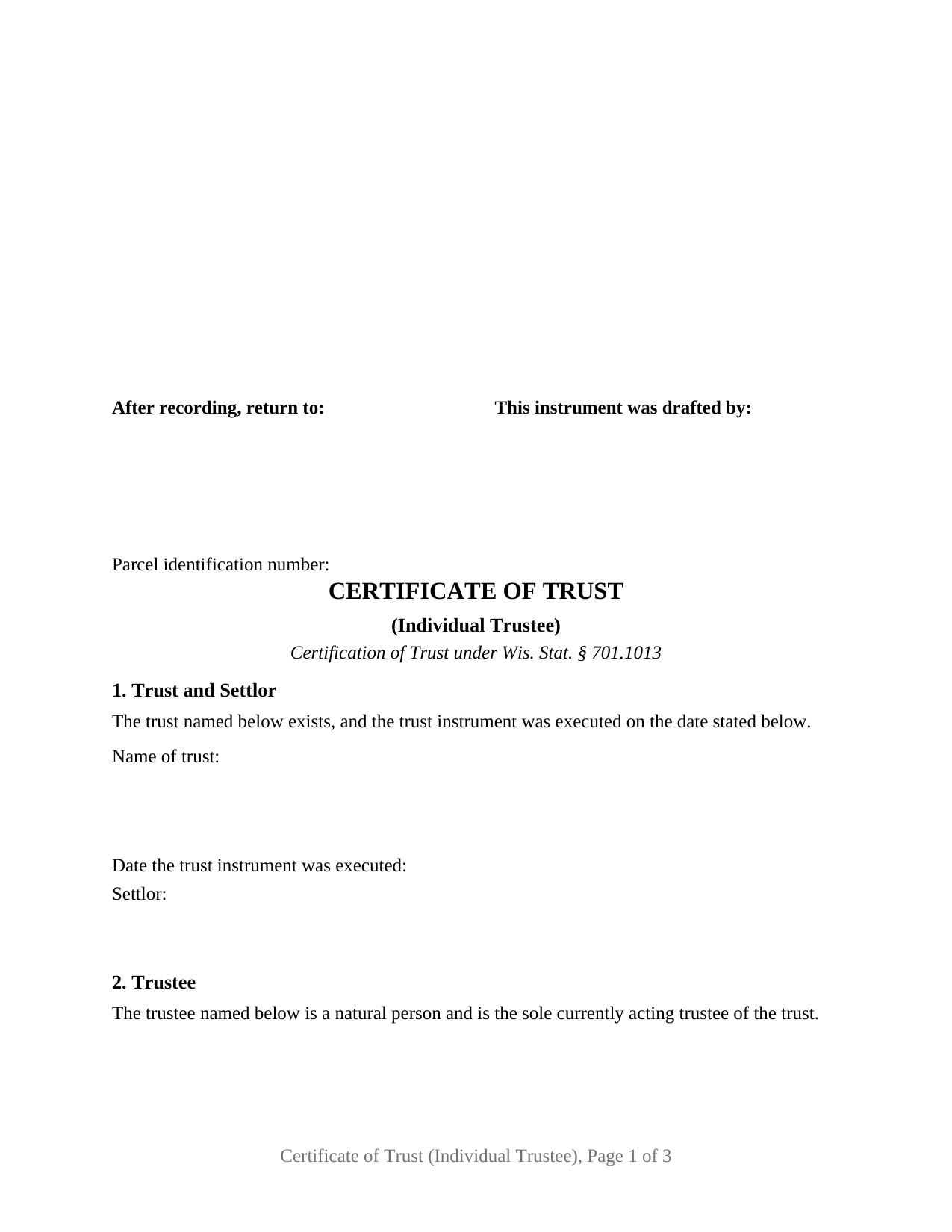
This Wisconsin certificate of trust is drawn for one trustee who serves alone: a natural person who is the sole currently acting trustee of a trust certifies the facts about the trust that Wis. Stat. § 701.1013 lists, identifies one parcel of Wisconsin real property, signs once, and acknowledges once. The form prints that configuration as fixed text, so the trustee's own words and the certificate the notarial officer completes both read as a certification by a single trustee acting in that capacity.
One trustee, one signature, one certificate
The form carries exactly one signature block, headed TRUSTEE, and exactly one acknowledgment certificate. Section 2 recites, in fixed text, that the trustee named there is a natural person and is the sole currently acting trustee of the trust, and the three-line entry under that sentence takes the trustee's name and mailing address, the identity and address item of § 701.1013(1)(c). Nothing on the form offers a second trustee a place to sign, and no line is marked for use if applicable. The acknowledgment certificate is printed in the representative-capacity short form of Wis. Stat. § 140.16(2), with the words as trustee of fixed ahead of an entry for the name of the trust, so the officer's certificate states the capacity in which the trustee acknowledged rather than treating the trustee as an individual signing for herself or himself.
The cotrustee item answered in fixed text
Section 701.1013(1)(f) asks a certification to state the authority of a cotrustee to sign and whether all cotrustees or less than all are required in order to exercise the powers of the trustee. On a form built for cotrustees that is a blank the trustees fill from the trust instrument. On this form it is Section 5, a fixed paragraph with no entries: the trustee named in Section 2 is the sole currently acting trustee, no cotrustee is serving, and the signature or other authentication of the sole trustee alone is sufficient to exercise the powers of the trustee. That paragraph is what distinguishes the sole-trustee certification on its face. A successor trustee named in the trust instrument but not yet serving does not change the recital, because the recital speaks to the trustee currently acting.
What the sole trustee certifies
The remaining items of § 701.1013(1) are factual entries in the statute's order. Section 1 opens with the fixed sentence that the trust exists and that its instrument was executed on the date stated, then takes the trust's name, that date, and the settlor. Section 3 takes the powers of the trustee as the trust instrument confers them. Section 4 takes the revocability or irrevocability of the trust as a written entry, never a box, together with the person who holds a power to revoke. Section 6 takes the manner in which title to trust property may be taken, which in the completed example reads as the trustee's name, as trustee of the named trust, with the trust's date. Section 7 then identifies the property by Wisconsin county, legal description, street address, and the register of deeds document number of the instrument vesting title in the trustee.
Section 8 is the certification itself and has no blanks. The sole trustee certifies under § 701.1013 that the representations stated in the certificate are correct and that the trust has not been revoked, modified, or amended in any manner that would cause those representations to be incorrect, the statement subsection (3) requires in the statute's own words, and that the certification does not contain the dispositive terms of the trust, which subsection (4) permits. A person who relies on a certification without knowledge that its representations are incorrect may assume the facts it states without inquiry under subsection (6), and a recipient who still wants proof of the trustee's authority may require the excerpts subsection (5) describes, which this certification does not replace.
Laid out for the register of deeds
A certification of trust takes effect by being furnished to the person dealing with the trust; recording is not what makes it operate. The form is nonetheless built for the register of deeds of the county where the property lies, where it sits in the chain of title beside the deed to the trustee. Its first page keeps the upper-right area blank for the register's recording information and carries the document name, the return information, the drafter's name, and a parcel identification number line, the standard document format items of Wis. Stat. § 59.43(2m)(a). Because the certificate passes no ownership interest in real estate, no electronic real estate transfer return and no transfer fee accompany it; the deed into or out of the trust is the instrument that carries those.
Patterns the record shows
The sole-trustee certification appears in the Wisconsin record in three recurring shapes: a settlor serving as trustee of the settlor's own revocable living trust, which is the fact pattern of the completed example; a single successor trustee who has accepted the office after the settlor's death or resignation and is selling or refinancing trust real estate; and the one named trustee of an irrevocable trust taking title to a parcel. Each presents the same instrument: one natural person, one signature, one representative-capacity acknowledgment, and the fixed statement that no cotrustee is serving.
The form is not set up as a certification by two cotrustees signing together, by a corporate trustee such as a bank or trust company signing through an officer, or by a trustee acting through an attorney-in-fact. Each of those prints different fixed text or a different certificate, and a certification in one of those configurations follows a different form. The form also recites nothing about the trustee's marital status and adds no spouse's signature: a certification of trust conveys nothing, so the homestead joinder rule for a conveyance that alienates a married person's homestead interest does not reach it.
The download contains the fillable certificate of trust form with its non-recorded instructions cover page, a completed example filled in for a fictional revocable trust holding a Brown County residence, and a guide that walks through each numbered section, the signing and acknowledgment, and recording with the register of deeds. This description and the guide describe the form and the Wisconsin statutes in general terms; they are not legal advice.
Important: County-Specific Forms
Our certificate of trust (individual trustee) forms are specifically formatted for each of the 72 counties in Wisconsin.
After selecting your county, you'll receive forms that meet all local recording requirements, ensuring your documents will be accepted without delays or rejection fees.