Wisconsin Easement Deed (Ingress and Egress, Husband and Wife)
County Specific Legal Forms Validated as recently as November 27, 2026 by our Forms Development Team
About the Wisconsin Easement Deed (Ingress and Egress, Husband and Wife)
How to Use This Form
- Select your county from the list
- Download the county-specific form
- Fill in the required information
- Have the document notarized if required
- Record with your county recorder's office
What Others Like You Are Saying
"This site was a breeze using."
"This is my very first use with your company. I submitted my package and within the hour you had resp…"
"The DEEDs website is very easy to navigate and find the required documents. I have not yet had an op…"
"Using an I pad and cannot type on form that was downloaded. I do not have a computer Charles"
"Easy to download this form. I will use it when the time comes to transfer title of my house."
4.8/5 from 4,867 reviews. Read all
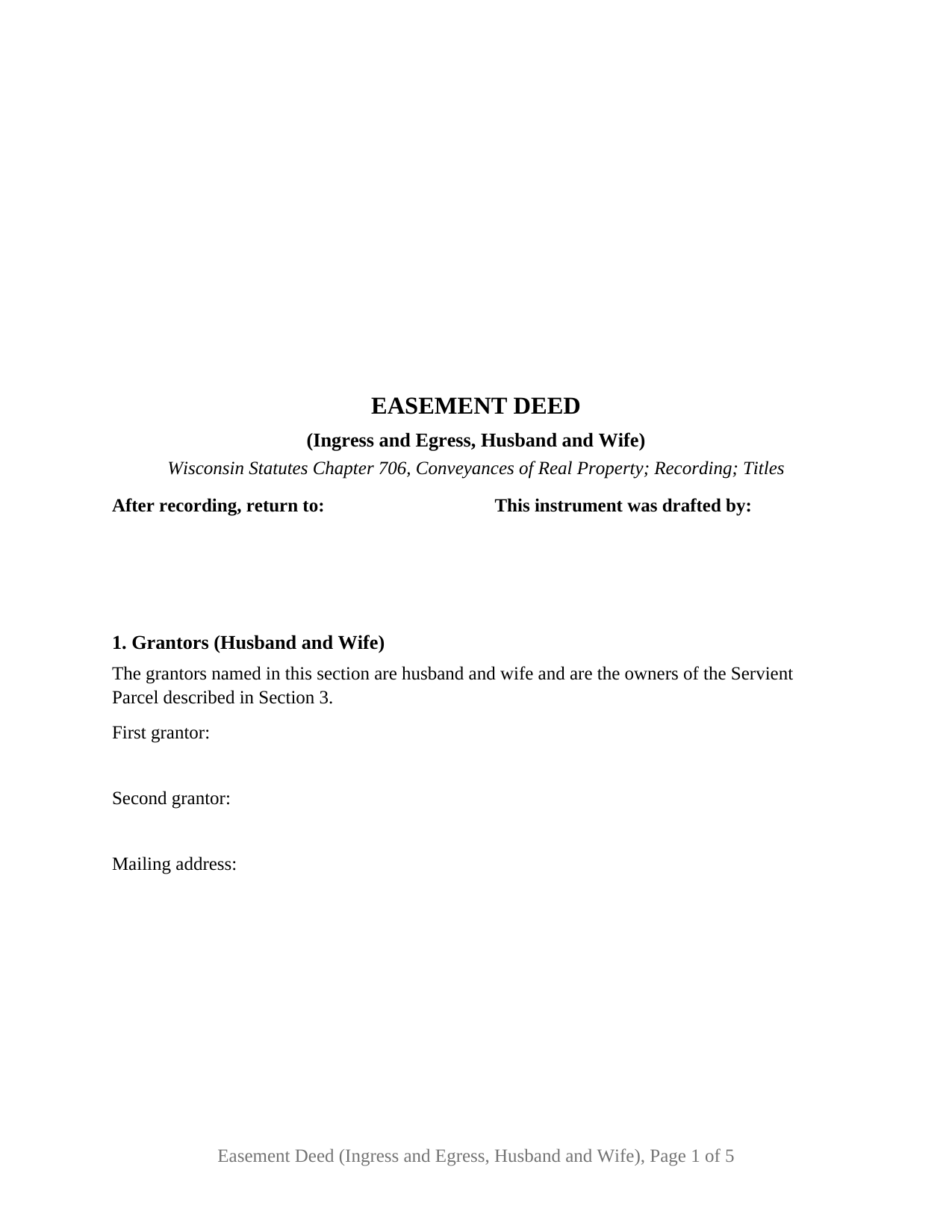
Two Wisconsin spouses who own a parcel together can give a neighbor a permanent right to cross it, and this easement deed is written for exactly that signing pattern: husband and wife as the two grantors, both signing, each with an acknowledgment certificate of their own, granting a perpetual, nonexclusive easement for ingress and egress over a described strip of their land. The instrument is a Wisconsin easement deed in the ingress and egress, husband and wife configuration, and it recites that configuration as fixed deed text rather than leaving it to a blank.
Why both spouses sign a Wisconsin access easement
Wisconsin is a marital property state, and land that spouses hold in both names other than in the alternative is managed and controlled only by both spouses acting together under Wis. Stat. 766.51(2). Chapter 706 adds a second rule aimed at the home itself: under Wis. Stat. 706.02(1)(f), a conveyance that alienates any interest of a married person in a homestead is invalid unless each spouse signs it or joins in it. An easement for a driveway or access lane across the yard, the field between the house and the road, or the lane along the lot line is an alienation of an interest in that land, and where the strip falls within the homestead as Wis. Stat. 706.01(7) defines it, the second spouse's signature is what the statute asks for. This deed builds that answer into its structure. Section 1 recites that the two grantors are husband and wife and the owners of the burdened parcel, Section 8 carries a signature block for each spouse, and the form follows with a separate acknowledgment certificate for each grantor in the short form of Wis. Stat. 140.16(1), so the two spouses may acknowledge on different dates, before different notarial officers, or in different states. That separate-certificate layout is the form's architecture; Wisconsin notarial law lets one certificate name more than one person who appears together.
A right of passage that attaches to the land next door
What the deed conveys is an easement appurtenant to a neighboring parcel. The form identifies three pieces of ground: the Servient Parcel, which is the grantors' land and carries the burden; the Benefited Parcel, which is the grantee's land and receives the benefit; and the Easement Area, the strip or lane within the Servient Parcel over which travel may occur. The operative clause in Section 7 grants and conveys a perpetual, nonexclusive easement for ingress and egress, on foot and by vehicle, over, across, and along the Easement Area for the purpose of passing to and from the Benefited Parcel. The deed then states that the easement is appurtenant to the Benefited Parcel and runs with the land, which is what makes a right of way easement of this kind pass automatically to each later owner of the benefited lot and bind each later owner of the burdened lot. Under Wis. Stat. 706.10(3) a conveyance passes all of the grantor's interest unless a different intent appears, and the Wisconsin Supreme Court has held in Borek Cranberry Marsh, Inc. v. Jackson County, 2010 WI 95, that words such as heirs and assigns are not needed to make a granted interest in land transferable.
The grant is nonexclusive, so the grantors keep every use of the Easement Area that does not prevent or unreasonably interfere with passage, and they agree not to obstruct it in a manner that does. The deed allocates maintenance and repair of the Easement Area to the grantee at the grantee's cost and places no duty of upkeep on the grantors. It is made without warranty of title; Wis. Stat. 706.10(6) implies no covenant in any Wisconsin conveyance, and the deed does not add one.
No transfer return, and a deed that says so
Most Wisconsin deeds reach the register of deeds with an electronic real estate transfer return and a transfer fee of 30 cents per hundred dollars of value, or with an exemption number from Wis. Stat. 77.25 written on their face. An easement deed is different. Wis. Stat. 77.21(1), the definition section for the transfer fee, defines a conveyance to include deeds and other instruments for the passage of ownership interests in real estate but expressly excludes easements, so neither the fee nor the return under Wis. Stat. 77.22(1) applies to an easement. Because the register at the counter has no duty to decide whether an exclusion is valid, the Department of Revenue's published guidance describes a statement on the instrument that it is an easement only and not a conveyance. Section 7 of this form carries that statement with its statutory citations, so the deed explains its own treatment when it is presented for recording.
Built for the Wisconsin standard document format
The form is laid out to the standard document format of Wis. Stat. 59.43(2m)(a) that every Wisconsin register of deeds applies, with the return address and the drafter's name on the first page below the blank recording area, and it records for the flat $30 fee of Wis. Stat. 59.43(2)(ag) whatever its page count. Once of record, an access easement recorded after January 1, 1960 is outside the 40-year limitation of Wis. Stat. 893.33 by force of Wis. Stat. 893.33(6m)(b), created by 2021 Wisconsin Act 174 for easements that allow a person to travel across another's land to reach a location.
The husband and wife configuration this form recites
The form recites exactly two grantors who are married to each other and who together own the Servient Parcel, with both signing and a certificate for each. A married couple granting a shared driveway to the owner of the adjoining lot, spouses granting a farm lane across their field to a landlocked parcel behind them, and a couple splitting off a lot by certified survey map and granting the new lot access to the road across the lot they keep all present the two-grantor spousal pattern this deed recites. The form is not set up as a one-owner easement deed, an easement from unmarried co-owners, a deed signed by a trustee, an entity, or an attorney-in-fact, or an easement for utilities, drainage, or parking; each of those changes the recital, the signature blocks, or the operative language. The grantee side stays open: the owner or owners of the Benefited Parcel, whether one person, a couple, a trust by its trustee, or a company, are named in Section 2 and do not sign.
The package contains the fillable easement deed form, a completed example filled in for a Columbia County fact pattern with a certified survey map lot on each side of the easement, and the guide that walks through each section, the spousal signing rules, the acknowledgment certificates, and recording with the register of deeds. The guide and this description explain the form and the governing Wisconsin statutes in general terms and are not legal advice.
Important: County-Specific Forms
Our easement deed (ingress and egress, husband and wife) forms are specifically formatted for each of the 72 counties in Wisconsin.
After selecting your county, you'll receive forms that meet all local recording requirements, ensuring your documents will be accepted without delays or rejection fees.