Wisconsin Gift Deed (Individual)
County Specific Legal Forms Validated as recently as November 19, 2026 by our Forms Development Team
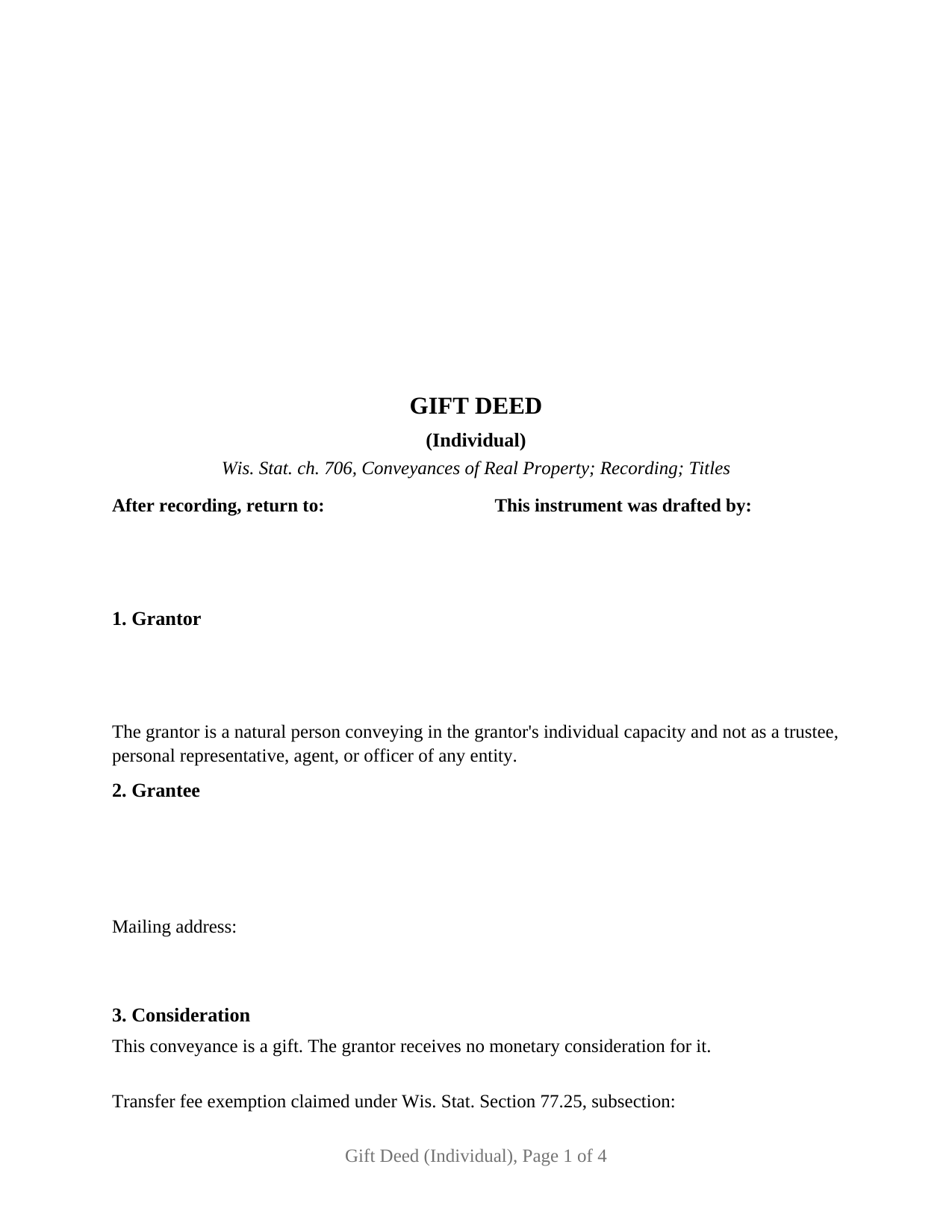
About the Wisconsin Gift Deed (Individual)
How to Use This Form
- Select your county from the list
- Download the county-specific form
- Fill in the required information
- Have the document notarized if required
- Record with your county recorder's office
What Others Like You Are Saying
"It would be nice to get a reply in a small window that says "Your request package has been subm…"
"Excellent Service! Fast and friendly. Thank you will use again!"
"Professional"
"The process was incredibly simple from start to finish. Someone from the team even sent a message to…"
"I loved the fact that the forms came with examples of the required info. That was helpful and made f…"
4.8/5 from 4,860 reviews. Read all
A Wisconsin gift deed moves real property from one person to another with no money changing hands, and this form prepares that deed for a single grantor: one natural person who holds the property in that person's own name and conveys it, in the grantor's individual capacity, to one or two grantees as a gift. The deed says on its face that the grantor receives no monetary consideration, conveys by the words gives, conveys, and quitclaims, and carries a second signature block for a spouse who joins in the gift, because Wisconsin's marital property law gives a one-spouse gift of real estate its own rule.
A gift recited on the face of the deed
Wisconsin has no gift deed statute. The instrument is a conveyance under chapter 706 of the Wisconsin Statutes, which keeps the deed forms in common use and permits shorter ones (section 706.10(1)), so what makes a deed a gift deed is what it says. Section 3 of this form fixes the gift recital as deed text: the conveyance is a gift and the grantor receives no monetary consideration for it. That recital is the hinge for the real estate transfer fee. Wisconsin charges the fee at 30 cents per $100 of value on the grantor of every conveyance (section 77.22(1)), and for a gift the value is the open-market price the property would bring, not the zero dollars that changed hands (section 77.21(3)(b)). Section 77.25 lists the conveyances that pay nothing, and the family transfers a gift deed most often carries are on the list: parent and child, stepparent and stepchild, parent and child-in-law, and, since 2025 Wisconsin Act 38 took effect on November 1, 2025, grandparent and grandchild, each for nominal or no consideration (section 77.25(8)), and a conveyance between husband and wife (section 77.25(8m)). Section 77.22(1) requires an exempt deed to cite the exemption subsection on its face, and the form carries that line in Section 3 beside the recital. The completed example claims subsection (8) for a gift from a father to his two adult children.
What the quitclaim words do
This deed conveys without warranty of title. It uses the words gives, conveys, and quitclaims and states that it is a quitclaim deed carrying no warranty of title, so section 706.10(4) supplies its effect: it passes all of the interest in or appurtenant to the land described which the grantor could lawfully convey, but does not warrant or imply the existence, quantity or quality of any such interest. A donor who gives property away therefore makes no covenant that could later be sued on, and the grantee takes the property as it stands, subject to any mortgage, easement, or other matter of record. The grantee block takes one or two grantees with the words that fix how two of them hold title, and the guide walks through each form Wisconsin recognizes, from tenancy in common and joint tenancy under chapter 700 to the marital property and survivorship marital property forms of chapter 766 that exist between grantees who are married to each other.
One grantor, and a spouse who may join
The form recites exactly one grantor, a natural person signing in the grantor's own capacity and not as a trustee, personal representative, agent, or company officer; Section 1 prints that capacity as fixed deed text. The grantor may be married or unmarried, and the marital status is part of the grantor entry rather than a preprinted choice. What the form adds for a married grantor is the SPOUSE OF GRANTOR signature block with its own acknowledgment certificate. Two Wisconsin rules give that block its work. Under section 706.02(1)(f) a conveyance that alienates a married person's interest in a homestead is invalid unless each spouse signs or joins in it, a rule the Wisconsin courts enforce as written. Under section 766.53 a spouse acting alone may give marital property to a third person only up to $1,000 in a calendar year, or a larger amount reasonable in light of the spouses' finances, and any larger gift of marital property is subject to the other spouse's remedies under section 766.70(6) unless both spouses act together in making it. The joinder sentence in Section 6 states what the spouse's signature does under each rule. Where the grantor is unmarried, where the property is neither the homestead nor marital property, or where the spouse is the grantee, the block simply stays blank. Two record owners conveying together, a trustee or an agent signing for someone else, and a company grantor each present a different pattern from the one this deed recites.
The transfer return that travels with a gift
A Wisconsin deed is not a complete recording package by itself. Section 77.22(2) and section 706.05(12) require an electronic real estate transfer return to accompany every conveyance offered for recording, and the register of deeds may not accept the deed without the completed return and any fee due. On an exempt gift the return reports the exemption and no fee is paid; on a gift to anyone outside the section 77.25 list the fee is computed on the reported open-market value. The deed itself is built to the standard document format of section 59.43(2m): a blank recording area of 3 by 3 inches in the upper right corner of the first page, the document name and the return address on that page, the drafter's name section 59.43(5)(a) requires, a line for the parcel identification number, and 12-point type throughout. The recording fee is $30 per document in every Wisconsin county. The grantor signs before a notarial officer, who completes the chapter 140 short-form acknowledgment printed on the deed, and a joining spouse signs and acknowledges on a separate certificate, which lets the two of them appear on different days or before different officers.
The download holds three files: the blank fillable deed formatted for Wisconsin recording, a completed example filled through both acknowledgment certificates for a Dane County gift from a father to his two children, and a plain-language guide that takes the deed section by section with its statutory sources. This description and the guide describe the form and the governing Wisconsin statutes in general terms; they are not legal advice.
Important: County-Specific Forms
Our gift deed (individual) forms are specifically formatted for each of the 72 counties in Wisconsin.
After selecting your county, you'll receive forms that meet all local recording requirements, ensuring your documents will be accepted without delays or rejection fees.