Wisconsin Special Warranty Deed
County Specific Legal Forms Validated as recently as September 25, 2026 by our Forms Development Team
About the Wisconsin Special Warranty Deed
How to Use This Form
- Select your county from the list
- Download the county-specific form
- Fill in the required information
- Have the document notarized if required
- Record with your county recorder's office
What Others Like You Are Saying
"Used a form from this service. Best part about these forms is that they don't let you get in trouble…"
"it was convenient to have a starting place, however, though the property is in Colorado, the probate…"
"Thanks for the complete and reasonably priced set of docs. I was specifically looking for and glad t…"
"Great service! fast turnaround! I’ve used Deeds.com multiple times, and the software interface is ea…"
"This was so very easy and fast! Well worth the small fee. I will use this again if I have a need. Th…"
4.8/5 from 4,826 reviews. Read all
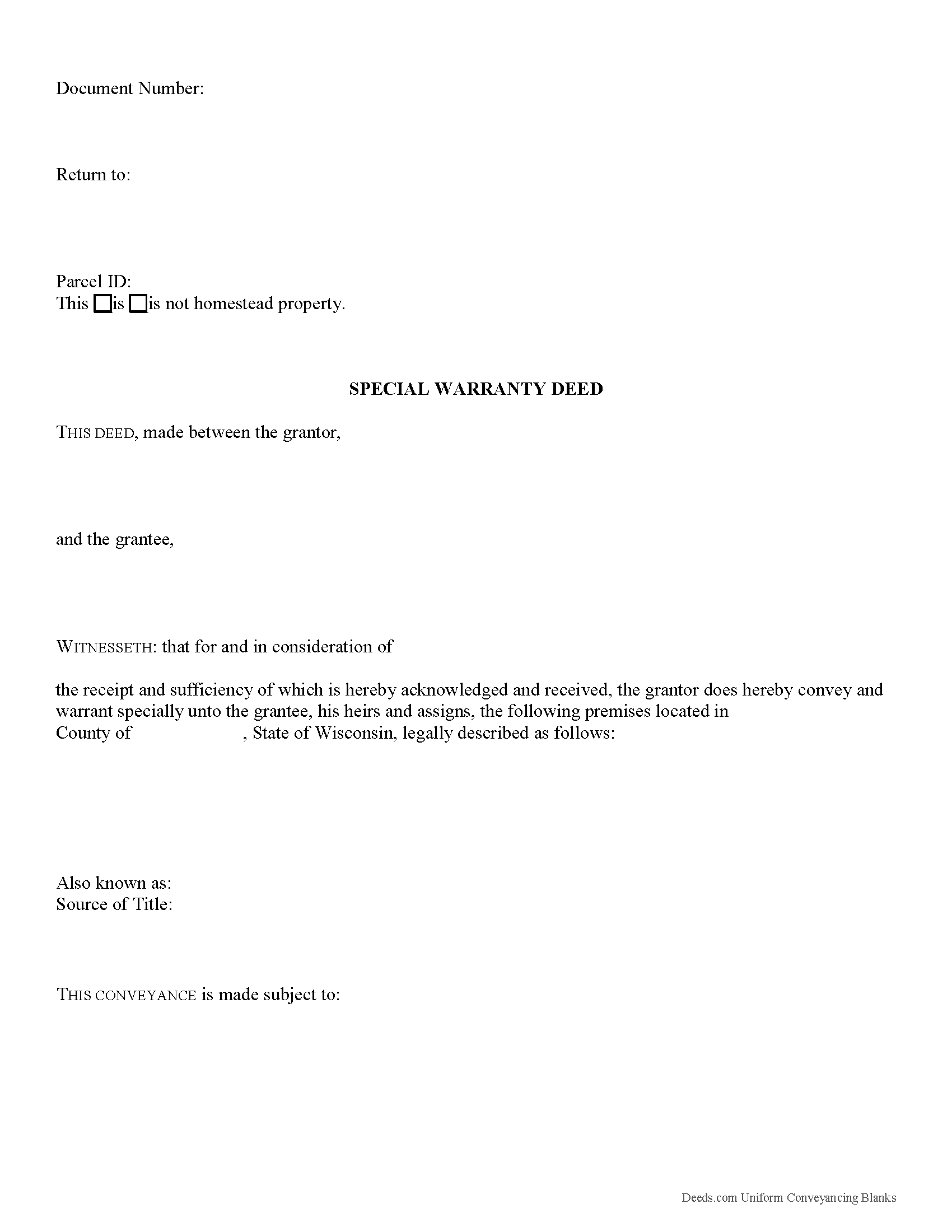
In Wisconsin, title to real property can be transferred from one party to another using a special warranty deed. When recorded, a special warranty deed conveys an interest in real property to the named grantee with limited warranties of title.
A special warranty deed offers a more limited warranty than a general warranty deed. Special warranty deeds convey real property in fee simple to the grantee, typically with a covenant from the grantor that the property is free from encumbrances made by the grantor. The grantor also covenants that he will defend title against any lawful claim arising by, through, or under the grantor, but none other. This means that the deed will not protect the grantee against title issues that arose prior to the time the grantor acquired title. A special warranty deed is recognizable by the terms "convey and warrant specially," but no warranties are implied in Wisconsin, so any special warranty covenants must be explicitly stated in the deed (706.10(6)).
In addition to meeting all state and local standards for recorded documents, a lawful special warranty deed includes the grantor's full name, mailing address, and marital status, the consideration given for the transfer, and the grantee's full name, marital status, vesting, and mailing address. Vesting describes how the grantee holds title to the property. Generally, real property is owned in either sole ownership or in co-ownership. For Wisconsin residential property, the primary methods for holding title in co-ownership are tenancy in common, joint tenancy, and community (marital) property. A conveyance of real estate to two or more unmarried persons creates a tenancy in common, unless a joint tenancy is declared (700.18). All property of spouses acquired either individually or jointly during the marriage is presumed to be marital property unless otherwise specified by a marital property agreement (766.31).
Deeds in Wisconsin must be accompanied by a receipt that evidences completion of a Wisconsin Real Estate Transfer Return. The real estate transfer fee is levied based on either the consideration made for the transfer or the current fair market value of the real property, as reflected on the form (77.22(1)). Submit the form electronically via the Wisconsin Department of Revenue website. All conveyances require a completed form or an exemption stated on the face of the deed. Find a list of exempt documents at 77.25.
As with any conveyance of realty, a special warranty deed requires a complete legal description of the parcel. Recite the prior deed reference to maintain a clear chain of title, and detail any restrictions associated with the property. The finished copy of the deed must be signed by the grantor and notarized. Additionally, the grantor's spouse must join in signing to release rights of homestead, regardless of whether he or she holds an actual interest in the property conveyed. Record the original completed deed, along with any additional materials, at the Register of Deeds office of the county where the property is located. Contact the same office to verify recording fees and accepted forms of payment.
This article is provided for informational purposes only and is not a substitute for the advice of an attorney. Contact a Wisconsin lawyer with any questions related to the transfer of real property.
(Wisconsin SWD Package includes form, guidelines, and completed example)
Important: County-Specific Forms
Our special warranty deed forms are specifically formatted for each of the 72 counties in Wisconsin.
After selecting your county, you'll receive forms that meet all local recording requirements, ensuring your documents will be accepted without delays or rejection fees.