Wisconsin Grant Deed (Individual Grantor)
County Specific Legal Forms Validated as recently as November 19, 2026 by our Forms Development Team
About the Wisconsin Grant Deed (Individual Grantor)
How to Use This Form
- Select your county from the list
- Download the county-specific form
- Fill in the required information
- Have the document notarized if required
- Record with your county recorder's office
What Others Like You Are Saying
"EXCELLENT SERVICE. WILL MAINTAIN CONTACT FOR FUTURE REFERENCE. THANK YOU!"
"Ordered two separate forms for two separate states at two differnt times and couldn't be happier wit…"
"The free additional forms that came with the form I ordered were invaluable as well. Worth every pen…"
". Easy to use."
"very quick and easy"
4.8/5 from 4,861 reviews. Read all
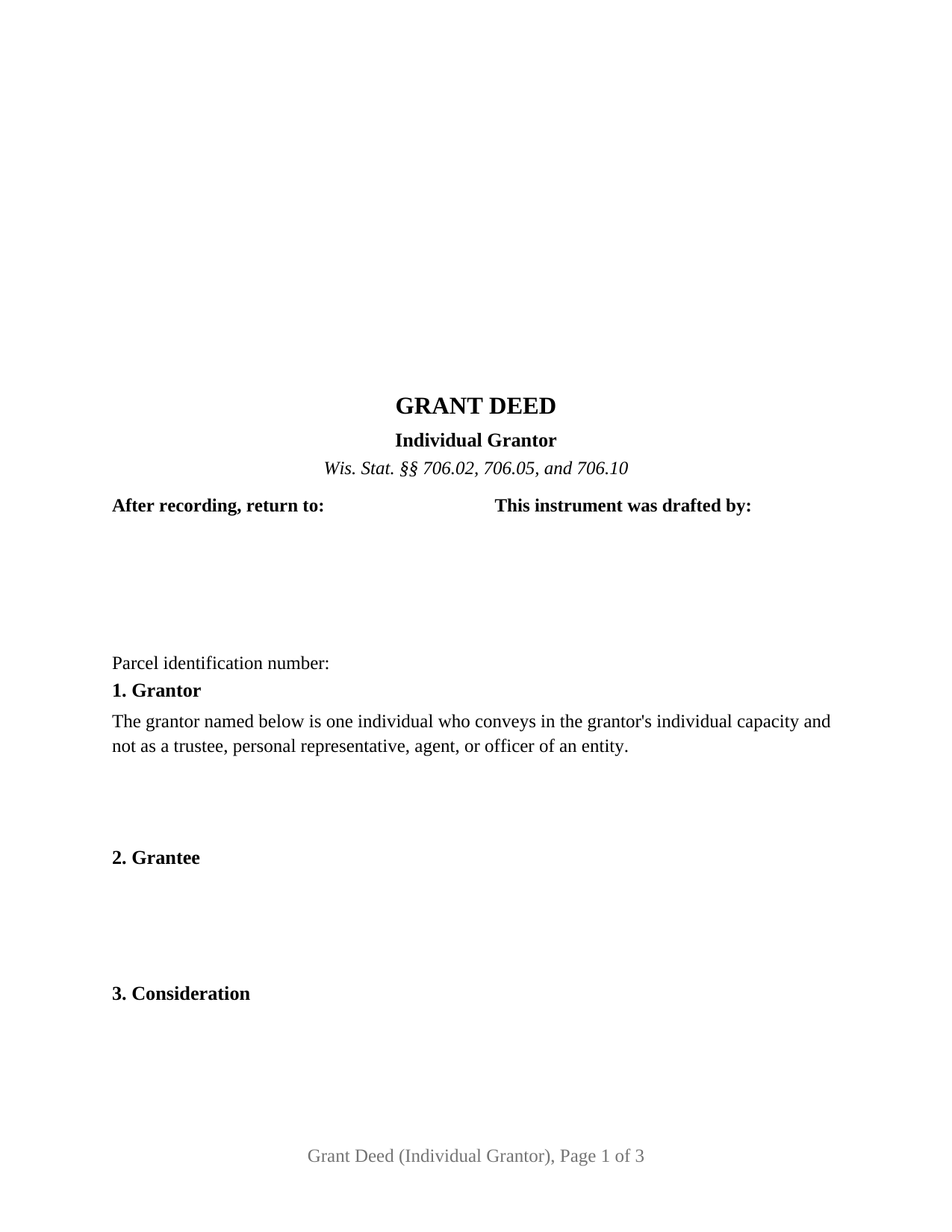
The Wisconsin Grant Deed (Individual Grantor) is a fill-in-the-blank deed built around one signature: a single individual, conveying in that person's own capacity, grants and conveys Wisconsin real estate to the grantee named in the deed. The instrument carries one grantor block, one acknowledgment certificate, and a fixed recital that the grantor is an individual acting in the grantor's own right, and it passes all of the grantor's estate and interest in the described land with the two covenants that give a grant deed its name, written out in the deed because Wisconsin implies none.
One grantor, one signature, one certificate
Section 1 of the deed prints a fixed sentence: the grantor named below is one individual who conveys in the grantor's individual capacity and not as a trustee, personal representative, agent, or officer of an entity. The only grantor entries are the name and mailing address. The signature page carries a single grantor block with a printed-name line, which satisfies the clear-name rule of Wis. Stat. § 59.43(2m)(a)10, and a single acknowledgment certificate in the short form Wis. Stat. § 140.16(1) supplies for an acknowledgment in an individual capacity. Marital status is not fixed by the deed, and no ownership recital is printed; the deed conveys whatever estate the named grantor holds, whole or undivided.
Words of grant, and two covenants written out
Wisconsin statutes name no grant deed. Chapter 706 prescribes no deed form at all; Wis. Stat. § 706.10(1) keeps the forms in common use and permits any other form that conforms to the chapter, and the State Bar of Wisconsin publishes a warranty deed and a quit claim deed as its standard conveyance forms. The grant deed described here takes its meaning from the statute's rules of construction rather than from a form. Wis. Stat. § 706.10(3) provides that every conveyance passes all the estate or interest of the grantor unless a different intent appears in its terms, and the operative clause in Section 7 says exactly that: the grantor grants and conveys the real estate, together with all appurtenant rights, title, and interests, and the conveyance passes all of the grantor's estate and interest in it.
Elsewhere, a grant deed takes its two covenants from a statute that implies them whenever a deed uses the word grant: that the grantor has not already conveyed the estate to someone else, and that the estate is free from encumbrances the grantor made. Wisconsin takes the opposite rule. Wis. Stat. § 706.10(6) provides that, apart from the improvement covenant of sub. (7) and any other rule of law, no warranty or covenant is implied in any conveyance, whether or not the conveyance contains special warranties or covenants. So this deed writes the two covenants out. The grantor covenants that the grantor has not conveyed the same real estate, or any right, title, or interest in it, to any person other than the grantee, and that the real estate is free from encumbrances made or suffered by the grantor or by any person claiming under the grantor, except as stated in the deed's exceptions section. Under the first sentence of Wis. Stat. § 706.10(5), a conveyance by which the grantor contracts to warrant the land or its title is construed according to its terms under the rules for construction of contracts, which is how those two sentences take effect.
The same clause then states that these are the only covenants of title in the deed and that the grantor does not otherwise warrant the land or its title. That sentence does work of its own: the second sentence of § 706.10(5) reads the full set of covenants, seisin, good right to convey, freedom from all encumbrance, and a guarantee of title and quiet possession, into a conveyance by which the grantor warrants the land or its title, except as the terms of the conveyance otherwise provide, and the deed's terms provide otherwise.
Between the warranty deed and the quitclaim
A Wisconsin quitclaim deed under Wis. Stat. § 706.10(4) passes the interest the grantor could lawfully convey and does not warrant or imply the existence, quantity, or quality of any interest; it releases rather than grants. A warranty deed carries the full statutory covenants, reaching defects that arose before the grantor ever held title. The grant deed sits between them. Its words of grant identify the real estate as the thing conveyed, its express statement of intent passes the grantor's whole estate under § 706.10(3), its two covenants answer for the grantor's own acts and nothing older, and its closing sentence keeps the full warranty set out. The pattern appears in the record where a grantor conveys a complete interest and stands behind the grantor's own period of ownership while the parties allocate older title risk elsewhere: a sale closed on a title insurance policy, a transfer into or out of a family arrangement, or a conveyance of land the grantor received by gift or inheritance.
The grantee side stays open
The grantee section is free-form. It receives one grantee, or two or more grantees with the words that create the form of ownership they will hold. Wisconsin recognizes tenancy in common as the default for co-owners, joint tenancy created by words such as as joint tenants or with right of survivorship under Wis. Stat. § 700.19(1), and the spousal forms of Wis. Stat. § 766.60: marital property, which carries no survivorship on its own, and survivorship marital property, which vests the deceased spouse's interest in the survivor by nontestamentary disposition. The completed example conveys from one individual to a married couple as survivorship marital property, and the guide describes each recognized form with the statute that creates it.
What the register of deeds reads on page one
The first page is laid out to the standard document format of Wis. Stat. § 59.43(2m)(a) as revised by 2025 Wisconsin Act 234: the top three and one-half inches are left blank for the recording area, the document name sits inside the window the statute sets, and the return address and the drafter statement that Wis. Stat. § 59.43(5)(a) requires on every conveyance appear under the title, followed by a parcel identification number line for the counties that require one. Section 8 carries the line Wis. Stat. § 77.22(1) calls for on an exempt conveyance, where the reason for exemption is stated by reference to the subsection of Wis. Stat. § 77.25 that applies; a sale subject to the real estate transfer fee leaves it at none. The deed is presented to the register of deeds of the county where the land lies with the electronic real estate transfer return receipt and the $30 recording fee of Wis. Stat. § 59.43(2)(ag)1.
The configuration this deed recites
The form is set up as a one-grantor, individual-capacity conveyance. A single owner selling a house, a parent conveying a parcel to a child for nominal consideration under the § 77.25(8) exemption, and an individual moving land into a trust present the pattern this deed recites. The form is not set up as a two-grantor deed, as a deed from a corporation, limited liability company, trustee, or personal representative, or as a deed signed by an agent under a power of attorney; each of those carries different recitals and a different certificate. The deed also carries no signature block for a non-grantor spouse. Wis. Stat. § 706.02(1)(f) requires a conveyance that alienates any interest of a married person in a homestead to be signed or joined in by each spouse, except a conveyance between spouses, and Wisconsin courts hold that the requirement cannot be waived by conduct; a married grantor's homestead therefore presents a configuration this deed does not carry, which the guide explains with the marital property rules of Wis. Stat. ch. 766.
The package contains the fillable Wisconsin grant deed form, a completed example filled in for a Dane County fact pattern, and a guide that walks through every numbered section, the signing and notarization rules, and the recording process with the eRETR. The description and the guide describe the form and the governing statutes in general terms; they are not legal advice.
Important: County-Specific Forms
Our grant deed (individual grantor) forms are specifically formatted for each of the 72 counties in Wisconsin.
After selecting your county, you'll receive forms that meet all local recording requirements, ensuring your documents will be accepted without delays or rejection fees.