Oneida County Grant Deed (Individual Grantor) Form
Last validated November 19, 2026 by our Forms Development TeamFormatted for recording in Oneida County, for property anywhere in the county: rural and unincorporated areas as well as Harshaw, Hazelhurst, Lake Tomahawk, Mc Naughton, Minocqua, Pelican Lake, Rhinelander, Three Lakes and 2 more.
- 3 documents included
- Immediate PDF download
- Formatting guarantee
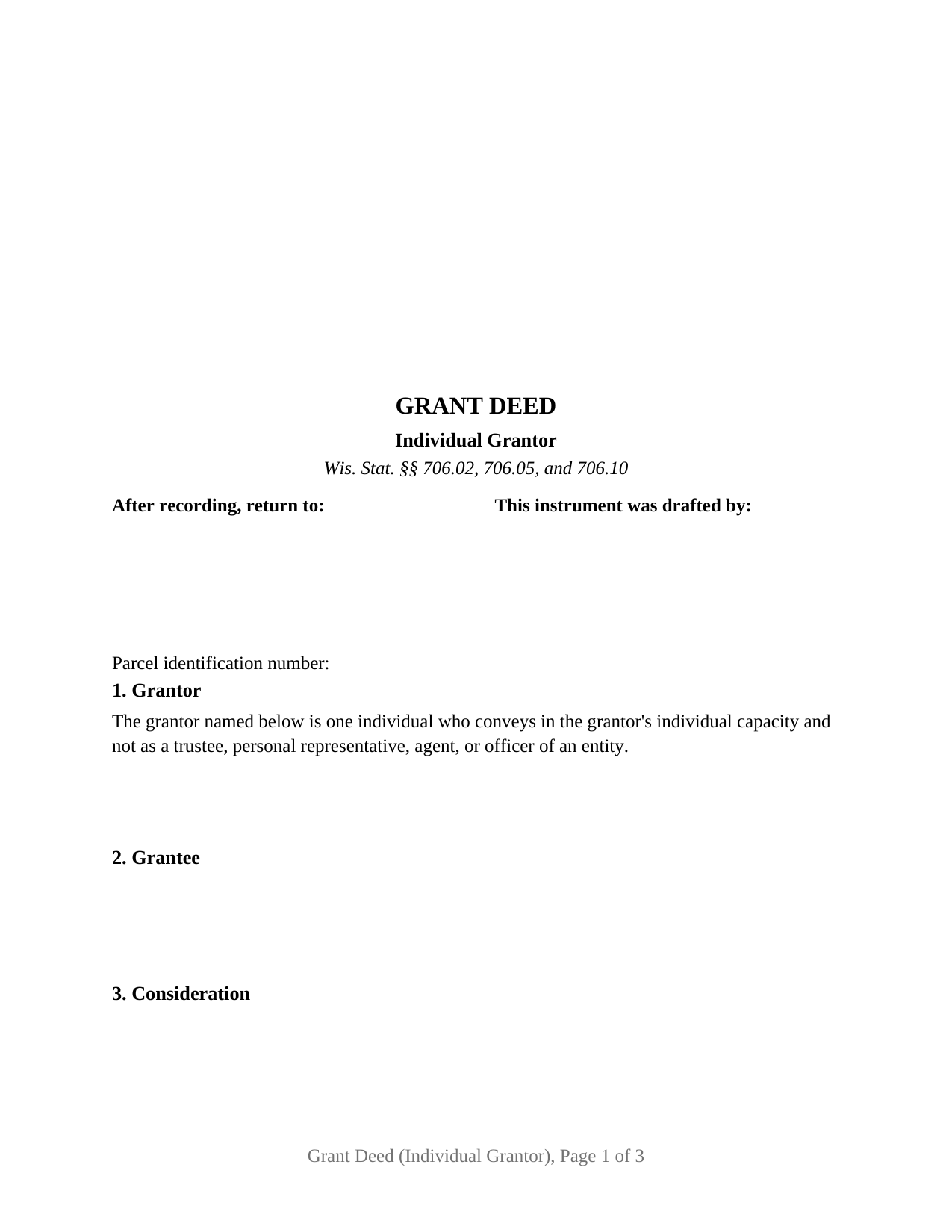
Oneida County Grant Deed (Individual Grantor) Form
Fill in the blank Grant Deed (Individual Grantor) form formatted to comply with all Wisconsin recording and content requirements.
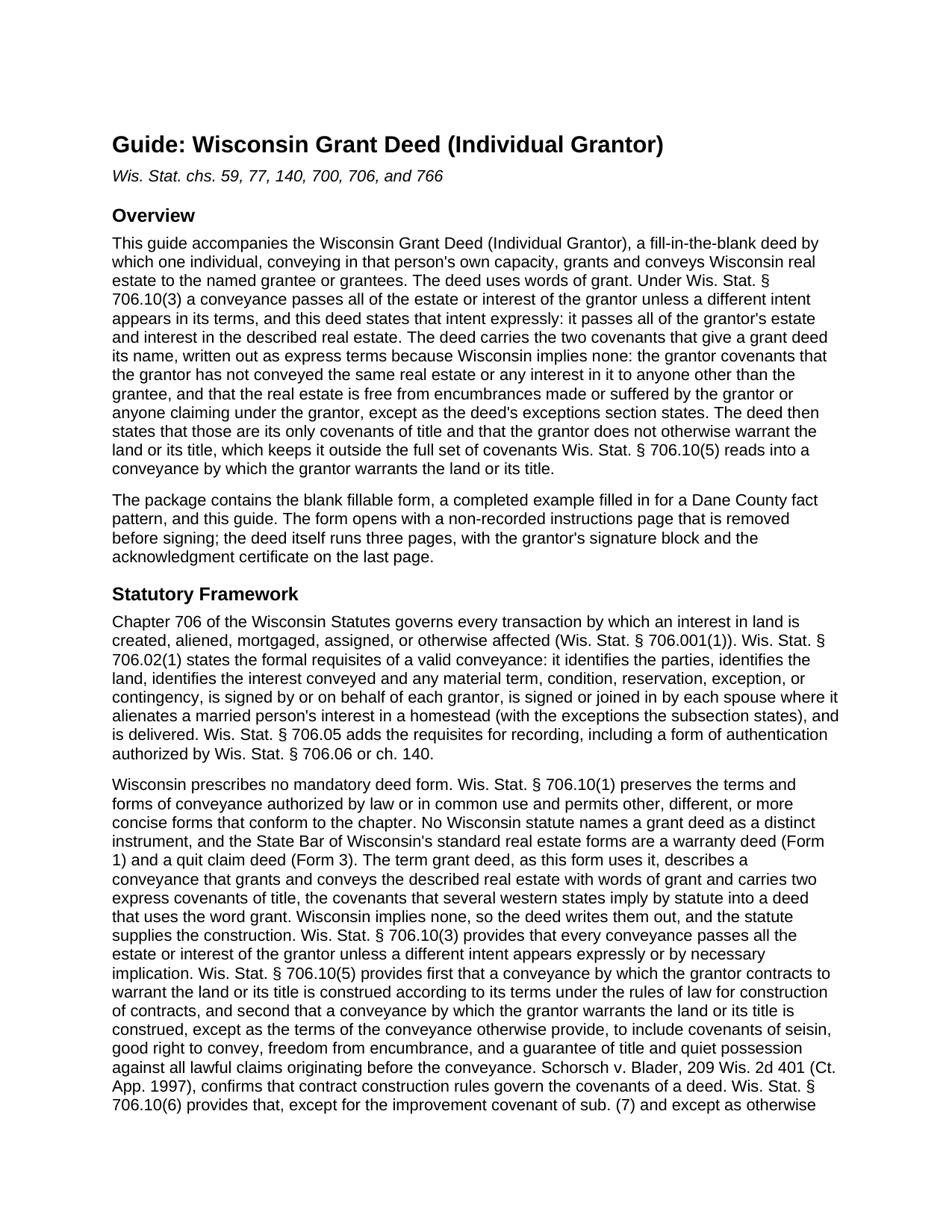
Oneida County Grant Deed (Individual Grantor) Guide
Line by line guide explaining every blank on the Grant Deed (Individual Grantor) form.
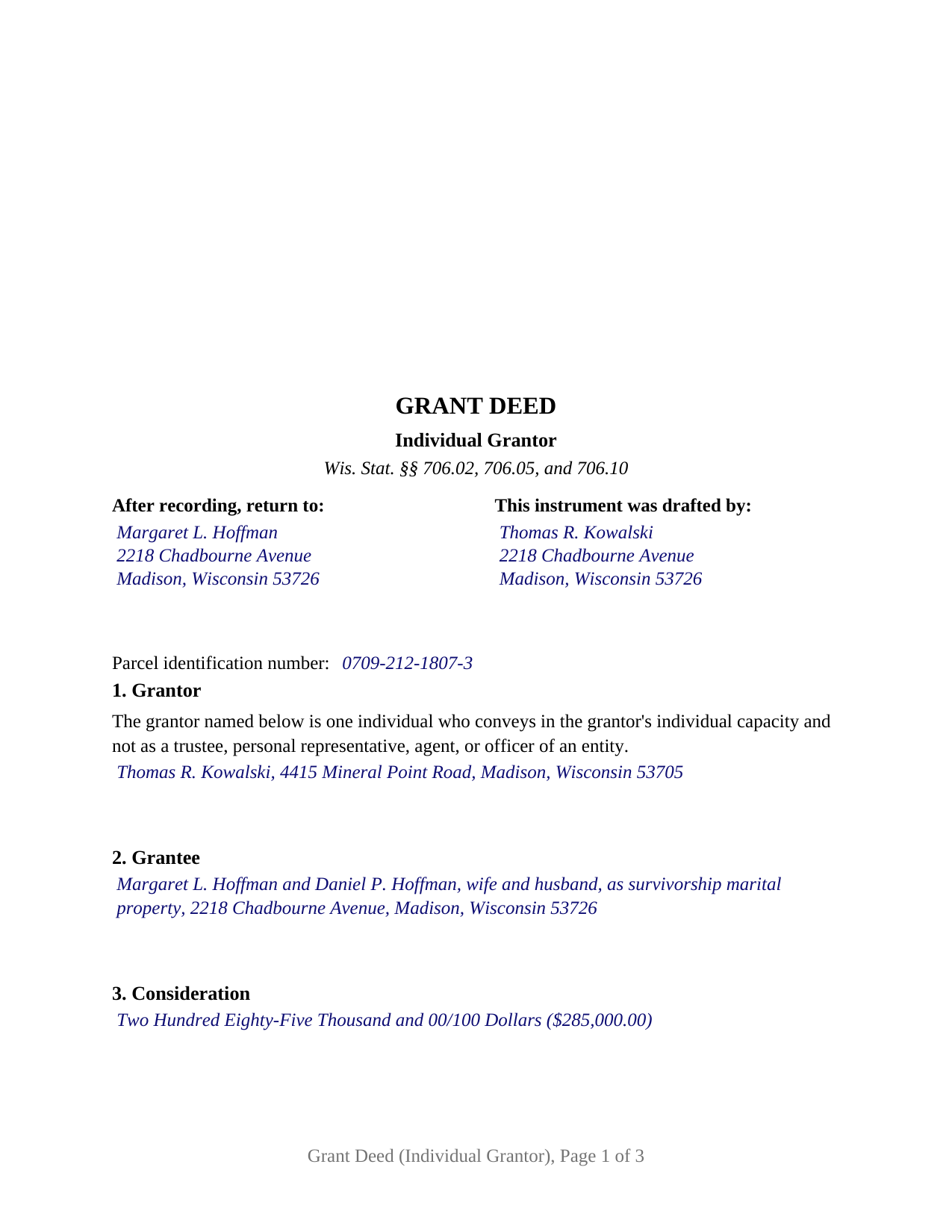
Oneida County Completed Example of the Grant Deed (Individual Grantor) Document
Example of a properly completed Wisconsin Grant Deed (Individual Grantor) document for reference.
All 3 documents above included • One-time purchase • No recurring fees
Immediate Download • Secure Checkout
Additional Wisconsin and Oneida County documents included at no extra charge:
Where to Record Your Documents
Oneida County Register of Deeds
Rhinelander, Wisconsin 54501
Hours: Monday - Friday 8:00am - 4:30pm
Phone: (715) 369-6150
Recording Tips for Oneida County:
- Bring your driver's license or state-issued photo ID
- Ensure all signatures are in blue or black ink
- Recording fees may differ from what's posted online - verify current rates
- Request a receipt showing your recording numbers
- Ask about accepted payment methods when you call ahead
Cities and Jurisdictions in Oneida County
Properties in any of these areas use Oneida County forms:
- Harshaw
- Hazelhurst
- Lake Tomahawk
- Mc Naughton
- Minocqua
- Pelican Lake
- Rhinelander
- Three Lakes
- Tripoli
- Woodruff
Hours, fees, requirements, and more for Oneida County
How do I get my forms?
Forms are available for immediate download after payment. The Oneida County forms will be in your account ready to download to your computer. An account is created for you during checkout if you don't have one. Forms are NOT emailed.
Are these forms guaranteed to be recordable in Oneida County?
Yes. Our form blanks are guaranteed to meet or exceed the applicable formatting requirements used for recording in Oneida County, including margin requirements, font requirements, and other layout standards. This guarantee applies to formatting, not to the legal sufficiency of information entered by the user or the suitability of a form for a particular transaction.
Can I reuse these forms?
Yes. You can reuse the forms for your personal use. For example, if you have multiple properties in Oneida County you only need to order once.
What do I need to use these forms?
The forms are PDFs that you fill out on your computer. The free Adobe Acrobat Reader is recommended, and most PDF apps also work. You do NOT enter your property information online - you download the blank forms and complete them privately on your own computer.
Are there any recurring fees?
No. This is a one-time purchase. Nothing to cancel, no memberships, no recurring fees.
How much does it cost to record in Oneida County?
Recording fees in Oneida County vary. Contact the recorder's office at (715) 369-6150 for current fees.
Questions answered? Let's get started!
The Wisconsin Grant Deed (Individual Grantor) is a fill-in-the-blank deed built around one signature: a single individual, conveying in that person's own capacity, grants and conveys Wisconsin real estate to the grantee named in the deed. The instrument carries one grantor block, one acknowledgment certificate, and a fixed recital that the grantor is an individual acting in the grantor's own right, and it passes all of the grantor's estate and interest in the described land with the two covenants that give a grant deed its name, written out in the deed because Wisconsin implies none.
One grantor, one signature, one certificate
Section 1 of the deed prints a fixed sentence: the grantor named below is one individual who conveys in the grantor's individual capacity and not as a trustee, personal representative, agent, or officer of an entity. The only grantor entries are the name and mailing address. The signature page carries a single grantor block with a printed-name line, which satisfies the clear-name rule of Wis. Stat. § 59.43(2m)(a)10, and a single acknowledgment certificate in the short form Wis. Stat. § 140.16(1) supplies for an acknowledgment in an individual capacity. Marital status is not fixed by the deed, and no ownership recital is printed; the deed conveys whatever estate the named grantor holds, whole or undivided.
Words of grant, and two covenants written out
Wisconsin statutes name no grant deed. Chapter 706 prescribes no deed form at all; Wis. Stat. § 706.10(1) keeps the forms in common use and permits any other form that conforms to the chapter, and the State Bar of Wisconsin publishes a warranty deed and a quit claim deed as its standard conveyance forms. The grant deed described here takes its meaning from the statute's rules of construction rather than from a form. Wis. Stat. § 706.10(3) provides that every conveyance passes all the estate or interest of the grantor unless a different intent appears in its terms, and the operative clause in Section 7 says exactly that: the grantor grants and conveys the real estate, together with all appurtenant rights, title, and interests, and the conveyance passes all of the grantor's estate and interest in it.
Elsewhere, a grant deed takes its two covenants from a statute that implies them whenever a deed uses the word grant: that the grantor has not already conveyed the estate to someone else, and that the estate is free from encumbrances the grantor made. Wisconsin takes the opposite rule. Wis. Stat. § 706.10(6) provides that, apart from the improvement covenant of sub. (7) and any other rule of law, no warranty or covenant is implied in any conveyance, whether or not the conveyance contains special warranties or covenants. So this deed writes the two covenants out. The grantor covenants that the grantor has not conveyed the same real estate, or any right, title, or interest in it, to any person other than the grantee, and that the real estate is free from encumbrances made or suffered by the grantor or by any person claiming under the grantor, except as stated in the deed's exceptions section. Under the first sentence of Wis. Stat. § 706.10(5), a conveyance by which the grantor contracts to warrant the land or its title is construed according to its terms under the rules for construction of contracts, which is how those two sentences take effect.
The same clause then states that these are the only covenants of title in the deed and that the grantor does not otherwise warrant the land or its title. That sentence does work of its own: the second sentence of § 706.10(5) reads the full set of covenants, seisin, good right to convey, freedom from all encumbrance, and a guarantee of title and quiet possession, into a conveyance by which the grantor warrants the land or its title, except as the terms of the conveyance otherwise provide, and the deed's terms provide otherwise.
Between the warranty deed and the quitclaim
A Wisconsin quitclaim deed under Wis. Stat. § 706.10(4) passes the interest the grantor could lawfully convey and does not warrant or imply the existence, quantity, or quality of any interest; it releases rather than grants. A warranty deed carries the full statutory covenants, reaching defects that arose before the grantor ever held title. The grant deed sits between them. Its words of grant identify the real estate as the thing conveyed, its express statement of intent passes the grantor's whole estate under § 706.10(3), its two covenants answer for the grantor's own acts and nothing older, and its closing sentence keeps the full warranty set out. The pattern appears in the record where a grantor conveys a complete interest and stands behind the grantor's own period of ownership while the parties allocate older title risk elsewhere: a sale closed on a title insurance policy, a transfer into or out of a family arrangement, or a conveyance of land the grantor received by gift or inheritance.
The grantee side stays open
The grantee section is free-form. It receives one grantee, or two or more grantees with the words that create the form of ownership they will hold. Wisconsin recognizes tenancy in common as the default for co-owners, joint tenancy created by words such as as joint tenants or with right of survivorship under Wis. Stat. § 700.19(1), and the spousal forms of Wis. Stat. § 766.60: marital property, which carries no survivorship on its own, and survivorship marital property, which vests the deceased spouse's interest in the survivor by nontestamentary disposition. The completed example conveys from one individual to a married couple as survivorship marital property, and the guide describes each recognized form with the statute that creates it.
What the register of deeds reads on page one
The first page is laid out to the standard document format of Wis. Stat. § 59.43(2m)(a) as revised by 2025 Wisconsin Act 234: the top three and one-half inches are left blank for the recording area, the document name sits inside the window the statute sets, and the return address and the drafter statement that Wis. Stat. § 59.43(5)(a) requires on every conveyance appear under the title, followed by a parcel identification number line for the counties that require one. Section 8 carries the line Wis. Stat. § 77.22(1) calls for on an exempt conveyance, where the reason for exemption is stated by reference to the subsection of Wis. Stat. § 77.25 that applies; a sale subject to the real estate transfer fee leaves it at none. The deed is presented to the register of deeds of the county where the land lies with the electronic real estate transfer return receipt and the $30 recording fee of Wis. Stat. § 59.43(2)(ag)1.
The configuration this deed recites
The form is set up as a one-grantor, individual-capacity conveyance. A single owner selling a house, a parent conveying a parcel to a child for nominal consideration under the § 77.25(8) exemption, and an individual moving land into a trust present the pattern this deed recites. The form is not set up as a two-grantor deed, as a deed from a corporation, limited liability company, trustee, or personal representative, or as a deed signed by an agent under a power of attorney; each of those carries different recitals and a different certificate. The deed also carries no signature block for a non-grantor spouse. Wis. Stat. § 706.02(1)(f) requires a conveyance that alienates any interest of a married person in a homestead to be signed or joined in by each spouse, except a conveyance between spouses, and Wisconsin courts hold that the requirement cannot be waived by conduct; a married grantor's homestead therefore presents a configuration this deed does not carry, which the guide explains with the marital property rules of Wis. Stat. ch. 766.
The package contains the fillable Wisconsin grant deed form, a completed example filled in for a Dane County fact pattern, and a guide that walks through every numbered section, the signing and notarization rules, and the recording process with the eRETR. The description and the guide describe the form and the governing statutes in general terms; they are not legal advice.
Important: Your property must be located in Oneida County to use these forms. Documents should be recorded at the county recording office listed above.
This Grant Deed (Individual Grantor) meets all recording requirements specific to Oneida County.
Our Promise
The documents you receive here are guaranteed to meet or exceed the applicable Oneida County recording format requirements. If there is a rejection caused by our formatting, we will correct the issue or refund your payment. This guarantee applies to document formatting only and does not extend to information entered by the user, the selection of the form, or the legal effect of the completed document.
Save Time and Money
Get your Oneida County Grant Deed (Individual Grantor) form done right the first time with Deeds.com Uniform Conveyancing Blanks. At Deeds.com, we understand that your time and money are valuable resources, and we don't want you to face a penalty fee or rejection imposed by a county recorder for submitting nonstandard documents. We constantly review and update our forms to meet rapidly changing state and county recording requirements for roughly 3,500 counties and local jurisdictions.
4.8 out of 5 - ( 4,861 Reviews )
Debora E. 5 out of 5 stars
I was amazed! This company is so incredibly fast! They promised 10 minutes, it was actually less and I had the exact info I was needing! Definitely worth the cost!
We appreciate your business and value your feedback. Thank you. Have a wonderful day!
richard z. 5 out of 5 stars
Great service they had what i need easy to use on printing as soon as you pay you can print also as many copys as you need. i would use this service again
We appreciate your business and value your feedback. Thank you. Have a wonderful day!
Thomas G. 5 out of 5 stars
fast and easy
Thank you!
Julie P. 5 out of 5 stars
Easy to use service. Thank you.
Thank you for your feedback. We really appreciate it. Have a great day!
William L. 5 out of 5 stars
This is an initial review of Deeds.Com and the ordering process for their Quit Claim package for Virginia. The ordering process was very easy and the price seems reasonable for what you get. I have reviewed and downloaded all my forms, but have not used them yet. Thus far I am pleased with the product and the process. E-Recording service is also offered, but I have not used that yet either. At this writing, I can whole-heartedly recommend Deeds.Com.
Thank you for your feedback. We really appreciate it. Have a great day!
Elizabeth W. 5 out of 5 stars
would have been smart to give each pdf a name instead of unintelligible numbers...
Thank you for your feedback. We really appreciate it. Have a great day!
Mary B. 5 out of 5 stars
Your information was orderly and very clear and helpful. Thanks!
Thank you for your feedback. We really appreciate it. Have a great day!
Carolyn R. 5 out of 5 stars
Definitely 5 stars. Everything was taken care of well within 24 hours. If our law firm needs to record a single document in a different county again, we will use your service. Thanks!
Thank you for your feedback. We really appreciate it. Have a great day!
Clifford K. 5 out of 5 stars
got the forms we needed, and ones we did not even know we needed!
Your feedback is greatly appreciated. Thank you for taking the time to share your experience!
Robert J D. 5 out of 5 stars
I accidentally ordered 2 forms for the affidavit of death. I only need one.
Thanks for your feedback. Looking at your account we do not see any duplicate orders. Our system does stop duplicate orders before they are processed in many cases. Have a great day.
Ronald S. 5 out of 5 stars
got what i wanted
Thank you for your feedback. We really appreciate it. Have a great day!
spencer d. 5 out of 5 stars
Great and quick service!
Thank you!
RICK M. 5 out of 5 stars
great
Thank you!
srikanth n. 1 out of 5 stars
why not word format??
Good question. There are many reasons, we'll touch on a few. For the end user (you) Adobe Reader is free, Word is not. PDF is the portable document standard, Word is a decent word processor. A portable document format (PDF) maintains document formatting such as margins and font size which is very important to legal documents, Word does not. Have a wonderful day.
Mark B. 5 out of 5 stars
Simply to use. Excellent communication.
Thank you for taking a moment to share your thoughts.