Wisconsin Grant Deed (Married Couple as Grantors)
County Specific Legal Forms Validated as recently as November 19, 2026 by our Forms Development Team
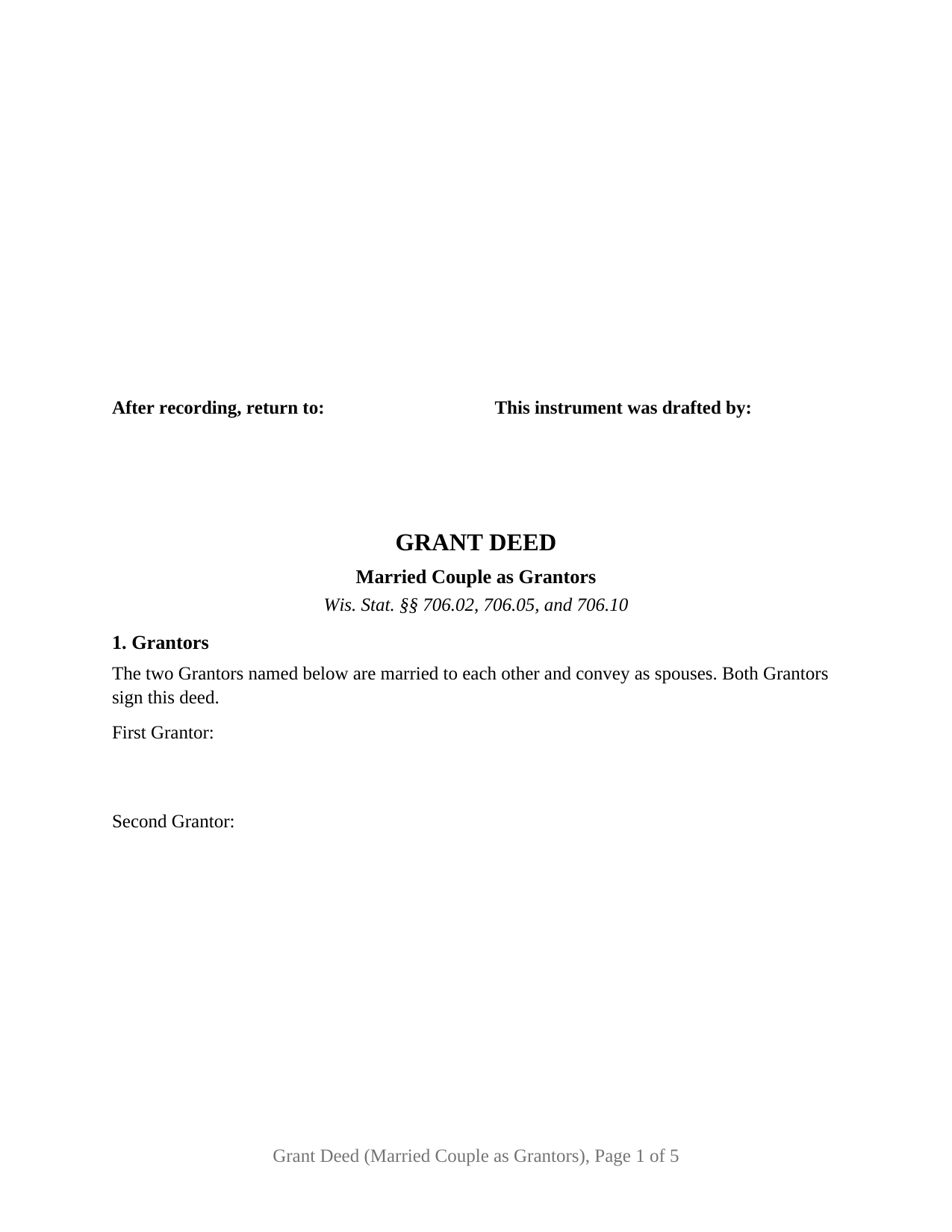
About the Wisconsin Grant Deed (Married Couple as Grantors)
How to Use This Form
- Select your county from the list
- Download the county-specific form
- Fill in the required information
- Have the document notarized if required
- Record with your county recorder's office
What Others Like You Are Saying
"I find the resources on this website so helpful. The service is outstanding. Thank you."
"Awesome service! This took care of my needs 10x faster than I thought possible. I even bought an ext…"
"Listen, I love your services. It's been such a convenience utilizing it."
"fulfilled all NC requirements"
"I am so very happy with the service provided by Deeds.com. The process was simple and saved me a lot…"
4.8/5 from 4,861 reviews. Read all
Two spouses who sell or give away Wisconsin real estate they own together sign one deed, and the Wisconsin Grant Deed (Married Couple as Grantors) is drawn for exactly that signing: two grantors who are married to each other, both signing, each with an acknowledgment certificate of their own. The deed grants and conveys the property to one or two grantees, states two express covenants of title, and says plainly that those two covenants are the only ones it carries.
Why a Wisconsin grant deed spells out its covenants
In some states the word grant carries covenants by statute. Wisconsin takes the opposite position. Wis. Stat. § 706.10(6) provides that, apart from the construction covenant of subsection (7) and as otherwise provided by law, no warranty or covenant is implied in any conveyance, whether or not the conveyance contains special warranties or covenants. The warranty package of § 706.10(5), the covenants of seisin, right to convey, freedom from encumbrance, and a promise to defend title, arises only in a conveyance by which the grantor warrants the land or its title, and a quitclaim deed under § 706.10(4) warrants nothing at all.
A Wisconsin grant deed therefore writes its covenants out. This deed grants and conveys the property, which under § 706.10(3) passes all of the grantors' estate and interest unless a different intent appears, and then states two covenants in the grantors' own words: that the grantors have not conveyed the same estate or any interest in it to anyone other than the grantee, and that the property is free from encumbrances made or suffered by the grantors or anyone claiming under them, other than the matters the deed lists. The deed states that these are the only covenants of title it carries, that it does not warrant the land or its title within the meaning of § 706.10(5), and that under § 706.10(6) no other warranty or covenant is implied. Under § 706.10(5) a conveyance by which the grantor contracts to warrant is construed according to its terms under the rules for construction of contracts, so the covenants reach exactly as far as the deed's text takes them.
Two spouses, two signatures, two certificates
Section 1 of the deed prints a fixed recital that the two grantors named in it are married to each other and convey as spouses, and that both sign. The signature section carries a block for each spouse, and a separate acknowledgment certificate follows for each, so the two grantors may acknowledge on different dates, before different notarial officers, or in different states; that is the form's layout, since the Wisconsin short form of Wis. Stat. § 140.16(1) names the individual or individuals who appeared and one certificate may cover two signers who appear together. Both signatures on one instrument satisfy the homestead rule of Wis. Stat. § 706.02(1)(f), which makes a conveyance that alienates a married person's homestead interest invalid unless each spouse signs or joins in it, and the rule of § 766.51(2) that marital property held in both spouses' names is managed and controlled only by both spouses acting together.
A married couple selling the home they own as survivorship marital property, spouses deeding a rental duplex they hold as marital property to a buyer, and spouses moving a lake lot held in both names into the name of an adult child present the two-spouse grantor pattern this deed recites. The configuration is not set up as a deed from a sole grantor, from two grantors who are not married to each other, from a trustee, personal representative, or attorney-in-fact, from a corporation or limited liability company, from one spouse to the other, or from three or more grantors; each of those is a different signing pattern.
What the grantee side can carry
The grantee block is free form. It receives one grantee, or two grantees followed by the words that state how they take title: as survivorship marital property, the spousal form under which the surviving spouse owns the whole outside probate under Wis. Stat. § 766.60(5), as marital property without survivorship, as joint tenants under § 700.19(1), or as tenants in common. The completed example conveys a Brookfield home from a married couple to a second married couple as survivorship marital property, and the guide walks through each Wisconsin form, the words that create it, and the default classification that applies when the deed names none.
The transfer fee line and the register's page
Wisconsin collects a real estate transfer fee of 30 cents per $100 of value from the grantor when a deed is recorded, and the electronic real estate transfer return accompanies every conveyance offered for recording under Wis. Stat. §§ 77.22 and 706.05(12). Where a conveyance is exempt, § 77.22(1) requires the reason to be stated on the face of the deed by reference to the subsection of § 77.25 that applies, so the deed carries a dedicated exemption line; a sale for value, like the completed example, pays the fee and reads None there. The deed is also laid out to the standard document format of Wis. Stat. § 59.43(2m)(a) as revised by 2025 Wisconsin Act 234: the title sits within the top six inches of the first page, the upper right corner of that page is left blank for the register's recording information, the return address and the drafter's name appear in blocks at the top of the first page, and a parcel identification number line is provided for counties that require one. The statewide recording fee is $30 for the document.
The download holds three files: this grant deed as a fillable PDF with a non-recorded instructions page in front of it, a completed example filled in for a Waukesha County sale by a married couple to two grantees, and a guide that describes every section of the deed, the signing and notarization rules, and the recording process. The guide and this description explain the form and the Wisconsin statutes in general terms and are not legal advice.
Important: County-Specific Forms
Our grant deed (married couple as grantors) forms are specifically formatted for each of the 72 counties in Wisconsin.
After selecting your county, you'll receive forms that meet all local recording requirements, ensuring your documents will be accepted without delays or rejection fees.