Wisconsin Personal Representative Deed (Administrator)
County Specific Legal Forms Validated as recently as November 20, 2026 by our Forms Development Team
About the Wisconsin Personal Representative Deed (Administrator)
How to Use This Form
- Select your county from the list
- Download the county-specific form
- Fill in the required information
- Have the document notarized if required
- Record with your county recorder's office
What Others Like You Are Saying
"Great website.....fast and easy access!"
"Very helpful."
"After a little glitch due to heavy volume at the County Recorder, my document was recorded. County R…"
"The deed easily downloaded. Form fill was smooth. I thought the service was a good value."
"Wonderful. Easier to fill out this form than I thought it would be."
4.8/5 from 4,862 reviews. Read all
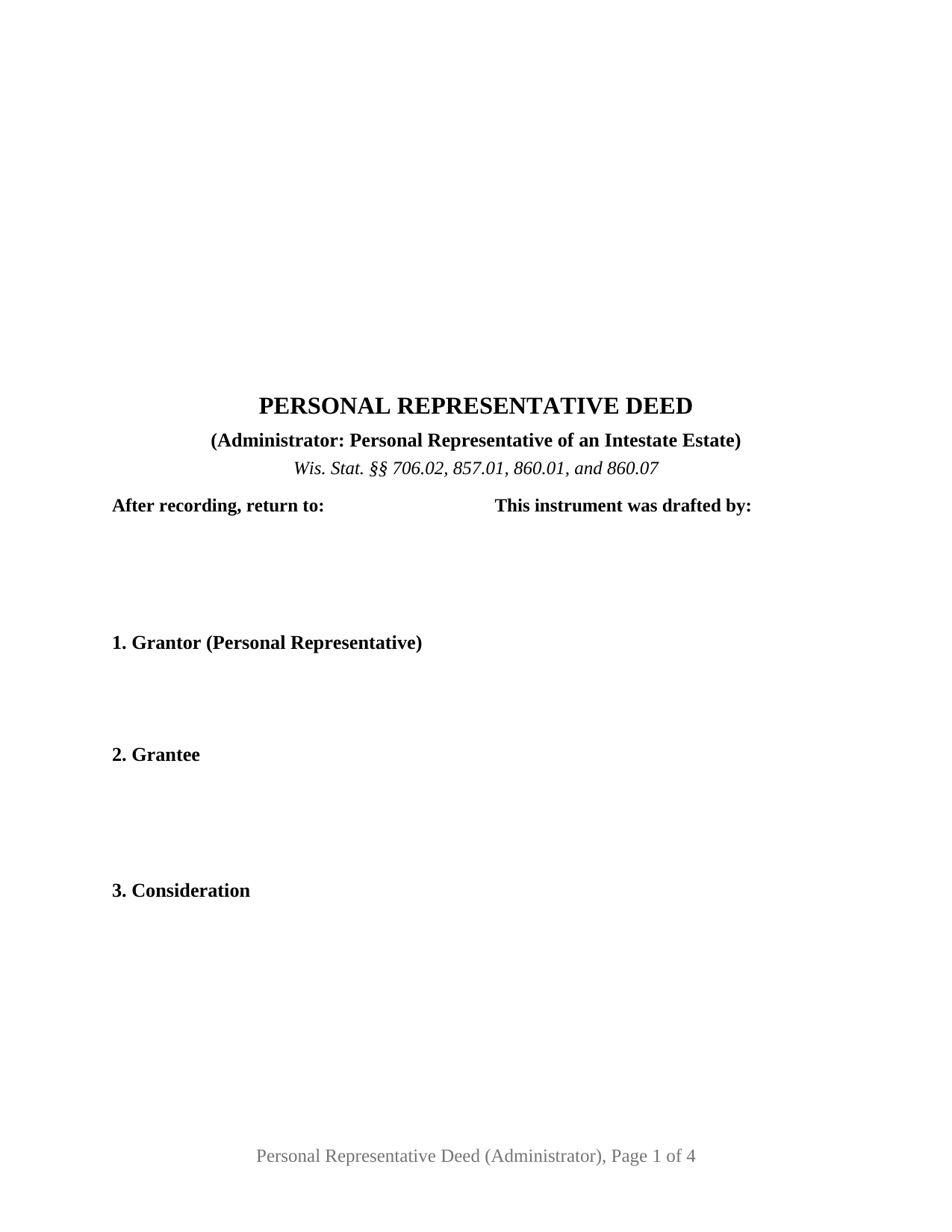
When a Wisconsin resident dies without a will, the person the court or the probate registrar appoints to settle the estate is a personal representative, the role other states still call an administrator. This Wisconsin Personal Representative Deed (Administrator) is the deed that personal representative signs to pass the decedent's real estate out of an intestate estate, whether to the heirs who take under the intestacy statute or to a buyer in a sale by the estate. The deed recites, as fixed text, that the decedent died intestate and that unrevoked domiciliary letters issued to the grantor, and it identifies the court, the case number, and the date the letters issued.
One title for two kinds of estates, and a deed built for the second
Wisconsin's probate code retired the separate titles executor and administrator decades ago. Wis. Stat. § 851.23 defines a personal representative as any person to whom letters to administer a decedent's estate have been granted by the court or by the probate registrar, and the same statutes govern the appointment whether or not there was a will. The difference lives in what the representative is working with. A will can restrict a sale, prohibit it, or make a specific bequest of the house, and Wis. Stat. § 860.11 holds a representative to those restrictions. An intestate estate has no such instrument. The representative's power to sell, mortgage, or lease estate property comes straight from Wis. Stat. § 860.01, without notice, hearing, or court order, and distribution follows the shares Wis. Stat. § 852.01 fixes: the surviving spouse or domestic partner, the children per stirpes, then parents, siblings, and grandparents in turn. This deed is drafted for that estate. It prints the intestacy recital the testate configuration cannot carry, and its appointment section asks for the court, the case number, and the date of the letters rather than for a will.
Why the deed conveys without warranty
A personal representative in Wisconsin cannot warrant title. Wis. Stat. § 860.07 provides that, outside the narrow case of a contract the decedent signed before death, a personal representative has no power to give warranties in any sale, mortgage, or lease that bind the representative personally or the estate. The deed therefore conveys all of the estate and interest the decedent had immediately before death, and all the representative has acquired since, without warranty of title, and it cites Wis. Stat. § 706.10(6), under which no warranty or covenant is implied in any conveyance. That is the posture every Wisconsin estate deed takes, including the State Bar's standard personal representative's deed, and assurance of title on a sale from an estate comes from title insurance rather than from deed covenants. What the buyer does receive is the protection of Wis. Stat. § 860.01, which makes the purchaser's title unaffected by any procedural irregularity or jurisdictional defect in the administration, and of Wis. Stat. § 860.05, under which title on a sale passes free and clear of creditor rights based on claims filed and allowed in the estate.
Distribution to heirs, or sale to a buyer, on the same page
The grantee section receives one or two grantees. A deed of distribution names the heir or heirs taking under the intestacy statute, states no monetary consideration, and claims the transfer fee exemption for a conveyance by descent under Wis. Stat. § 77.25(11) on its face, as Wis. Stat. § 77.22(1) requires of every exempt conveyance. A deed of sale names the buyer, states the price, and pays the transfer fee of 30 cents per $100 of value on that price, since the Department of Revenue's published guidance treats the sale price as the value subject to the fee. Either way, an electronic real estate transfer return accompanies the deed to the register of deeds, because Wis. Stat. § 77.255 excuses the return only for two exemptions and the estate exemption is not among them. The completed example in this package shows a distribution to two children as tenants in common, each as to an undivided one-half interest, which is the share the statute gives two children where no spouse survives.
What this configuration recites and what it is not set up as
The form recites exactly one personal representative as grantor, signing solely in that capacity and not individually, with one acknowledgment certificate in the representative-capacity short form Wis. Stat. § 140.16(2) supplies: the officer certifies that the record was acknowledged by the named person as personal representative of the estate of the named decedent. A single heir who was appointed in informal administration and is now distributing the family home to the heirs, and a sole representative selling the house to pay the estate's debts, present the one-representative, intestate pattern this deed recites. The form is not set up as a deed by co-personal representatives, by a bank or trust company serving as representative, by a representative acting through an attorney-in-fact, by a special administrator, or by the representative of an estate in which a will has been admitted to probate; the intestacy recital is fixed deed text, and it is true only of an estate with no will.
Built for the Wisconsin register of deeds
The deed is laid out to the standard document format of Wis. Stat. § 59.43(2m): the first page reserves the blank recording area in the upper right, carries the return address, and names the drafter as the statute requires, and the body prints at 12 point type on letter-size pages with every margin above the statutory minimum. The parcel identification number, the legal description copied from the decedent's vesting deed, and the street address each have their own entry. The statewide recording fee is $30 per document. Searches for an administrator's deed, an estate deed, or an intestate deed in Wisconsin all describe this instrument.
The package includes the fillable personal representative deed, a completed example filled in for a realistic Dane County intestate estate, and a guide that walks through every section, the signing and notarization rules, and the transfer return and recording process. This description and the guide describe the form and the governing Wisconsin statutes in general terms; they are not legal advice.
Important: County-Specific Forms
Our personal representative deed (administrator) forms are specifically formatted for each of the 72 counties in Wisconsin.
After selecting your county, you'll receive forms that meet all local recording requirements, ensuring your documents will be accepted without delays or rejection fees.