Wisconsin Personal Representative Deed (Executor)
County Specific Legal Forms Validated as recently as November 20, 2026 by our Forms Development Team
About the Wisconsin Personal Representative Deed (Executor)
How to Use This Form
- Select your county from the list
- Download the county-specific form
- Fill in the required information
- Have the document notarized if required
- Record with your county recorder's office
What Others Like You Are Saying
"Great service!"
"Using www.deeds.com was super ez even for a non-technical person like me, it saved me lots of time a…"
"I would absolutely use this service again. It was very convenient and I was pleasantly surprised at …"
"fast and easy to fill out forms."
"my only problem is the cost of the form I downloaded. A bit cheaper would be nice"
4.8/5 from 4,862 reviews. Read all
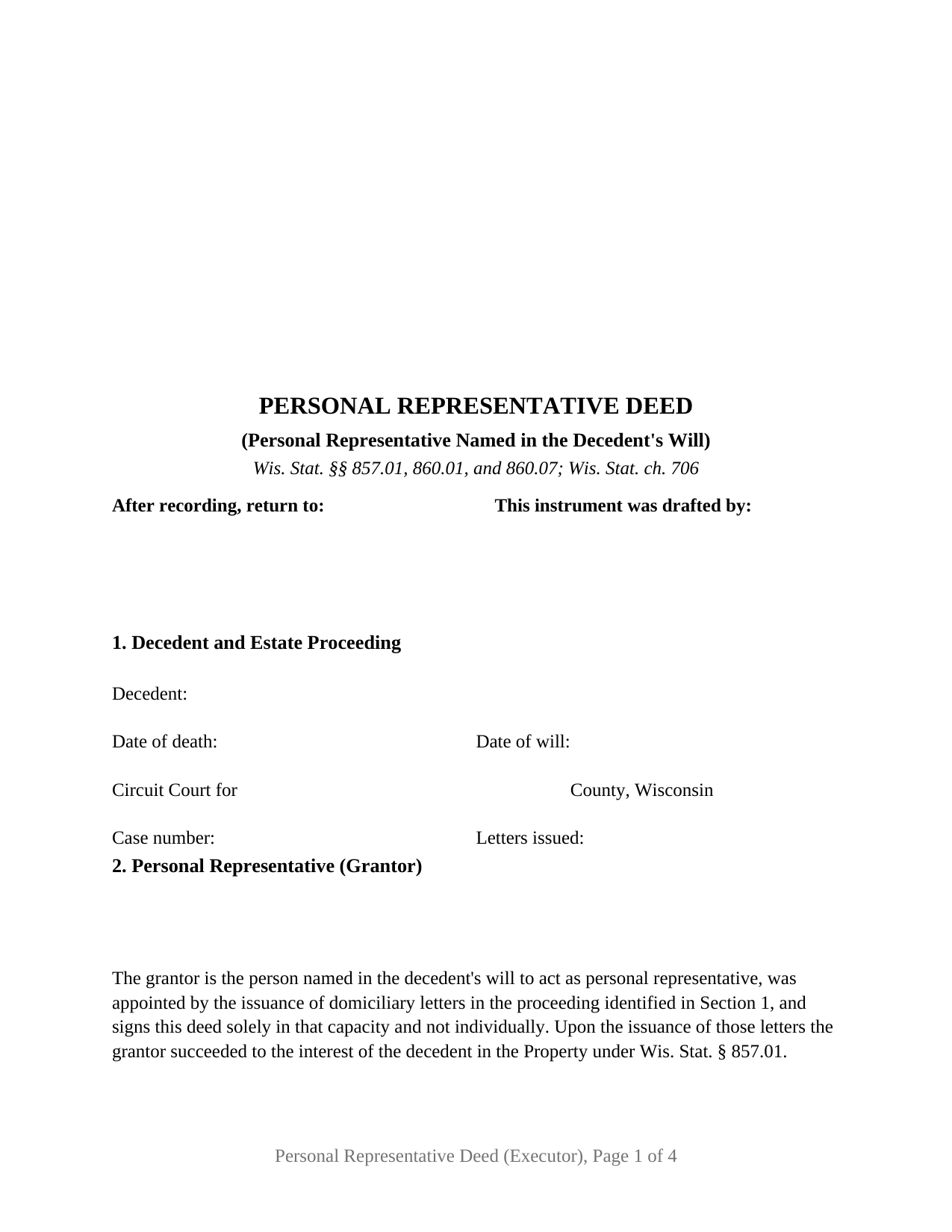
A Wisconsin personal representative deed in the executor configuration is the instrument by which the person a will names to settle the estate conveys the estate's real property. Wisconsin's probate code calls that person the personal representative, whether the decedent left a will or not, and this form is built for the personal representative who was named in the will and appointed by the issuance of domiciliary letters, the fiduciary most people still call the executor. The deed conveys the interest the decedent held at death to a purchaser or to a devisee, without warranty of title, under the sale power that Wisconsin gives every personal representative holding unrevoked letters.
The executor Wisconsin calls a personal representative
Wisconsin retired the words executor and administrator from its probate code decades ago. Wis. Stat. section 851.23 defines a personal representative as any person to whom letters to administer a decedent's estate have been granted by the court or by the probate registrar, and section 856.21(1) puts the person named in the will to act as personal representative first in line for domiciliary letters. The appointment can come from the circuit court in a formal administration or from the probate registrar in an informal one; under section 865.09(1) a personal representative appointed by the registrar has every power of one appointed by the court. The deed's first section carries the appointment facts a title examiner looks for: the decedent's name and date of death, the date of the will, the county whose circuit court holds the estate, the case number, and the date the domiciliary letters issued.
A sale that needs no court order
Upon the issuance of letters the personal representative succeeds to the decedent's interest in all of the decedent's property, Wis. Stat. section 857.01, and chapter 860 supplies the power to deal with it. Section 860.01 provides that a personal representative holding unrevoked letters may sell, mortgage, or lease any property in the estate without notice, hearing, or court order, and that the rights and title of a purchaser are not affected by any provision in the will or any procedural irregularity in the administration. The deed's conveyance paragraph recites that authority: the grantor conveys under section 860.01, the will, and the letters identified in the first section. Will restrictions still bind the personal representative as a matter of duty to the persons interested under section 860.11, and a purchase by the personal representative needs the consents, court approval, or will authorization section 860.13 names, but neither question is a condition on the purchaser's title, and no court confirmation accompanies the recorded deed.
A deed that promises nothing about title
The deed conveys without warranty, and it says so twice: in the operative words, which convey all of the estate, right, title, and interest the decedent had at death and any interest the estate has since acquired, and in a second paragraph stating that the deed carries no covenant or warranty of title by the grantor, personally or as personal representative, or by the estate. That posture is not a drafting choice; Wis. Stat. section 860.07 withholds from a personal representative the power to give warranties that bind the personal representative or the estate, except where the decedent's own contract to convey required them. Section 860.05 adds the protection the buyer does get from the statute: property sold by a personal representative passes free of claims that rest on the filing and allowance of a claim in the estate, though still subject to secured creditors. The exceptions section lists the matters of record the parties choose to name, under a fixed sentence that keeps the listing informational so that neither the listing nor an omission creates a warranty.
One fiduciary, one signature, one certificate
The form recites exactly one personal representative, a natural person named in the will, signing solely in that capacity and not individually, and one or two grantees with any designation of how they hold title written after their names. It carries one signature block and one acknowledgment certificate, printed in the representative-capacity short form of Wis. Stat. section 140.16(2): the record was acknowledged by the named person as personal representative of the estate of the named decedent. An adult child named in a parent's will and selling the family home to a buyer, a surviving sibling named in the will and conveying inherited farmland to the devisee the will names, and a named personal representative closing out the last parcel of a modest estate present the one-fiduciary pattern this deed recites. The form is not set up as a conveyance by a personal representative the court selected because the named person did not qualify, by copersonal representatives acting together, by a bank or trust company serving as personal representative, by a personal representative signing through an attorney-in-fact, or by a special administrator, and it carries no covenant of title; each of those is a different configuration of the Wisconsin personal representative deed.
Transfer fee on a sale, exemption on a distribution
Wisconsin's real estate transfer fee of 30 cents per $100 of value is imposed on the grantor and collected by the register of deeds with the electronic real estate transfer return, Wis. Stat. section 77.22, so a sale by the estate pays the fee and files the return. A distribution to a devisee or heir is treated by the Department of Revenue's exemption guide as a conveyance by will or descent, exempt under section 77.25(11), and section 77.22(1) places the reason for exemption on the face of the deed by reference to that subsection; the form's fourth section carries a consideration entry sized for any amount and an exemption line that reads None on a sale and the section 77.25 subsection on a distribution. The deed is laid out to the standard document format of section 59.43(2m), with the title under a 3 by 3 inch recording area, the return and drafted-by blocks on page one, and a parcel identification number line, and the register's recording fee is $30 regardless of page count.
The package includes the fillable personal representative deed with its non-recorded instructions cover page, a completed example filled in for a Dane County estate sale, and a guide that walks through every section, the statutory framework, the marital property questions a Wisconsin estate presents, and the recording process. This description and the guide describe the form and the governing Wisconsin statutes in general terms; they are not legal advice.
Important: County-Specific Forms
Our personal representative deed (executor) forms are specifically formatted for each of the 72 counties in Wisconsin.
After selecting your county, you'll receive forms that meet all local recording requirements, ensuring your documents will be accepted without delays or rejection fees.