Ashland County Personal Representative Deed (Husband and Wife Grantees) Form
Last validated November 20, 2026 by our Forms Development TeamFormatted for recording in Ashland County, for property anywhere in the county: rural and unincorporated areas as well as Ashland, Butternut, Clam Lake, Glidden, High Bridge, La Pointe, Marengo, Mellen and 1 more.
- 3 documents included
- Immediate PDF download
- Formatting guarantee
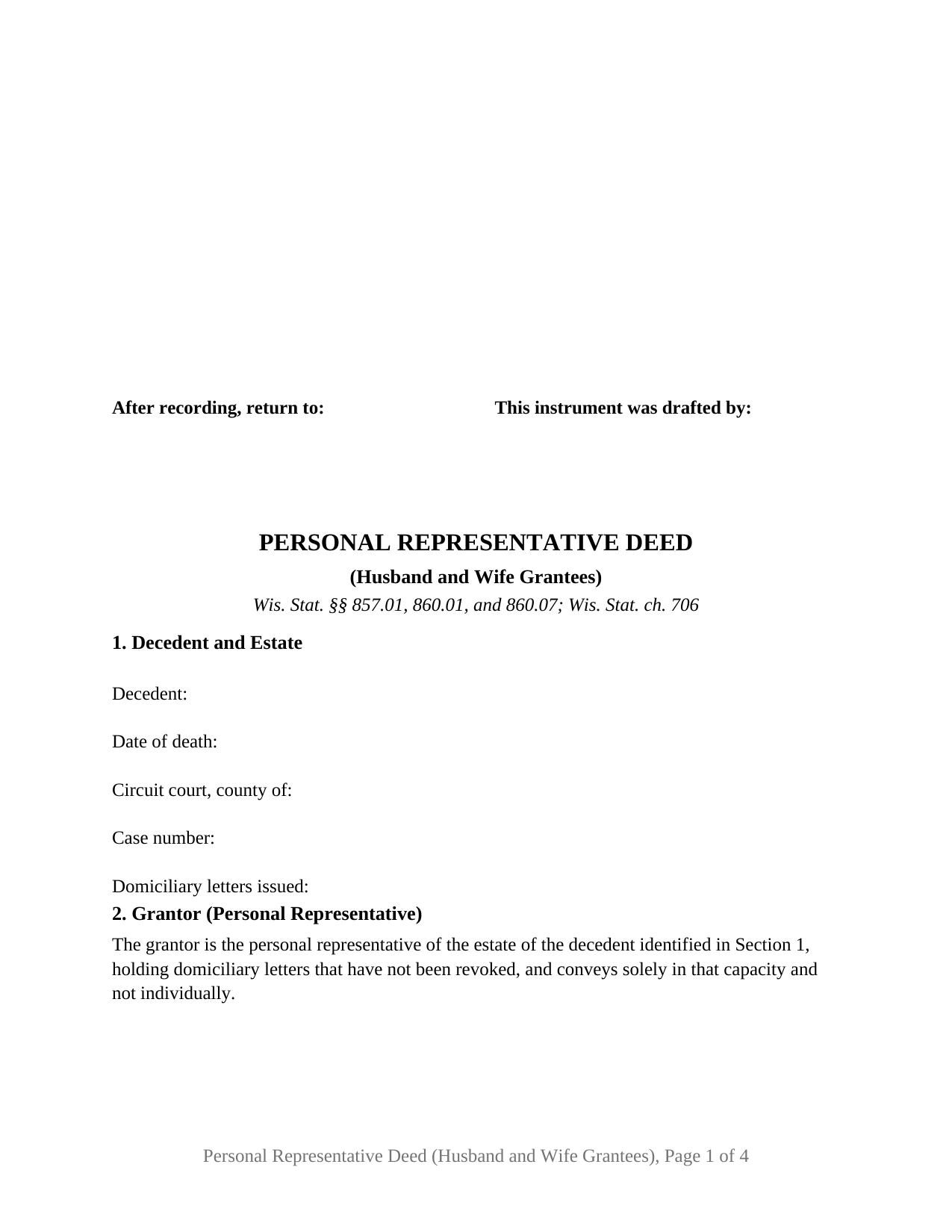
Ashland County Personal Representative Deed (Husband and Wife Grantees) Form
Fill in the blank Personal Representative Deed (Husband and Wife Grantees) form formatted to comply with all Wisconsin recording and content requirements.
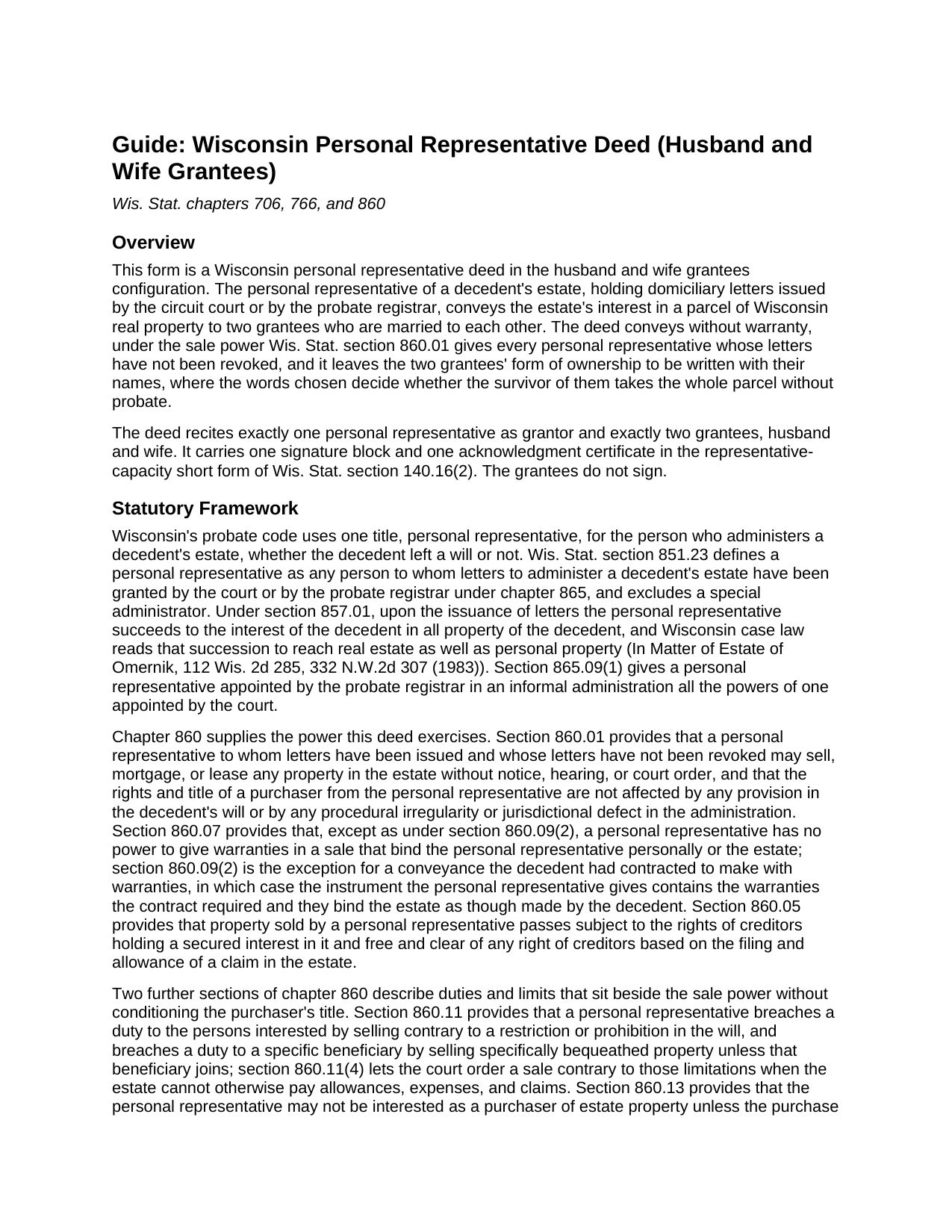
Ashland County Personal Representative Deed (Husband and Wife Grantees) Guide
Line by line guide explaining every blank on the Personal Representative Deed (Husband and Wife Grantees) form.
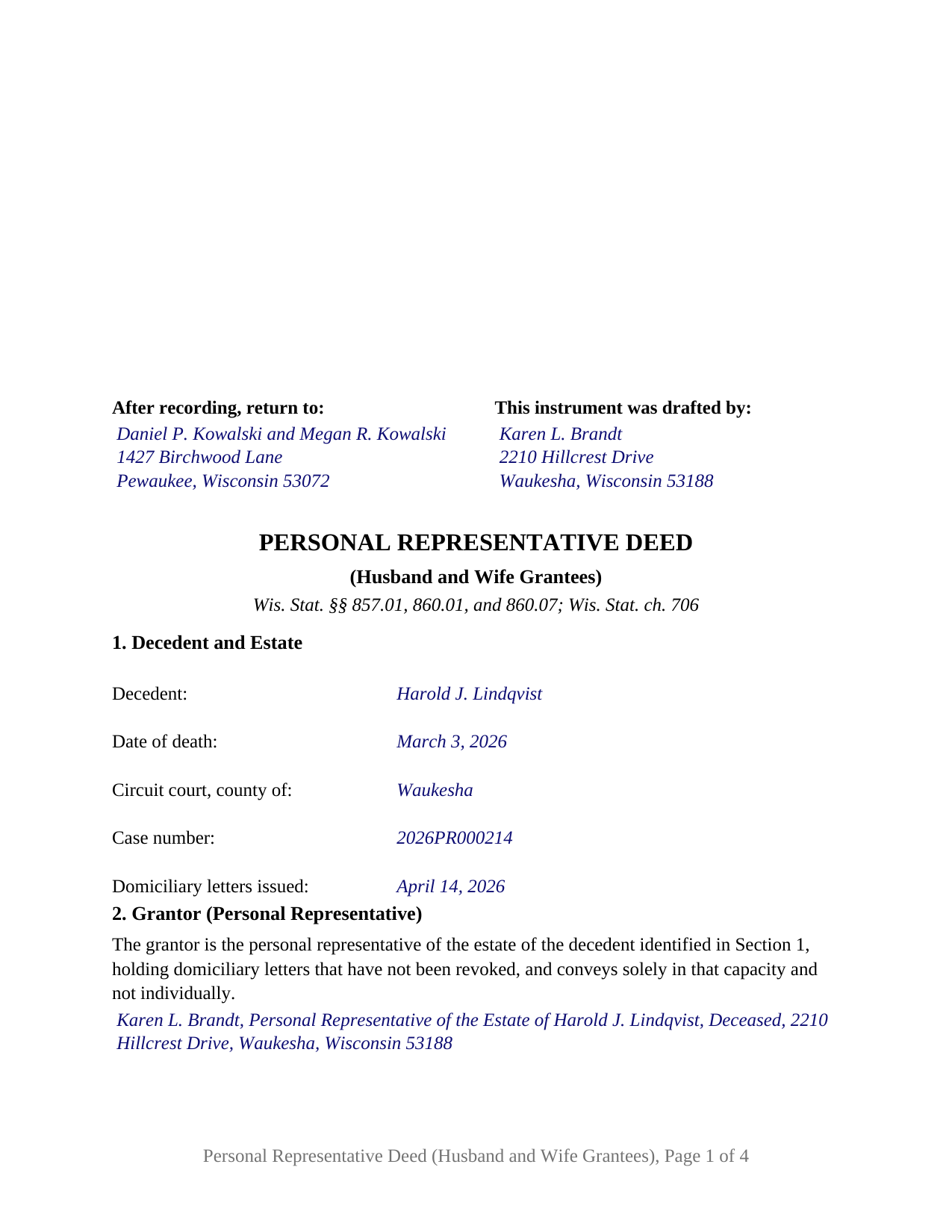
Ashland County Completed Example of the Personal Representative Deed (Husband and Wife Grantees) Document
Example of a properly completed Wisconsin Personal Representative Deed (Husband and Wife Grantees) document for reference.
All 3 documents above included • One-time purchase • No recurring fees
Immediate Download • Secure Checkout
Additional Wisconsin and Ashland County documents included at no extra charge:
Where to Record Your Documents
Ashland County Clerk
Ashland, Wisconsin 54806-1680
Hours: Monday - Friday 8:00 am - 5:00 pm
Phone: (715) 682-7008
Recording Tips for Ashland County:
- Bring your driver's license or state-issued photo ID
- Ensure all signatures are in blue or black ink
- Ask if they accept credit cards - many offices are cash/check only
- Check that your notary's commission hasn't expired
- Documents must be on 8.5 x 11 inch white paper
Cities and Jurisdictions in Ashland County
Properties in any of these areas use Ashland County forms:
- Ashland
- Butternut
- Clam Lake
- Glidden
- High Bridge
- La Pointe
- Marengo
- Mellen
- Odanah
Hours, fees, requirements, and more for Ashland County
How do I get my forms?
Forms are available for immediate download after payment. The Ashland County forms will be in your account ready to download to your computer. An account is created for you during checkout if you don't have one. Forms are NOT emailed.
Are these forms guaranteed to be recordable in Ashland County?
Yes. Our form blanks are guaranteed to meet or exceed the applicable formatting requirements used for recording in Ashland County, including margin requirements, font requirements, and other layout standards. This guarantee applies to formatting, not to the legal sufficiency of information entered by the user or the suitability of a form for a particular transaction.
Can I reuse these forms?
Yes. You can reuse the forms for your personal use. For example, if you have multiple properties in Ashland County you only need to order once.
What do I need to use these forms?
The forms are PDFs that you fill out on your computer. The free Adobe Acrobat Reader is recommended, and most PDF apps also work. You do NOT enter your property information online - you download the blank forms and complete them privately on your own computer.
Are there any recurring fees?
No. This is a one-time purchase. Nothing to cancel, no memberships, no recurring fees.
How much does it cost to record in Ashland County?
Recording fees in Ashland County vary. Contact the recorder's office at (715) 682-7008 for current fees.
Questions answered? Let's get started!
A Wisconsin personal representative deed in the husband and wife grantees configuration conveys a decedent's real property out of the estate to two grantees who are married to each other. The personal representative conveys without warranty under the sale power of Wis. Stat. section 860.01, and the deed hands the receiving side of the transaction to Wisconsin's marital property system, where the words written after the spouses' names decide whether the survivor of them takes the whole parcel without probate.
Two grantees, one marriage, and the words that classify the parcel
Wisconsin is a marital property state, and a deed to spouses is classified under chapter 766 of the statutes rather than by the common-law labels most other states use. All property of spouses is presumed to be marital property under section 766.31(2), and each spouse holds a present undivided one-half interest in it under section 766.31(3). Section 766.60 then supplies the title forms a deed to spouses may carry: the names joined by or, or by and, as marital property under subsections (1) and (2), and the same forms with the words survivorship marital property in their place under subsection (5)(a). The distinction carries real weight. Marital property held in the plain form passes the deceased spouse's one-half interest through that spouse's estate; survivorship marital property vests the deceased spouse's ownership rights solely in the surviving spouse by nontestamentary disposition at death. A deed that expresses a joint tenancy exclusively between spouses after their determination date is classified as survivorship marital property under section 766.60(4)(b)1.a., and a homestead acquired by spouses after their determination date and held exclusively between them is survivorship marital property under section 766.605 unless the instrument or a marital property agreement says otherwise.
This form fixes the grantee side as husband and wife, married to each other, and leaves the form of ownership to be written with their names, in the style the completed example shows: Daniel P. Kowalski and Megan R. Kowalski, husband and wife, as survivorship marital property. The operative clause conveys to the grantees in the form of ownership so stated, and the guide's title section walks through each form Wisconsin recognizes for a married couple, the words that create it, and what happens to the parcel at the first death under each.
A conveyance out of the estate without a court order
Wisconsin gives every personal representative holding unrevoked letters the power to sell estate property without notice, hearing, or court order, and section 860.01 adds that the rights and title of a purchaser from the personal representative are not affected by any provision in the decedent's will or by any procedural irregularity or jurisdictional defect in the administration. The power is the same whether the letters came from the circuit court in a formal administration or from the probate registrar in an informal one, because section 865.09(1) gives the registrar's appointee all the powers of a court appointee, and it is the same whether the decedent left a will or died intestate, because section 851.23 uses the one term personal representative for both. The deed's first section carries the appointment facts a title examiner reads: the decedent's name and date of death, the county whose circuit court holds the estate, the case number, and the date the domiciliary letters issued. The grantor block identifies the personal representative by name and capacity, and a fixed recital states that the grantor holds unrevoked letters and conveys solely in that capacity, never individually.
Why the deed warrants nothing, and what the buyers get instead
The conveyance paragraph conveys, without warranty, all of the estate, right, title, and interest the decedent held at death, together with any interest the estate has since acquired, and a second paragraph states that the grantor gives no warranty, personally or as personal representative, and that none binds the estate. That is the posture section 860.07 assigns to every sale by a personal representative, with a single exception for a conveyance the decedent had contracted to make with warranties. What a married couple buying from an estate receives in place of covenants is the statutory protection of section 860.05: title passes free and clear of any right of creditors that rests on the filing and allowance of a claim in the estate, though still subject to creditors holding a secured interest in the parcel, so an existing mortgage rides with the property unless it is paid and satisfied separately. The deed's exceptions section lists the matters of record the parties choose to name under a fixed sentence that keeps the listing informational.
What this configuration recites and what it does not
The form recites exactly one personal representative as grantor, a natural person signing in that capacity, and exactly two grantees, husband and wife, named together with their form of ownership and a mailing address. It carries one signature block and one acknowledgment certificate, drawn in the representative-capacity short form of Wis. Stat. section 140.16(2), with the decedent's name completing the sentence that identifies the estate on whose behalf the record was signed. A married couple buying a house from an estate, a married couple purchasing the decedent's vacant lot beside their own, and spouses named together in the decedent's will as devisees of one parcel and taking its distribution present the pattern this deed recites. The form is not set up as a conveyance to one grantee, to two grantees who are not married to each other, to three or more grantees, or to a trust or business entity, and on the grantor side it is not set up as a conveyance by copersonal representatives acting together, by a bank or trust company serving as personal representative, by a personal representative acting through an attorney-in-fact, or by a special administrator; each of those is a different configuration of the Wisconsin personal representative deed.
Sale or distribution: the fee follows the transaction
A sale by the estate to the married couple pays Wisconsin's real estate transfer fee, which section 77.22 imposes on the grantor at 30 cents for each $100 of value and which the register of deeds collects when the deed and the electronic real estate transfer return receipt are presented. A distribution to spouses who take under the will or by intestacy is a conveyance by will or descent, exempt under section 77.25(11), and the exemption line in the deed's fourth section carries that subsection because section 77.22(1) requires the reason for exemption to appear on the face of an exempt conveyance. The deed is laid out to the standard document format of section 59.43(2m), with the return and drafter blocks on page one above the title, a parcel identification number line for the counties that use them, and a blank recording area on the first page.
The package includes the fillable personal representative deed with its non-recorded instructions cover page, a completed example filled in for a Waukesha County estate sale to a married couple taking as survivorship marital property, and a guide that walks through every section, the forms of ownership available to the grantees, the statutory framework, and the recording steps at the register of deeds. The description here and the guide explain the form and the Wisconsin statutes that govern it in general terms only, and neither is legal advice.
Important: Your property must be located in Ashland County to use these forms. Documents should be recorded at the county recording office listed above.
This Personal Representative Deed (Husband and Wife Grantees) meets all recording requirements specific to Ashland County.
Our Promise
The documents you receive here are guaranteed to meet or exceed the applicable Ashland County recording format requirements. If there is a rejection caused by our formatting, we will correct the issue or refund your payment. This guarantee applies to document formatting only and does not extend to information entered by the user, the selection of the form, or the legal effect of the completed document.
Save Time and Money
Get your Ashland County Personal Representative Deed (Husband and Wife Grantees) form done right the first time with Deeds.com Uniform Conveyancing Blanks. At Deeds.com, we understand that your time and money are valuable resources, and we don't want you to face a penalty fee or rejection imposed by a county recorder for submitting nonstandard documents. We constantly review and update our forms to meet rapidly changing state and county recording requirements for roughly 3,500 counties and local jurisdictions.
4.8 out of 5 - ( 4,862 Reviews )
Pamela D K. 5 out of 5 stars
very helpful. Was unable to find what I needed, but did everything they could to help. Will try them again in the future, if need be.
Thank you for your feedback. We really appreciate it. Have a great day!
Brandon O. 5 out of 5 stars
Simple and quick recording.
We appreciate your review and your business. Thank you.
Brian O. 5 out of 5 stars
It's an instant download. I was very pleased that it included instructions and any necessary additional forms. Much easier than spending 3 hours on a county assessor's website searching for every single form. A good deal and I don't know how Deeds.com keeps up with thousands of counties. The fillable .pdf capability is a great enhancement.
Thank you for your feedback. We really appreciate it. Have a great day!
Hoang N. 5 out of 5 stars
Thank you for helping. Deeds online service is so good. I would refer to my friends or whoever if they need this services. once again you guy is doing great work
Thank you!
CHARLES V. 5 out of 5 stars
Legit. Reasonable prices.
Thank you for your feedback. We really appreciate it. Have a great day!
Michael O. 5 out of 5 stars
Received everything that was promised.
We appreciate your business and value your feedback. Thank you. Have a wonderful day!
John L. 5 out of 5 stars
First time user but very pleased with user friendly service and reasonable cost.
Thank you!
WILLIAM H. 5 out of 5 stars
i also need a "NOTE" and this trust deed is not exactly what i wanted. it may work but not to well.
Thank you for your feedback. We really appreciate it. Have a great day!
David A. 5 out of 5 stars
Excellent service. I have been looking for a beneficiary deed for quite a wile with no success. My friend found your site and I was overjoyed. Fast, easy to use, and understand.I recommend this site to anyone.
We appreciate your business and value your feedback. Thank you. Have a wonderful day!
Cynthia H. 5 out of 5 stars
Thank you for having these forms so reasonable and easy to access. I only WISH I would have looked here 1st, spent way to much valuable time trying to get help with this deed. This was so EASY and quick... THANK YOU THANK YOU Highly Recommend
Thank you!
A. S. 3 out of 5 stars
First, I am glad that you gave a blank copy, an example copy, and a 'guide'. It made it much easier to do. Overall I was very happy with your products and organization... however, things got pretty confusing and I have a pretty 'serious' law background in Real Estate and Civil law. With that said, I spent about 10+ hours getting my work done, using the Deed of Trust and Promissory note from you and there were a few problems: First, it would be FANTASTIC if you actually aligned your guide to actually match the Deed or Promissory Note. What I mean is that if the Deed says 'section (E)' then your guide shouldn't be 'randomly' numbered as 1,2,3, for advice/instructions, but should EXACTLY match 'section (E)'. Some places you have to 'hunt' for what you are looking for, and if you did it based on my suggestion, you wouldn't need to 'hunt' and it would avoid confusion. 2nd: This one really 'hurt'... you had something called the 'Deed of Trust Master Form' yet you had basically no information on what it was or how to use it. The only information you had was a small section at the top of the 'Short Form Deed of Trust Guide'. Holy Cow, was that 'section' super confusing. I still don't know if I did it correctly, but your guide says only put a return address on it and leave the rest of the 16 or so page Deed of Trust beneath it blank... and then include your 'Deed of Trust' (I had to assume the short form deed that I had just created) as part of it. I had to assume that I had to print off the entire 17 page or so title page and blank deed. I also had to assume that the promissory note was supposed to be EXHIBIT A or B on the Short Form Deed. It would be great if someone would take a serious look at that short section in your 'Short Form Deed of Trust Guide' and realize that those of us using your products are seriously turning this into a county clerk to file and that most of us, probably already have a property that has an existing Deed... or at least can find one in the county records if necessary... and make sure that you make a distinction between the Deed for the property that already exists, versus the Deed of Trust and Promissory note that we are trying to file. Thanks.
Thank you for your feedback. We'll have staff review the document for clarity. Have a great day!
Annelie A. 1 out of 5 stars
Unfortunately the forms were not useful to me, I still had to go pay a lawyer to create a deed for me.
Thank you for your feedback. We really appreciate it. Have a great day!
John G. 5 out of 5 stars
I was actually quite pleased with the ease of use of this site. I really, really liked the step by step instructions and examples of the finished product !!
Thank you!
Jamal . 5 out of 5 stars
So far so good!
Thank you!
Heidi S. 5 out of 5 stars
I had prompt service thank you
Thank you!