Wisconsin Special Warranty Deed (Individual Grantor)
County Specific Legal Forms Validated as recently as November 19, 2026 by our Forms Development Team
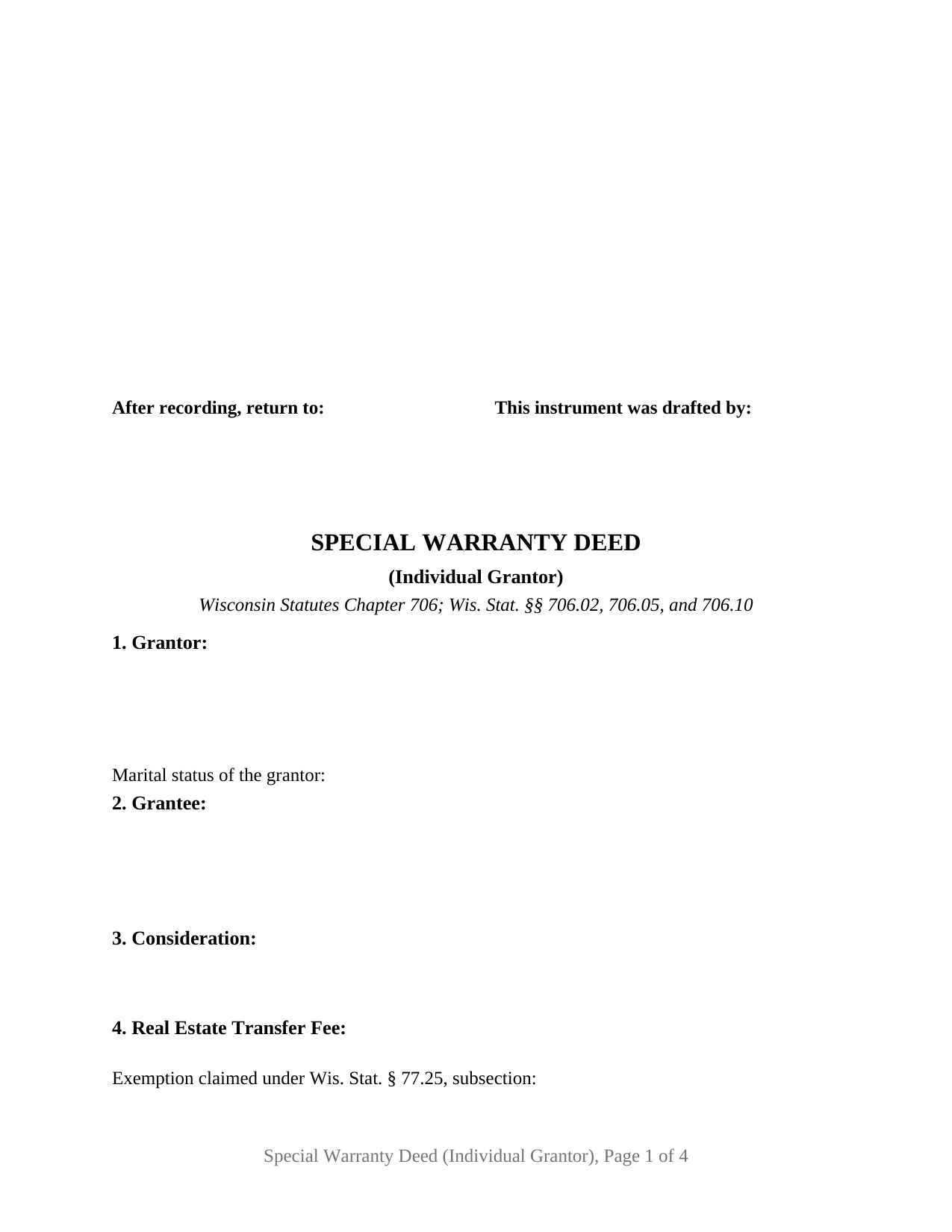
About the Wisconsin Special Warranty Deed (Individual Grantor)
How to Use This Form
- Select your county from the list
- Download the county-specific form
- Fill in the required information
- Have the document notarized if required
- Record with your county recorder's office
What Others Like You Are Saying
"Website is very easy to navigate."
"was fairly easy to work through the forms but needed better information on what goes on a few of the…"
"It's wonderful that these forms are easily accessible!"
"great service clean and accurate"
"It's always great!"
4.8/5 from 4,860 reviews. Read all
A Wisconsin special warranty deed signed by one grantor conveys the property with a promise that reaches exactly as far as the grantor's own period of ownership. This form prepares that deed for a single natural person who holds title in that person's own name: one grantor block, one grantor signature, and a second signature block for the spouse of a married grantor conveying a homestead, which Wisconsin law makes a signer of that conveyance.
A warranty that stops at the grantor's own acts
Wisconsin leaves the scope of a deed warranty to the deed itself. Under Wis. Stat. § 706.10(5), a conveyance by which the grantor warrants the land or its title is construed, except as the terms of the conveyance may otherwise provide, to include the full set of covenants: that the grantor is lawfully seized, has good right to convey, that the title is free from all encumbrance, and that the grantor will forever guarantee and defend title and quiet possession against all lawful claims originating before the conveyance. Wis. Stat. § 706.10(6) adds that no warranty or covenant is implied in any conveyance. A special warranty deed uses the opening the statute leaves. Section 8 of this form states the warranty in its own terms: title is good, indefeasible, in fee simple, and free and clear of encumbrances arising by, through, or under the grantor, except as listed in the deed, and the grantor will defend title against the lawful claims of persons claiming by, through, or under the grantor, and against no other claims. The same section states that the statutory covenants apply only as so limited, which is the express limitation § 706.10(5) permits.
The practical difference from a general warranty deed is time. A general warranty deed answers for the whole chain of title, back to its origin. This deed answers for the grantor's own ownership: a lien the grantor granted, an easement the grantor signed, a defect the grantor created. A defect that arose under a prior owner is outside the warranty, and so is anything listed among the exceptions in Section 7. A quitclaim deed, by contrast, passes whatever the grantor holds with no warranty at all under Wis. Stat. § 706.10(4). The special warranty pattern appears in the record where a grantor acquired the property at a sheriff's sale or from an estate, where investment property changes hands, and wherever a seller is willing to stand behind the seller's own acts and nothing earlier.
One grantor, and the spouse Wisconsin adds
The form recites one grantor conveying in that person's own name, with the grantor's marital status entered as a fact in Section 1. Wisconsin is a marital property state, and Wis. Stat. § 766.51(1)(am) lets a spouse acting alone manage and control marital property held in that spouse's name alone, so a married grantor whose property is not a homestead signs alone. The homestead is the exception. Wis. Stat. § 706.02(1)(f) makes a conveyance that alienates any interest of a married person in a homestead invalid unless it is signed, or joined in by separate conveyance, by each spouse, and the Wisconsin Supreme Court has enforced that rule in Weber v. Weber, 176 Wis. 2d 1085 (1993). Section 9 of this deed carries the joinder sentence, and the second signature block, captioned for the spouse of the grantor, carries the spouse's signature and its own acknowledgment certificate. An unmarried grantor, or a married grantor conveying property that is not a homestead, leaves that block blank.
The form is not set up as a conveyance by two or more grantors, which Wisconsin's marital property system makes the shape of a deed to property titled in both spouses' names, and it is not set up as a conveyance by a corporation or limited liability company, a trustee, a personal representative, or an attorney-in-fact. Each of those changes the party recital, the signing capacity, and the certificate, and each follows a different pattern. What this form carries is the individual grantor, the limited warranty, and the spouse joinder that Wisconsin attaches to a homestead.
Grantees, vesting, and the exceptions that matter
The grantee section receives one or two grantees with the words that designate how they hold: as joint tenants under Wis. Stat. § 700.19, as tenants in common, or, for spouses, as marital property or as survivorship marital property under Wis. Stat. § 766.60. The completed example conveys to a married couple as survivorship marital property, the Wisconsin form under which the surviving spouse takes the deceased spouse's interest by nontestamentary disposition. The guide's vesting section describes every form Wisconsin recognizes, the words that create each one, and why a marital property designation without the word survivorship creates no survivorship at all.
Section 7 lists the exceptions, reservations, and encumbrances to which the conveyance and the warranty are subject. On a special warranty deed that list does real work: an encumbrance the grantor created during the grantor's ownership and did not list is inside the warranty. Recorded subdivision restrictions, easements of record, a mortgage the grantee takes subject to, and current-year taxes are the entries that appear in practice.
Recording in Wisconsin
The deed is recorded with the register of deeds of the county where the land lies, for a flat $30 fee under Wis. Stat. § 59.43(2)(ag)1, and it travels with the electronic real estate transfer return that Wis. Stat. §§ 77.22 and 706.05(12) make a condition of acceptance for every conveyance. The transfer fee is 30 cents per $100 of value, paid by the grantor at recording; where an exemption under Wis. Stat. § 77.25 applies, the deed states the exemption subsection on its face, and Section 4 of the form is where that statement goes. The form is built to the standard document format of Wis. Stat. § 59.43(2m): a 3 by 3 inch blank recording area in the upper right corner of the first page, the document name within the top 6 inches, return information on the first page, the drafter's name that § 59.43(5)(a) requires, and a parcel identification number line for the counties that require one.
The package includes the fillable form, a completed example filled in for a Dane County fact pattern, and the guide that describes each section, the Wisconsin vesting forms, the homestead joinder rule, and the recording process. This description and the guide describe the form and the governing statutes in general terms; they are not legal advice.
Important: County-Specific Forms
Our special warranty deed (individual grantor) forms are specifically formatted for each of the 72 counties in Wisconsin.
After selecting your county, you'll receive forms that meet all local recording requirements, ensuring your documents will be accepted without delays or rejection fees.