Wisconsin Trustee Deed (Husband and Wife)
County Specific Legal Forms Validated as recently as November 20, 2026 by our Forms Development Team
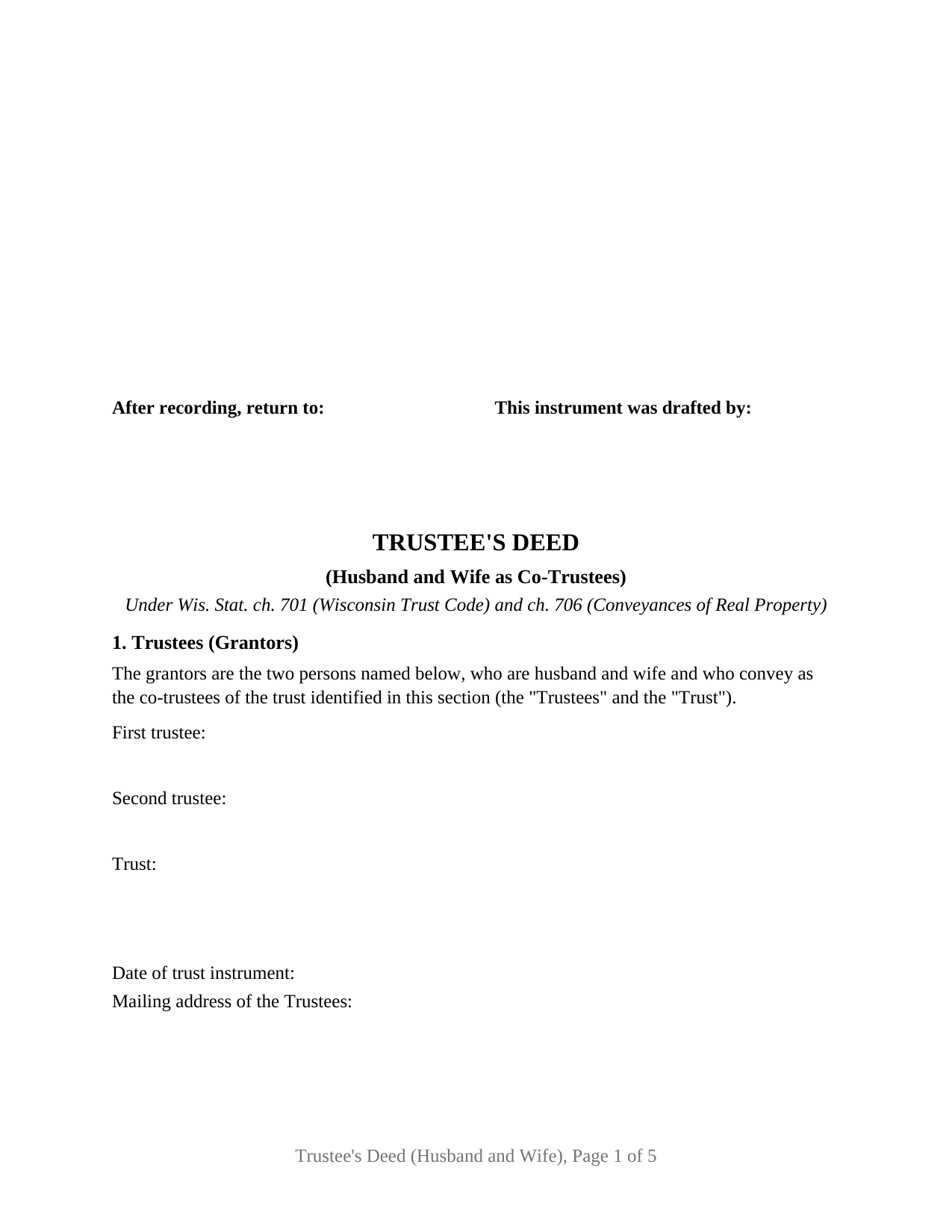
About the Wisconsin Trustee Deed (Husband and Wife)
How to Use This Form
- Select your county from the list
- Download the county-specific form
- Fill in the required information
- Have the document notarized if required
- Record with your county recorder's office
What Others Like You Are Saying
"Seamless transaction. Was pleased with the additional information that was provided. Thank you!"
"Good, easy to use, quit claim form worked as expected."
"Great service and instructions are excellent."
"Information found, thank you. I own Ground Rent on property and needed to know name of property owne…"
"So far it has been a good experience. I am working on getting a beneficiary deed."
4.8/5 from 4,862 reviews. Read all
When a married couple serve together as the two co-trustees of a Wisconsin trust, a deed out of that trust carries two signatures and two trustee acknowledgments, and the Wisconsin Trust Code is the reason: Wis. Stat. sec. 701.0703(1) provides that cotrustees may act only by majority decision, and a majority of two is both. This Wisconsin Trustee Deed (Husband and Wife) is written for exactly that configuration. It recites two grantors who are husband and wife, conveying as the co-trustees of one named trust, and it conveys whatever right, title, and interest the trustees hold in the described property to the grantee named in the deed.
Two spouses, one trust, both signatures
The deed identifies the trust by its name and by the date of its trust instrument, names each spouse as a trustee, and states in a fixed sentence that the two grantors are husband and wife conveying as co-trustees. Nothing about the spouses' own ownership is recited, because the title the deed passes is the title the trustees hold. That is the pattern a joint revocable living trust produces: the couple deeded the property to themselves as co-trustees years ago, and the trustee's deed is how a parcel leaves the trust on a sale to a purchaser, a distribution to a child or other beneficiary, or a transfer to a successor trust.
Both spouses sign, each in the trustee capacity, and the deed carries a separate acknowledgment certificate for each of them. The certificates use the short form Wis. Stat. sec. 140.16(2) supplies for an acknowledgment in a representative capacity, with the trust's name entered after the words as trustee of, so the public record shows that each spouse acknowledged the deed as trustee rather than as an individual owner. Two certificates also let the spouses acknowledge on different days or before different officers, which the completed example illustrates with a Dane County acknowledgment on one date and a Rock County acknowledgment two days later.
A covenant that stops at the trustees' own acts
Wisconsin prescribes no statutory trustee's deed, and Wis. Stat. sec. 706.10(6) provides that no warranty or covenant is implied in any conveyance, so a trustee's deed carries exactly the covenants it states. This form states one. The trustees covenant, in their capacity as trustees and not individually, that while holding title they have not conveyed, mortgaged, or otherwise encumbered the property except as the deed lists, and that the trust will defend against claims arising by, through, or under the trustees in that capacity. The deed then states that no other covenant or warranty of title is made. The limitation tracks sec. 701.0815(3), under which a trustee has no power to give warranties in a sale, mortgage, or lease that are binding on the trustee personally; the covenant binds the trust property, and the full warranty covenants of sec. 706.10(5) do not arise because the deed's terms provide otherwise.
The deed also carries the trustees' statement that the trust is in existence, that they are its currently acting co-trustees, and that the trust instrument authorizes the conveyance. A purchaser or lender who deals with a trustee in good faith and for value is protected by sec. 701.1012 without inquiring into the extent of the trustee's powers, and a certification of trust under sec. 701.1013, prepared separately and not included in this package, is the document a trustee may furnish in place of the trust instrument.
Why marriage between the trustees matters
Wisconsin's homestead rule, Wis. Stat. sec. 706.02(1)(f), requires a conveyance that alienates any interest of a married person in a homestead to be signed or joined in by each spouse. Whether that paragraph reaches a trustee's conveyance of a residence held in trust is a question this configuration never has to answer on the face of the deed, because both spouses sign it. The deed therefore carries no separate spousal joinder block, and the guide explains the marital property and homestead rules that stand behind that design.
Built for Wisconsin's register of deeds
The deed's first page carries the return address and the drafter's name above the title and keeps a blank recording area of at least 3 by 3 inches in the upper right corner, the standard document format of sec. 59.43(2m)(a) that every Wisconsin register applies. The property section takes the full legal description, the parcel identification number, the street address, and the document number of the deed by which the trustees took title. A transfer fee line lets the trustees state an exemption by its sec. 77.25 subsection where one applies, as sec. 77.22(1) requires on the face of an exempt conveyance; a distribution from a trustee to a beneficiary without actual consideration is exempt under sec. 77.25(9), while a sale pays the fee of $3 per $1,000 of value through the electronic real estate transfer return that accompanies every deed. The recording fee is $30 per document statewide.
What this configuration is and is not
The form recites exactly two trustees who are married to each other and who act for one trust; the signature blocks, the capacity sentence, and the two representative-capacity certificates are fixed to that pattern. Spouses selling the family home out of their joint revocable trust, a couple distributing a lake lot to an adult child from the trust that holds it, and a married pair serving as successor co-trustees of a parent's trust all present the pattern this deed recites. The grantee side is open: one or more individuals, a married couple taking as survivorship marital property as the example shows, an entity, or another trust. The form is not set up as a deed by a single trustee, a corporate trustee, a trustee acting through an attorney-in-fact, two co-trustees who are not married to each other, or three or more co-trustees, and it is not set up for spouses who hold title in their own names rather than in trust.
The download holds three files: the fillable Wisconsin trustee's deed with its instructions cover page, a completed example filled in for a Dane County sale by two co-trustees, and a plain language guide to every blank, the signing and notarization rules, and the recording package. These materials describe Wisconsin law in general terms and are not legal advice.
Important: County-Specific Forms
Our trustee deed (husband and wife) forms are specifically formatted for each of the 72 counties in Wisconsin.
After selecting your county, you'll receive forms that meet all local recording requirements, ensuring your documents will be accepted without delays or rejection fees.