Wisconsin Trustee Deed (Individual)
County Specific Legal Forms Validated as recently as November 20, 2026 by our Forms Development Team
About the Wisconsin Trustee Deed (Individual)
How to Use This Form
- Select your county from the list
- Download the county-specific form
- Fill in the required information
- Have the document notarized if required
- Record with your county recorder's office
What Others Like You Are Saying
"Turn time was great. Highly recommend."
"Very easy site to use and reasonably priced. My document was received by the county and filed within…"
"The process of obtaining the forms that I wanted was very easy and the cost reasonable. The site is …"
"I got exactly what I paid for. No fraudulent transaction on my card. I like that. This is an excelle…"
"OUtsdtanding. Quick and easy, both of which are a huge plus"
4.8/5 from 4,862 reviews. Read all
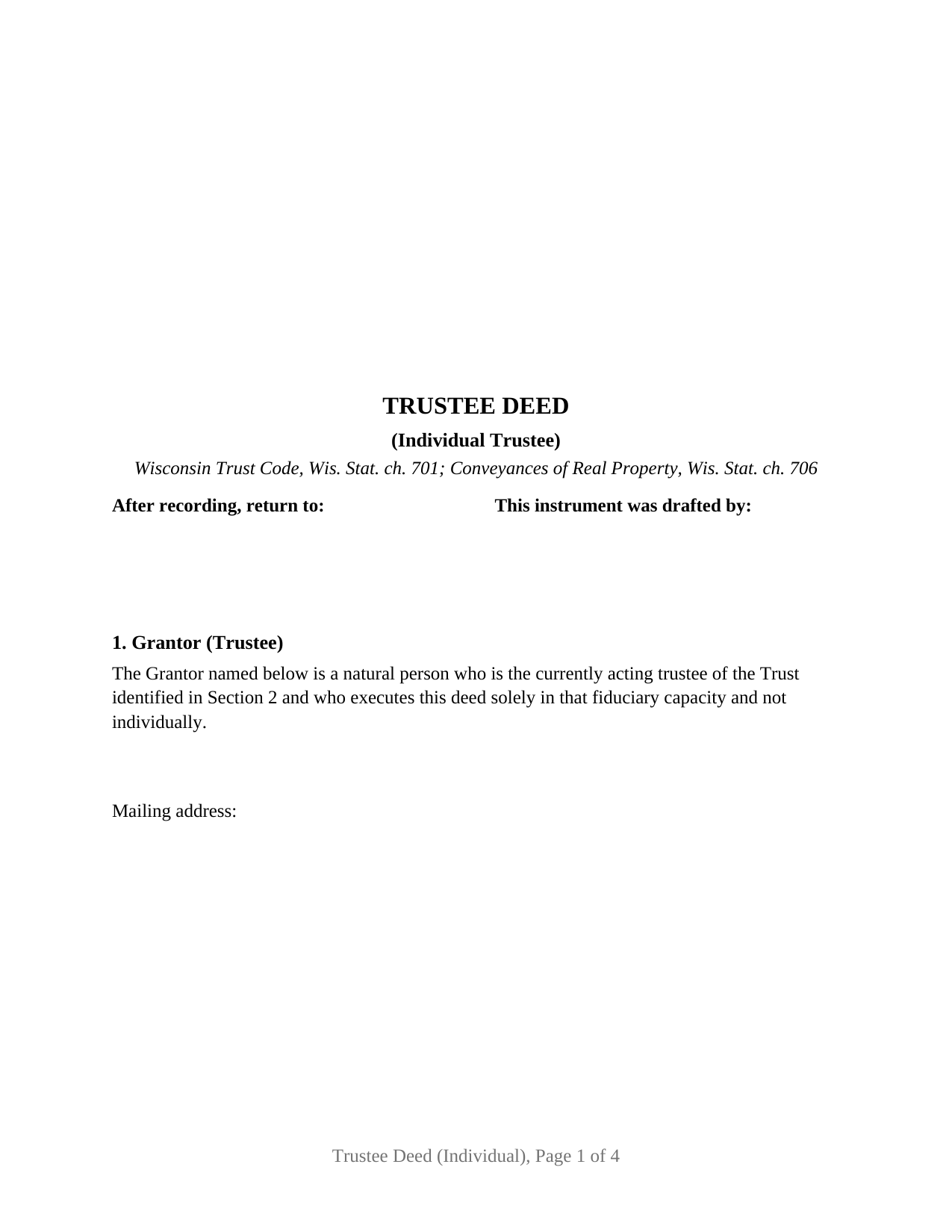
A Wisconsin trustee deed on this form is signed by one person: the natural person who is the currently acting trustee of a trust, signing as trustee and in no other capacity. The deed conveys real estate the trust holds to a buyer or to a beneficiary, states the trustee's authority under the trust instrument and the Wisconsin Trust Code, and gives one limited warranty, against claims arising by, through, or under the trustee, and nothing beyond it. One signature line and one acknowledgment certificate in a representative capacity complete it.
One trustee, signing as trustee
The grantor section of the deed states, as fixed text, that the grantor is a natural person who is the currently acting trustee of the trust identified in the deed and who executes the deed solely in that fiduciary capacity and not individually. The trustee's name follows that sentence, with the word Trustee after it, and the signature block prints the same name and capacity so the register of deeds indexes the grantor as the trustee. The acknowledgment certificate is the Wisconsin short form for an acknowledgment in a representative capacity under Wis. Stat. sec. 140.16 (2): the notarial officer certifies that the record was acknowledged by the named individual as Trustee of the named trust, which is the party on whose behalf the record was executed.
A trust administered by a single individual trustee, whether the original trustee or a successor who has accepted the trusteeship, presents the one-signer pattern this deed recites. A trust with cotrustees who are required to act together carries a signature and a certificate for each signing cotrustee, a corporate trustee signs through an authorized officer, and a trustee who acts through an attorney-in-fact carries the agent's capacity on the page; each of those is a different configuration, and this form is not set up as any of them.
Authority the deed states, and the law that stands behind it
The deed identifies the trust by its full name and the date of the trust instrument, names the settlor, and identifies by document number the recorded deed by which the trustee took title. Its operative paragraph then conveys, in the trustee's representative capacity and under the authority conferred by the trust instrument and by Wis. Stat. secs. 701.0815 and 701.0816 (2), all of the estate, right, title, and interest the trustee holds as trustee of the trust, together with the rents, profits, fixtures, and other appurtenant interests. Sec. 701.0815 (1) gives a trustee, without court authorization, every power over trust property that an unmarried, competent owner has over individually owned property, except as the terms of the trust limit it, and sec. 701.0816 (2) names the power to sell property at public or private sale among the trustee's specific powers.
Wisconsin's recording law adds a presumption written for exactly this instrument. Under Wis. Stat. sec. 706.08 (4), a person who is designated as trustee, holds an interest in land as trustee, and conveys that interest as trustee to a good faith purchaser is conclusively presumed to be a trustee of a valid express trust with full power of conveyance where the trustee's authority and powers are not set forth in a recorded instrument. Sec. 701.1012 (2) separately provides that a person dealing in good faith with a trustee is not required to inquire into the extent of the trustee's powers. A certification of trust under sec. 701.1013 remains the document a trustee furnishes to a purchaser or title company that asks for evidence of the trust's existence and terms; it is prepared separately and is not included in this package.
A limited warranty, and nothing beyond it
The deed conveys with the word conveys, which under Wis. Stat. sec. 706.10 (3) passes all of the estate and interest the trustee holds, and it then gives one covenant drawn narrowly: the trustee warrants, solely as trustee, that the trustee has not conveyed the same estate to anyone else, that the property is free from encumbrances the trustee made or suffered except those the deed lists, and that the trustee will defend the title against claims by, through, or under the trustee, and not otherwise. Under secs. 706.10 (5) and (6) the full statutory covenants arise only where the grantor warrants and the deed's terms do not otherwise provide, and no warranty is implied in any conveyance; this deed's terms otherwise provide, and it says on its face that no other warranty, express or implied, arises under it. The covenant binds the trust and the trust property only, not the trustee personally, which is the line sec. 701.0815 (3), created by 2023 Wisconsin Act 127, draws for every trustee's sale. The grantee therefore takes what the trust held, subject to the mortgages, easements, restrictions, and taxes that attached before the trustee took title, with a warranty that reaches the trustee's own acts and no further.
Sale or distribution: the two entries that differ
The same deed serves a sale of trust real estate and a distribution of it to a beneficiary, and the two transactions differ on the page in two places. The consideration entry states the price on a sale and states that no consideration was paid on a distribution. The transfer fee entry states the Wis. Stat. sec. 77.25 subsection under which the conveyance is exempt from the real estate transfer fee, because sec. 77.22 (1) requires the reason for an exemption to appear on the face of the conveyance; a distribution from a trustee to a beneficiary without actual consideration is exempt under sec. 77.25 (9), while a sale for a price pays the fee of 30 cents per $100 of value. A conveyance on this form files the Department of Revenue's electronic real estate transfer return whether or not it is exempt from the fee, and the register of deeds accepts the deed for recording with the return receipt and the $30 recording fee of sec. 59.43 (2) (ag). The completed example included with the package illustrates a distribution to a beneficiary in Waukesha County.
Built to the Wisconsin standard document format
The first page carries the document name within the top six inches, the return address block, and the drafter's name, with the upper right three inch by three inch recording area left blank, as Wis. Stat. sec. 59.43 (2m) (a) describes; the parcel identification number has its own entry for the counties that require one, and every entry prints in 12 point type on letter size pages. The form asks for no Social Security number, which sec. 59.43 (1m) bars from recorded documents. An instructions cover page, which is not recorded, explains how an entry that outgrows its space continues on a recorded exhibit page.
The package includes the fillable trustee deed form, a completed example filled in for a realistic Wisconsin fact pattern, and the guide that walks through every numbered section, the signing and acknowledgment steps, and recording with the register of deeds. This description and the guide describe the form and the governing Wisconsin statutes in general terms; they are not legal advice.
Important: County-Specific Forms
Our trustee deed (individual) forms are specifically formatted for each of the 72 counties in Wisconsin.
After selecting your county, you'll receive forms that meet all local recording requirements, ensuring your documents will be accepted without delays or rejection fees.