Wyoming Affidavit of Survivorship (Remainderman)
County Specific Legal Forms Validated as recently as November 11, 2026 by our Forms Development Team
About the Wyoming Affidavit of Survivorship (Remainderman)
How to Use This Form
- Select your county from the list
- Download the county-specific form
- Fill in the required information
- Have the document notarized if required
- Record with your county recorder's office
What Others Like You Are Saying
"Your Personal Representative's Deed and example for the state of PA were extremely helpful. Exactly …"
"I finally was able to download the forms. Thank you and I know I will be able to use your service an…"
"I thought your forms are great. Easy to use with instructions provided."
"Very helpful information! Thank you for your service!"
"The forms that I downloaded from Deeds were perfect for what I needed. I even checked with a lawyer …"
4.8/5 from 4,849 reviews. Read all
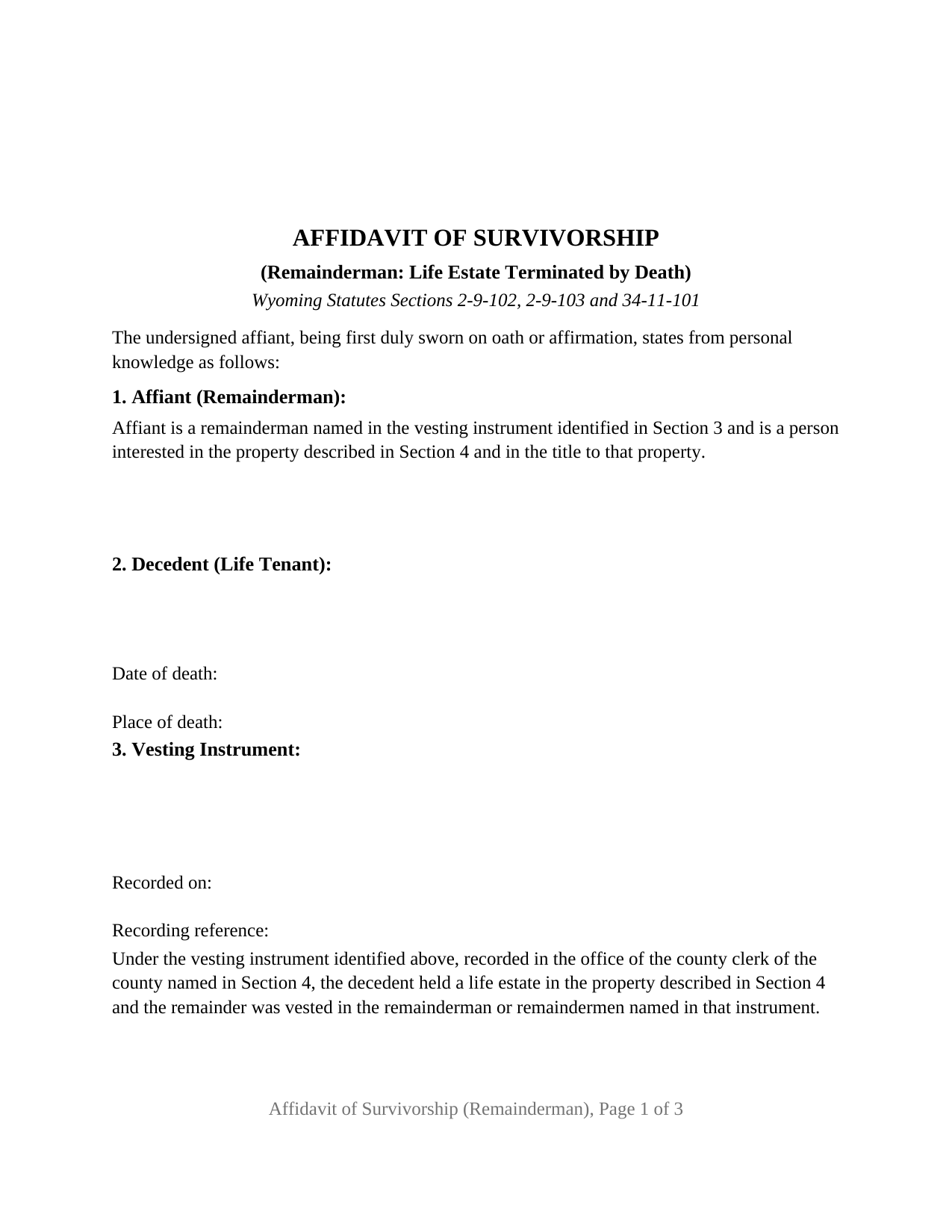
When a Wyoming life tenant dies, the life estate ends by the terms of the deed that created it, but the county land records still show the life tenant as an owner until someone places the death on the record. This form prepares the instrument that does that: a Wyoming affidavit of survivorship made by the remainderman, sworn before a notarial officer, and recorded with a certified copy of the life tenant's death certificate under Wyoming Statutes Section 2-9-102. It is written for one affiant, the remainderman named in the recorded vesting instrument, and for a life estate that terminated by reason of the life tenant's own death.
A death that ends an estate the record still shows
A life estate deed, whether the grantor reserved a life estate and conveyed the remainder or granted a life estate to one person with the remainder to another, vests both interests the day it is recorded. The remainderman's interest is already created; what the remainderman lacks after the life tenant's death is proof in the records that the measuring life has ended. Wyoming gives two routes to that proof. Section 2-9-101 is a petition in district court, with publication, a hearing, and a recorded decree. Section 2-9-102 is the nonjudicial route this affidavit follows, and Section 2-9-103 declares it independent of the court procedure. Any person interested in the property or its title may record, in the office of the county clerk of the county where the property is situated, an affidavit describing the property, identifying the instrument under which the estate was vested with its recording references, and certifying under oath to the death of the decedent as the person named in that instrument whose death terminated the decedent's estate.
What the affidavit swears to
The form carries the elements the statute names and the elements Section 34-11-101 adds for any recorded affidavit affecting title. Section 1 identifies the affiant as a remainderman named in the vesting instrument and a person interested in the property, the standing Section 2-9-102 requires. Section 2 identifies the decedent, the life tenant, with the date and place of death taken from the death certificate. Section 3 identifies the vesting instrument by title, date, parties, recording date, and document number or book and page. Section 4 carries the county, the legal description copied from the vesting instrument, and the street address. Section 5 names every owner of record at the time of recording, the item Section 34-11-101(c) requires so that the county clerk can index the affidavit in the record owner's name. Section 6 is the sworn certification itself, in words that track the statute: the affiant certifies under oath to the death of the decedent as the person named in the vesting instrument whose death terminated the decedent's life estate in the property, states that the certified copy of the official death certificate is attached, and states personal knowledge of the facts and competence to testify to them.
Once recorded, the affidavit is prima facie evidence that the facts stated in it are true, under both Section 2-9-103 and Section 34-11-101(a). It conveys nothing, creates nothing, and divides nothing; the remainder is whatever the vesting instrument made it, held by whomever that instrument named. A title examiner, a buyer, or a lender reading the chain of title finds the deed that created the remainder, the recorded affidavit, and the certified death certificate behind it, and the record then shows the remainderman's estate free of the life estate that preceded it.
One affiant, one sworn certificate
This configuration identifies exactly one affiant and fixes that affiant's role on the face of the instrument: a remainderman under the recorded vesting instrument, swearing to the death of the life tenant whose own life measured the estate. The form carries one signature block and one verification on oath or affirmation, the jurat Wyoming's notarial law describes in Section 32-3-115(a)(iii), printed in the statutory sentence verbatim. Section 34-11-101(a) states that a certificate of acknowledgment is not required on an affidavit containing a jurat in order to be recorded, so the affidavit is sworn rather than acknowledged, and no witness and no spouse signs it; the homestead joinder rule of Section 34-2-121 reaches conveyances, mortgages, and encumbrances, and this instrument is none of those. Where a vesting instrument names two or more remaindermen, the statute lets any interested person make the affidavit, and one remainderman's affidavit places the death on the record for the whole property while Section 5 lists every owner of record. A surviving joint tenant, a surviving spouse under an estate by the entireties, and a transfer on death deed beneficiary each prove a death by a different pattern, and the form's fixed text does not describe them.
Recording with the certified death certificate
The affidavit goes to the county clerk of the county where the property is situated with the certified copy of the death certificate attached behind it. For a death in Wyoming, the Wyoming Department of Health's Vital Statistics Services issues certified copies to entitled persons; a death elsewhere is certified by that state's vital records office. Recording fees are set statewide by Section 18-3-402(a)(xvi), twelve dollars for the first page and three dollars for each additional page, with the attached certificate counted among the pages, and Wyoming levies no transfer tax. The form reserves the top two inches of its first page for the clerk's recording label, keeps one-inch margins elsewhere, and prints the affiant's name beneath the signature line, the operational standards the larger county clerks' pages describe. A statement of consideration under Section 34-1-142 accompanies an instrument that transfers title; this affidavit transfers nothing, and the guide describes how that statute reads against a survivorship affidavit and what each county clerk's office states as its own practice.
The package includes the fillable affidavit, a completed example filled in for a fictional Laramie County life estate deed, and the guide that walks through every numbered section, the signing formalities, and the recording process. This description and the guide describe the form and the governing Wyoming statutes in general terms; they are not legal advice.
Important: County-Specific Forms
Our affidavit of survivorship (remainderman) forms are specifically formatted for each of the 23 counties in Wyoming.
After selecting your county, you'll receive forms that meet all local recording requirements, ensuring your documents will be accepted without delays or rejection fees.