Wyoming Affidavit of Survivorship (Surviving Spouse)
County Specific Legal Forms Validated as recently as November 11, 2026 by our Forms Development Team
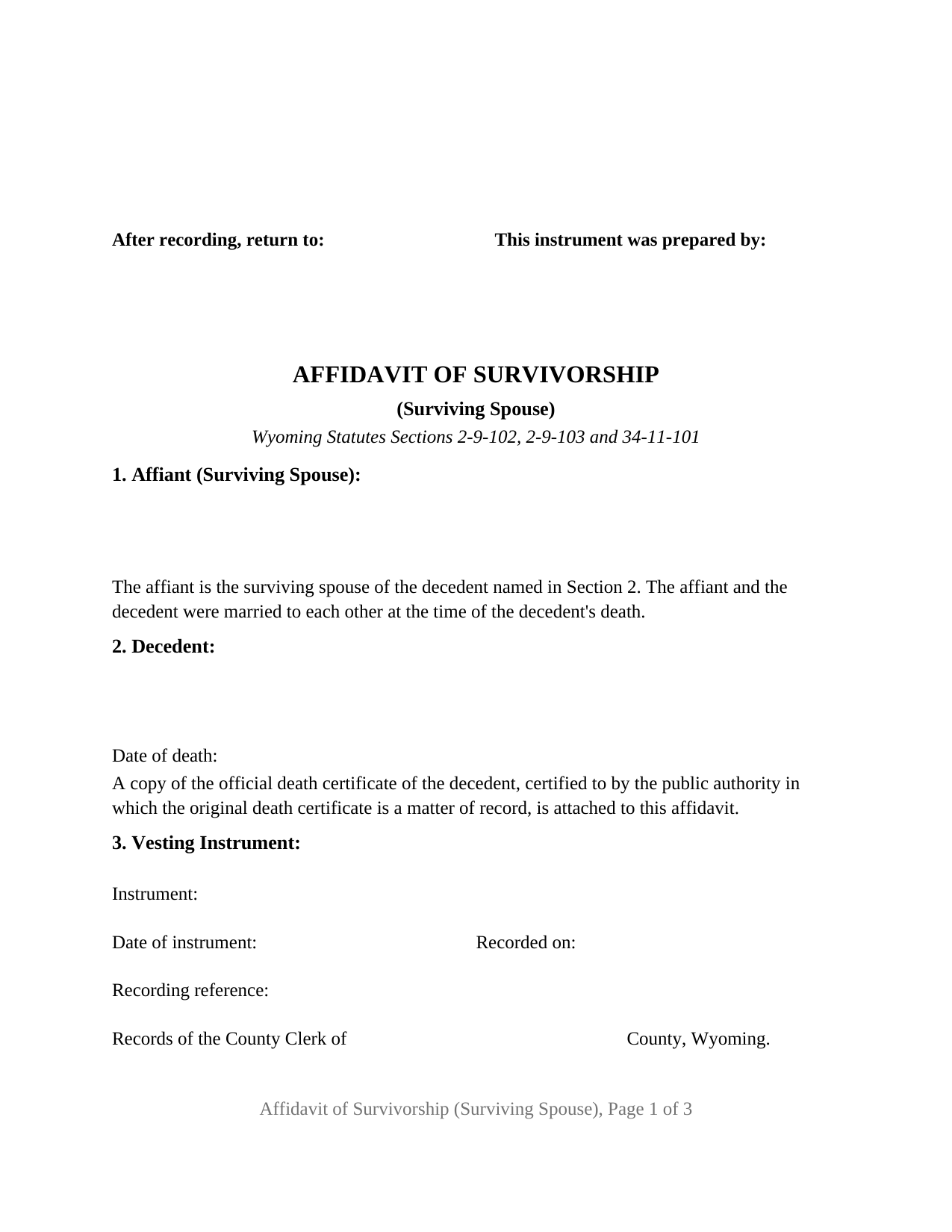
About the Wyoming Affidavit of Survivorship (Surviving Spouse)
How to Use This Form
- Select your county from the list
- Download the county-specific form
- Fill in the required information
- Have the document notarized if required
- Record with your county recorder's office
What Others Like You Are Saying
"Great documents! with complete instructions and the CTC as well. I work with a lot of recordings and…"
"Great service once again from Deeds.com. I will be using them again in the future."
"Easy to download, helpful information and forms quick when you need them. Thank you Deeds.com."
"What a great website. It does Pasco County PROUD !!"
"I have to admit this process was a scary one but you have made it very clear and simple to follow al…"
4.8/5 from 4,849 reviews. Read all
When one spouse dies and the couple held their Wyoming real estate as tenants by the entirety, the surviving spouse already owns the whole property; what the public record lacks is proof of the death. This Wyoming Affidavit of Survivorship (Surviving Spouse) is the sworn statement that supplies it. One affiant, the surviving spouse, signs a single affidavit, attaches a certified copy of the death certificate, and records both with the county clerk of the county where the property is situated, as Wyoming Statutes Section 2-9-102 provides.
Survivorship did the work; the affidavit records it
A tenancy by the entirety in Wyoming exists only between spouses, and the survivor takes the whole estate at the other spouse's death. No deed, no probate, and no court order moves the title, because the vesting deed already did. Section 2-9-102 lets any person interested in the property make the death a matter of record by recording an affidavit that describes the property, identifies the vesting instrument with its recording data, and certifies under oath to the death of the decedent as the party whose death terminated that person's estate under the vesting instrument. Section 2-9-103 then gives the recorded affidavit its standing: an affidavit signed, sworn to, and recorded substantially in compliance with the statute is prima facie evidence that the facts stated in it are true. The procedure is permissive and nonjudicial, and it stands apart from the district court petition that Section 2-9-101 offers for a decree on the same question.
One affiant, married to the decedent at death
This configuration is written for the surviving spouse and nothing else. The affidavit prints as fixed text that the affiant is the surviving spouse of the decedent and that the two were married to each other at the time of death; that under the vesting instrument the affiant and the decedent, as spouses, held title as tenants by the entirety; and that by reason of the death the estate by the entirety remains vested solely in the affiant as the surviving spouse, the result Wyoming's statute describes for an entirety estate. The sworn statements add that the tenancy had not been terminated by divorce, annulment, or conveyance before the death, which matters because Wyoming Statutes Section 2-6-125 severs the entirety on divorce and leaves former spouses as tenants in common. The variable entries are the names, the date of death, the deed's date and recording reference, the record owners exactly as the deed names them, the legal description, and the street address and parcel number. The form carries one signature block and one notarial certificate; it recites exactly one affiant signing in that person's own right, so a surviving joint tenant who was not the decedent's spouse, a remainder holder after a life estate, a personal representative, and an attorney-in-fact each follow a different pattern that this affidavit does not recite.
Spouse wording in the deed is enough
Wyoming spells out when spouses hold by the entirety. Section 34-1-140(a) lets an owner create a tenancy by the entirety by naming the tenants in the deed itself, and subsection (b), added in 2023, deems a deed that names its grantees as husband and wife, spouses, or similar language to create a tenancy by the entirety unless the deed specifies another form of ownership. The Wyoming Supreme Court treated that subsection as a clarification of existing law in 2026. So a deed to two people described as husband and wife, with no other ownership form stated, is the deed this affidavit describes, and the form's Section 3 asks for the record owners copied word for word from that deed so the entirety wording appears in the affidavit itself. A deed to spouses that instead names them as joint tenants with right of survivorship, or as tenants in common, presents a different pattern that this configuration does not recite.
Sworn, not acknowledged
An affidavit is sworn to before a notarial officer, so the certificate on this form is a verification on oath or affirmation, the jurat form Wyoming Statutes Section 32-3-115 provides, rather than an acknowledgment. Section 34-11-101, Wyoming's statute on recorded affidavits affecting title, provides that a certificate of acknowledgment is not required on an affidavit containing a jurat in order to be recorded, and it makes the recorded affidavit evidence of the facts stated insofar as they affect title. The form reserves a labeled area for the officer's official stamp, the rectangular stamp Section 32-3-116 describes, so the impression stays clear of the certificate text and reproduces cleanly. The affiant's mailing address, the clerk's return block, and the document title sit where Wyoming county clerks look for them, under a two-inch top margin on the first page that satisfies the recording-label rules the larger county clerks publish.
What goes to the clerk
The affidavit is recorded in the county where the property lies, with the certified death certificate attached behind it. Wyoming sets recording fees statewide at twelve dollars for the first page and three dollars for each additional page, and it imposes no state transfer tax or documentary stamp tax. Wyoming's sworn Statement of Consideration accompanies a deed, contract, or other document transferring title; a survivorship affidavit transfers nothing, and the guide explains how that statute reads against a document that records a death; county intake practice on the point belongs to the recording county's clerk. The clerk indexes the affidavit under the record owner's name in the same manner as a deed.
The package includes the fillable affidavit of survivorship form, a completed example filled in for a Laramie County fact pattern, and the guide that walks through each section of the form, the statutes behind it, the notarial certificate, and the recording process. This description and the guide describe the form and the governing Wyoming statutes in general terms; they are not legal advice.
Important: County-Specific Forms
Our affidavit of survivorship (surviving spouse) forms are specifically formatted for each of the 23 counties in Wyoming.
After selecting your county, you'll receive forms that meet all local recording requirements, ensuring your documents will be accepted without delays or rejection fees.