Wyoming Easement Deed (Husband and Wife)
County Specific Legal Forms Validated as recently as November 12, 2026 by our Forms Development Team
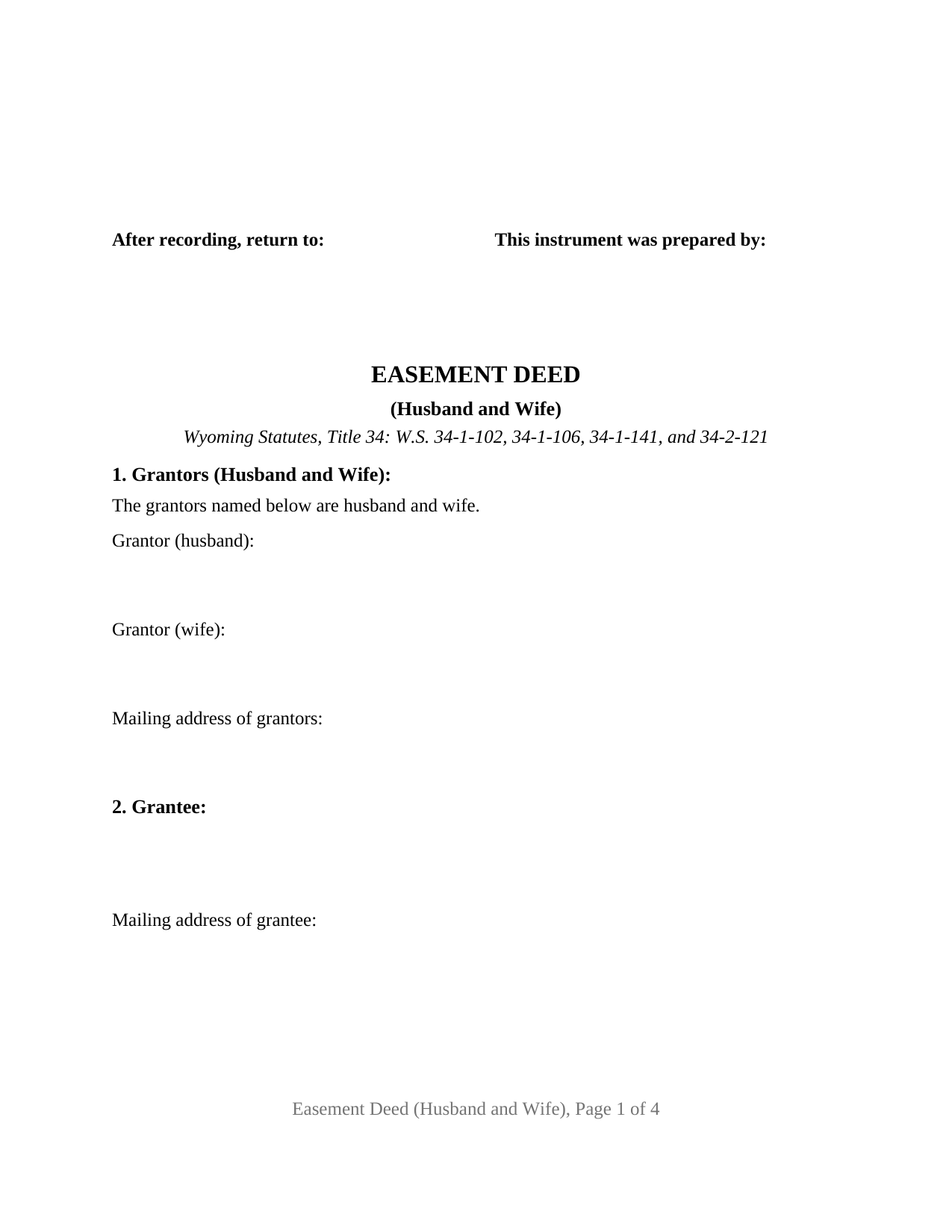
About the Wyoming Easement Deed (Husband and Wife)
How to Use This Form
- Select your county from the list
- Download the county-specific form
- Fill in the required information
- Have the document notarized if required
- Record with your county recorder's office
What Others Like You Are Saying
"This was a very easy process to find the correct documents and download them. The price was also rea…"
"The process was easy and the Staff was very helpful. Document was recorded quickly."
"The instructions were really clear and the site user friendly"
"If my availability does not coincide with your business hours it should not prevent me from uploadin…"
"This process exceeded my expectations. A great customer experience!"
4.8/5 from 4,853 reviews. Read all
When a married couple in Wyoming grants a neighbor a driveway, a utility company a line corridor, or an adjoining owner a water line route across their land, the easement deed carries two signatures and two acknowledgments, one for each spouse, because the land they burden is very often their homestead. This Wyoming Easement Deed (Husband and Wife) is built around that pattern: two grantors who are husband and wife, one perpetual easement, and the homestead release Wyoming law describes for a married owner's encumbrance.
Why both spouses sign a Wyoming easement
An easement is an encumbrance on the land it crosses. W.S. 34-2-121 provides that every owner or occupant of a Wyoming homestead may voluntarily sell, mortgage, or otherwise dispose of or encumber it, provided the instrument contains, in substance, a release and waiver of all rights under the homestead exemption laws of this state and is freely and voluntarily signed and acknowledged by the owner and the owner's spouse. The section's title states the consequence: a conveyance or encumbrance of a homestead is void unless the spouse joins. This deed carries the release sentence in the statute's own substance inside its operative section, recites that the grantors are husband and wife, and prints a signature block headed GRANTOR (HUSBAND) and another headed GRANTOR (WIFE). Each block is followed by its own acknowledgment certificate in the W.S. 32-3-115 short form, so the spouses may acknowledge on different days or before different officers; that separate-certificate layout is a feature of the form rather than a Wyoming requirement.
An easement that locates itself on the page
Wyoming is unusual in making the easement's location a condition of its existence. Under W.S. 34-1-141, an easement across land that does not specifically describe the location of the easement is null and void, with a one-year window to record a specific description, and the description is one sufficient to locate the easement rather than a survey. The deed separates the two descriptions the statute makes necessary. Section 4 carries the legal description of the servient property, copied from the couple's vesting deed. Section 5 carries the easement area itself, introduced by a fixed sentence stating that the easement is located on the following specifically described portion of the servient property, with six lines for a strip measured from a lot line, a metes and bounds call, or a reference to an attached sketch recorded with the deed. Section 6 states the purpose, and the grant in Section 8 conveys a perpetual easement over, under, across, and upon that area for that purpose, with reasonable access to use it.
Appurtenant to the neighbor's lot, or held in gross
Section 7 identifies the benefited property, the land the easement serves, and the operative section ties the result to that entry: where a benefited property is identified, the easement is appurtenant to it and passes with it; where none is identified, the easement is held by the grantee in gross. The Wyoming Supreme Court describes an appurtenant easement as one created to benefit the possessor of particular land in the use of that land, states a strong preference to construe an easement as appurtenant rather than in gross, and holds that an appurtenant easement passes automatically with the dominant land even when a later deed does not mention it (Smithson v. Lindzey, 2021 WY 15; Upper Wagon Box, LLC v. Box Hanging Three Ranch, 2022 WY 155). The deed extends the easement to the grantee's heirs, successors, and assigns in either case, which is one of the six badges of an appurtenant easement those decisions list.
What the deed warrants, and what it does not
The operative words are grant and convey, and the deed states that it is made without any covenant of warranty. W.S. 34-1-135 provides that no covenant is implied in a conveyance of Wyoming real estate other than a conveyance of oil, gas or other minerals, and the statutory warranty covenants of W.S. 34-2-103 attach only to a deed in the conveys-and-warrants form of W.S. 34-2-102, which this deed does not use. A prior mortgage or easement of record continues to bind the land under the race-notice rules of W.S. 34-1-120 and 34-1-121, which are also what make prompt recording with the county clerk the grantee's protection against a later purchaser.
The configuration this deed recites
The form recites exactly two grantors, married to each other, conveying one perpetual easement. It carries a name entry for each spouse and one mailing address, a free-form grantee entry that accepts one grantee or more than one with any designation of how they hold the easement, a consideration entry, the county, legal description, street address, and prior instrument reference of the burdened land, the easement area, the purpose, and the benefited property. Nothing on the deed is selected from a menu, and no vesting, status, or capacity language appears anywhere except the husband-and-wife recital the configuration fixes. A sole unmarried owner, a trustee or entity grantor, an attorney-in-fact, a couple with a non-owner spouse who does not join, three or more owners, and an easement for a term of years each follow a different pattern, and the form is not set up as any of them. A married couple holding title by the entirety, which W.S. 34-1-140(b) deems established by husband-and-wife wording in the vesting deed, and a couple whose home sits on the burdened land present the two-spouse pattern this deed recites.
Recording in the county where the land lies
The deed is recorded with the county clerk of the county where the servient property is located, at the statewide fee W.S. 18-3-402 sets, $12 for the first page and $3 for each additional page; the four-page instrument records at $21 before any exhibit. The grantee's mailing address sits on the face of the deed because W.S. 34-1-119(a) provides that the clerk does not record a document until it is furnished. Wyoming levies no transfer tax. Whether the clerk asks for the sworn Statement of Consideration that W.S. 34-1-142 attaches to a document transferring legal or equitable title turns on county practice for an instrument that conveys an interest rather than title; the guide describes the statute, the published county positions, and the form. The document is built at letter size with a two inch recording space at the top of the first page, one inch margins, and twelve point type, which meets the published standards of the state's largest county clerks.
The package includes the fillable easement deed, a completed example filled in for a Laramie County fact pattern, and the guide that walks through every numbered section, the homestead and marital property analysis, and the recording process. This description and the guide describe the form and the governing Wyoming statutes and decisions in general terms; they are not legal advice.
Important: County-Specific Forms
Our easement deed (husband and wife) forms are specifically formatted for each of the 23 counties in Wyoming.
After selecting your county, you'll receive forms that meet all local recording requirements, ensuring your documents will be accepted without delays or rejection fees.