Wyoming Easement Deed (Individual)
County Specific Legal Forms Validated as recently as November 12, 2026 by our Forms Development Team
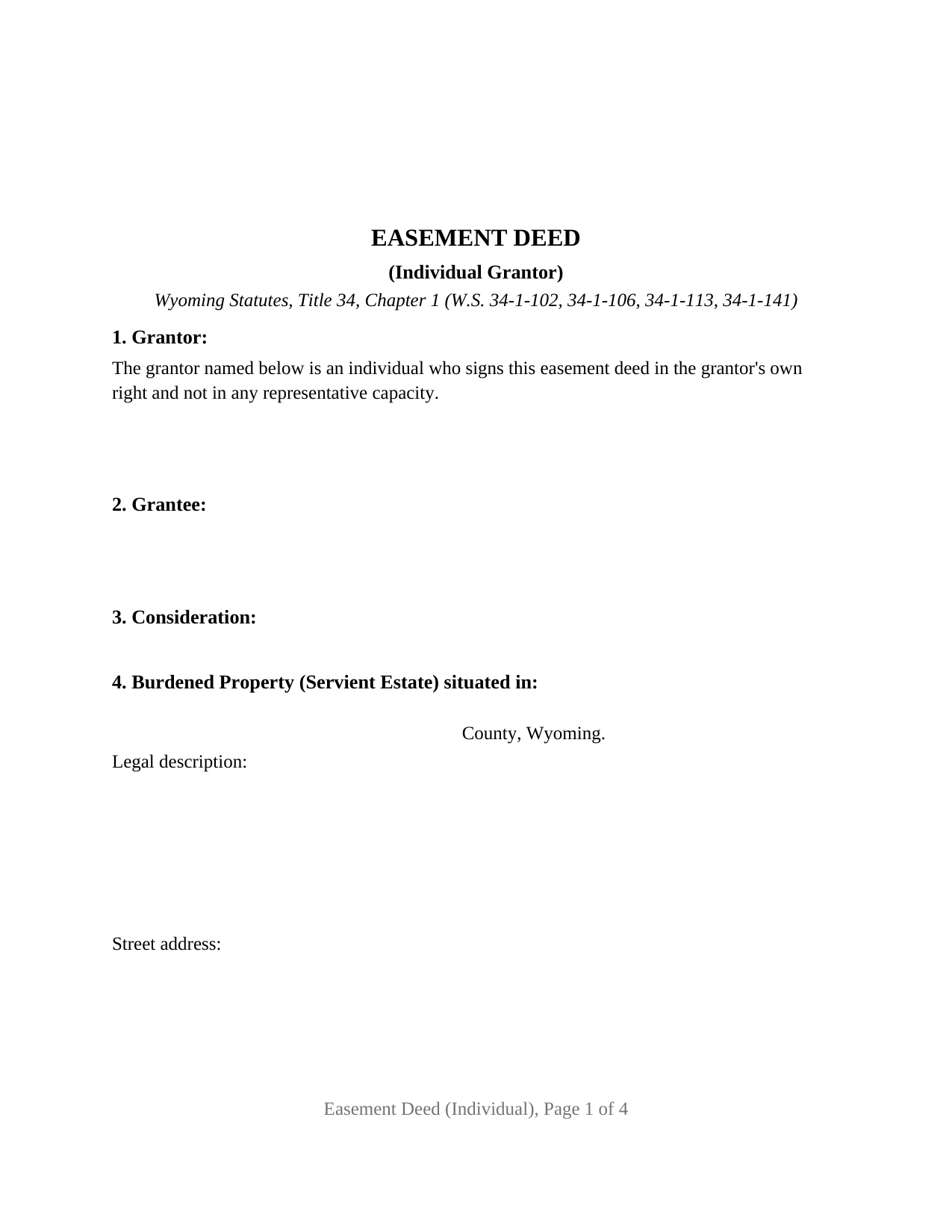
About the Wyoming Easement Deed (Individual)
How to Use This Form
- Select your county from the list
- Download the county-specific form
- Fill in the required information
- Have the document notarized if required
- Record with your county recorder's office
What Others Like You Are Saying
"So far it seems good. I am still trying to send information to this company so they can help me with…"
"Recording deeds from the comfort of my office has never been simpler thanks to Deeds.com. The servic…"
"5 STARS!!! YOU WERE AWESOME!"
"Could not be happier with deeds.com forms. The guide helped more than one can imagine, great resourc…"
"I am very happy with the service and would use again. Super fast, efficient, and very helpful friend…"
4.8/5 from 4,851 reviews. Read all
This Wyoming easement deed is drafted for one grantor: an individual who owns the burdened land and signs in the grantor's own right. The deed grants and conveys an easement over a specifically described area of that land to a grantee, for a stated purpose and term, and it carries the homestead release wording of W.S. 34-2-121 together with a signature block and acknowledgment certificate for the grantor's spouse. Where the grantor is married and the land is a homestead, the spouse signs there; otherwise that block stays blank.
One grantor, signing in the grantor's own right
The form recites exactly one grantor and fixes that grantor's capacity in deed text: an individual who signs in the grantor's own right and not in any representative capacity. The grantor block takes a name and mailing address and nothing else, because Wyoming requires no marital status statement on a deed. One signature line under the heading GRANTOR, one acknowledgment certificate for it, and a second signature line and certificate reserved for a joining spouse make up the execution of the deed. A sole owner granting a driveway easement to a neighbor, a landowner granting a utility line crossing to a buyer of an adjoining parcel, and a rural owner granting a pipeline or access easement across a quarter section present the single-grantor pattern this deed recites. The form is not set up as a deed by a corporation, a limited liability company, a trustee, or an attorney in fact, and it recites one grantor rather than two.
A spouse's signature the homestead statute calls for
Wyoming has no dower, no curtesy, and no community property, so a non-owner spouse ordinarily has no signature on the owner's deed. The homestead is the exception. W.S. 34-2-121 provides that an owner of a homestead may voluntarily sell, mortgage, or otherwise dispose of or encumber it, provided the instrument contains in substance the words hereby releasing and waiving all rights under and by virtue of the homestead exemption laws of this state, and is freely and voluntarily signed and acknowledged by the owner and the spouse of the owner. An easement across homestead land encumbers it. The deed therefore prints the release in the statute's own words inside its grant section, and it carries a SPOUSE OF GRANTOR signature block with its own acknowledgment certificate. The spouse who signs there conveys nothing; the block records the spouse's signature and acknowledgment of the release, which is what the statute asks for.
The location the easement describes
Wyoming is unusual among the states in making the easement's location a condition of its life. Under W.S. 34-1-141, an easement executed and recorded without a specific description of its location is valid for one year from execution and is of no further force and effect unless the specific description is recorded within that year; the statute adds that the description is sufficient if it locates the easement and is not limited to a survey. The deed's easement area section is that description, a strip of stated width along a stated boundary, a centerline with a width on each side, a metes and bounds call, or an attached survey or sketch recorded as an exhibit, and a short bold statement of the one-year rule sits beneath the box so the requirement is on the face of the instrument.
What the deed grants and what it keeps
The operative section grants and conveys the easement to the grantee and the grantee's heirs, successors, and assigns, for the purpose stated in the deed and for its term, perpetual unless a different term is written in, together with the right of entry reasonably necessary to exercise it. The easement burdens and runs with the burdened land, and where the deed identifies a benefited parcel the easement is appurtenant to that parcel and runs with it. The grantor keeps the right to use the easement area for any purpose that does not unreasonably interfere with the easement, and the easement is subject to matters of record. The deed is made without covenant or warranty of title; under W.S. 34-1-135 no covenant is implied in a Wyoming conveyance, so the words of the deed are the whole of what it promises. The deed states no maintenance, cost-sharing, or relocation terms, which belong to a separate easement agreement where the parties want them.
Recording in the county where the land lies
The grantor acknowledges the deed before a notarial officer, and the certificate on the form is Wyoming's statutory short form, W.S. 32-3-115(a)(i). The county clerk of the county where the land lies records the deed; W.S. 34-1-119(a) requires the grantee's mailing address before recording, and the grantee block carries it. Recording fees are statewide under W.S. 18-3-402(a)(xvi), twelve dollars for the first page and three dollars for each additional page, and the four-page deed records for twenty-one dollars without exhibits. A Statement of Consideration on the State Board of Equalization form accompanies instruments transferring title to real property under W.S. 34-1-142, and county clerks describe its reach in different words, so the guide explains how the statement is handled with an easement deed in the counties whose practices are published. An unrecorded easement is void against a later good-faith purchaser who records first, W.S. 34-1-120, which is why an easement deed is recorded promptly after it is signed.
The package includes the fillable easement deed form, a completed example filled in for a Laramie County fact pattern, and the guide that walks through every section, the homestead joinder, the location requirement, and recording. This description and the guide describe the form and the governing Wyoming statutes in general terms; they are not legal advice.
Important: County-Specific Forms
Our easement deed (individual) forms are specifically formatted for each of the 23 counties in Wyoming.
After selecting your county, you'll receive forms that meet all local recording requirements, ensuring your documents will be accepted without delays or rejection fees.