Wyoming Special Warranty Deed (Individual)
County Specific Legal Forms Validated as recently as November 5, 2026 by our Forms Development Team
About the Wyoming Special Warranty Deed (Individual)
How to Use This Form
- Select your county from the list
- Download the county-specific form
- Fill in the required information
- Have the document notarized if required
- Record with your county recorder's office
What Others Like You Are Saying
"Great, quick and easy to use"
"Absolutely Amazing Service! I learned about Deeds.com, created my Account, uploaded my documents int…"
"I have not yet used the site however, I feel that this site could be a big asset to the genealogical…"
"Absolutely awesome! Quick, easy and efficient. I will definitely be using again!"
"Thank you, I am very satisfied with the process and will provide a final review after the documents …"
4.8/5 from 4,847 reviews. Read all
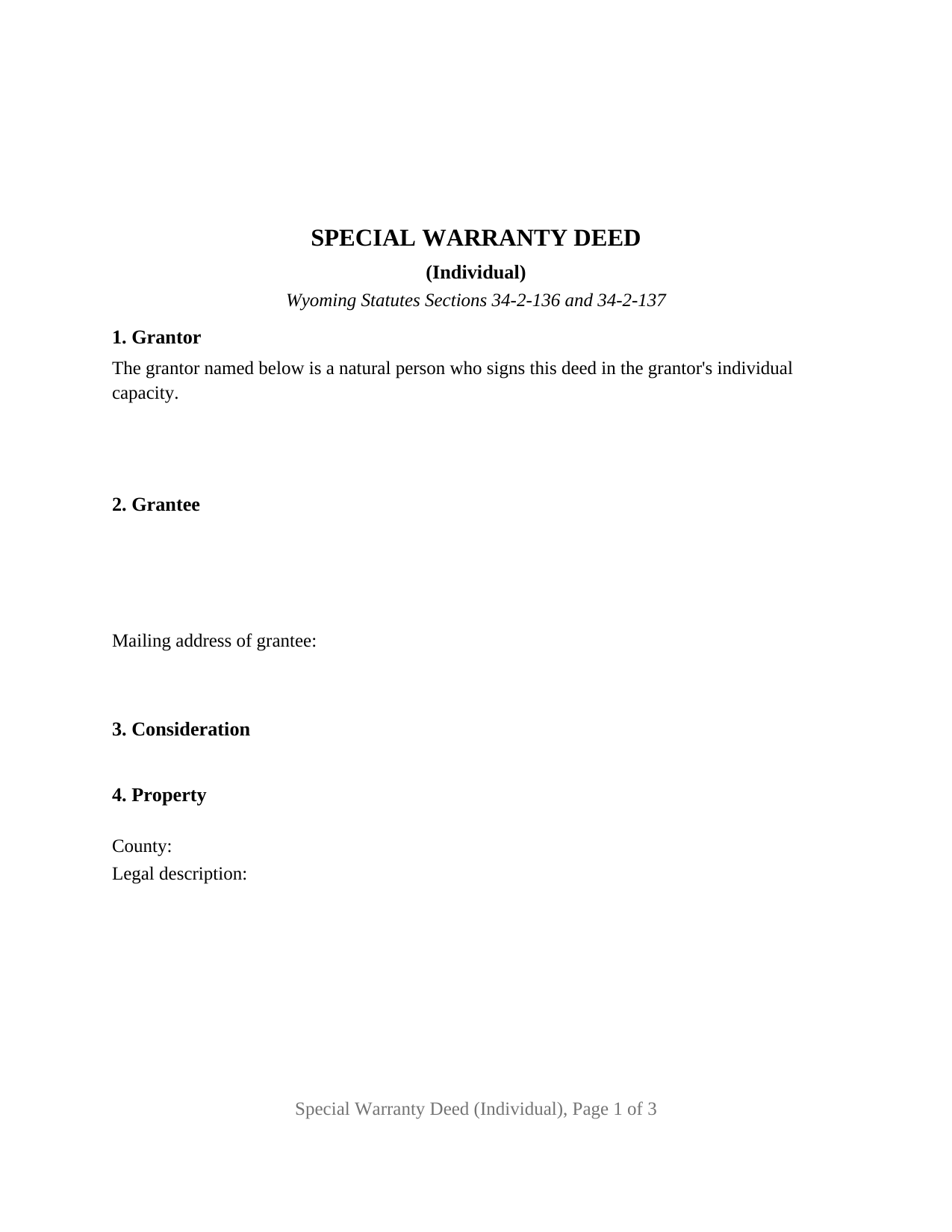
One grantor, one signature line, one acknowledgment certificate: this Wyoming special warranty deed is configured for a natural person who owns the property alone and conveys it in the grantor's individual capacity. The deed recites that configuration as fixed text at the top of Section 1, and it carries the operative words of Wyoming Statutes Section 34-2-136, conveys and specially warrants against all who claim by, through, or under the grantor, but against none other, with the covenants Section 34-2-137 attaches to them.
A deed that recites its signer
The first sentence of Section 1 states that the grantor named below is a natural person who signs this deed in the grantor's individual capacity. That sentence is printed, not filled in, so the instrument itself declares who is conveying and in what role. Beneath it, a single entry takes the grantor's name, any marital-status recital, and the place of residence the statutory form asks for. The execution pages follow the same shape: one GRANTOR signature block with a printed-name line, and one certificate carrying the Section 32-3-115 short form for the notarial officer to complete. Nothing on the deed invites a second signer, a representative capacity, or an entity name.
What the limited warranty covers
Under Section 34-2-137(a) a deed in substance in the statutory form passes a fee simple with its appurtenances, rights and privileges, and binds the grantor to two promises: that the property is free from encumbrances made by that grantor, and that the grantor will forever warrant and defend the title against any lawful claim of the grantor and of anyone claiming by, through, or under the grantor, but against none other. A title problem created by a prior owner sits outside both promises. Section 34-2-137(b) allows exceptions to the covenants to be inserted following the description of the land, and Section 5 of this deed occupies that spot, taking the current taxes, recorded easements and covenants, and any other matter the grantor is not warranting against.
The single-signer configuration and the homestead rule
The release and waiver of homestead rights that Section 34-2-121 calls for is printed into the operative sentence, in the statute's own words. The same statute asks that a conveyance of a homestead be signed and acknowledged by the owner and the owner's spouse, with one stated exception for a conveyance directly from husband to wife. This form carries a single signature block and a single certificate, so the patterns that present it are the ones in which one signature satisfies that statute on its face: an unmarried owner selling a house, an heir conveying inherited acreage that stands in that heir's name alone, a married owner conveying investment land that is not the family's homestead, and a husband deeding property directly to his wife. The form is not set up for a joining spouse, a second record owner, a trustee, a personal representative, an attorney-in-fact, or an officer signing for a company; each is a different signer configuration with its own signature block and certificate. The grantee entry is free-form and takes one or two grantees; under Section 34-1-140(b) grantees described as husband and wife or spouses take as tenants by the entirety unless the deed says otherwise, the form the completed example illustrates.
At the county clerk's counter
The deed is recorded with the county clerk where the land lies, and the statewide fee under Section 18-3-402 is twelve dollars for the first page and three dollars for each page after it, with no transfer tax. The grantee's mailing address, which Section 34-1-119(a) requires the clerk to have before recording, has its own entry in Section 2, and the sworn Statement of Consideration under Section 34-1-142, a confidential State Board of Equalization form the grantee or the grantee's agent completes, is prepared separately; the clerk may not accept a transfer instrument until it arrives. The deed prints at twelve point with one-inch margins and leaves the top two inches of page one open for the clerk's recording label.
Three items make up the package: the fillable special warranty deed, a completed example filled in for a fictional Laramie County conveyance by an unmarried owner to a married couple, and the guide, which takes each numbered section and the trip to the clerk's counter in turn. Both this page and the guide describe the form and Wyoming's statutes in general terms rather than applying them to anyone's facts, and neither is legal advice.
Important: County-Specific Forms
Our special warranty deed (individual) forms are specifically formatted for each of the 23 counties in Wyoming.
After selecting your county, you'll receive forms that meet all local recording requirements, ensuring your documents will be accepted without delays or rejection fees.