Wyoming Special Warranty Deed
County Specific Legal Forms Validated as recently as November 5, 2026 by our Forms Development Team
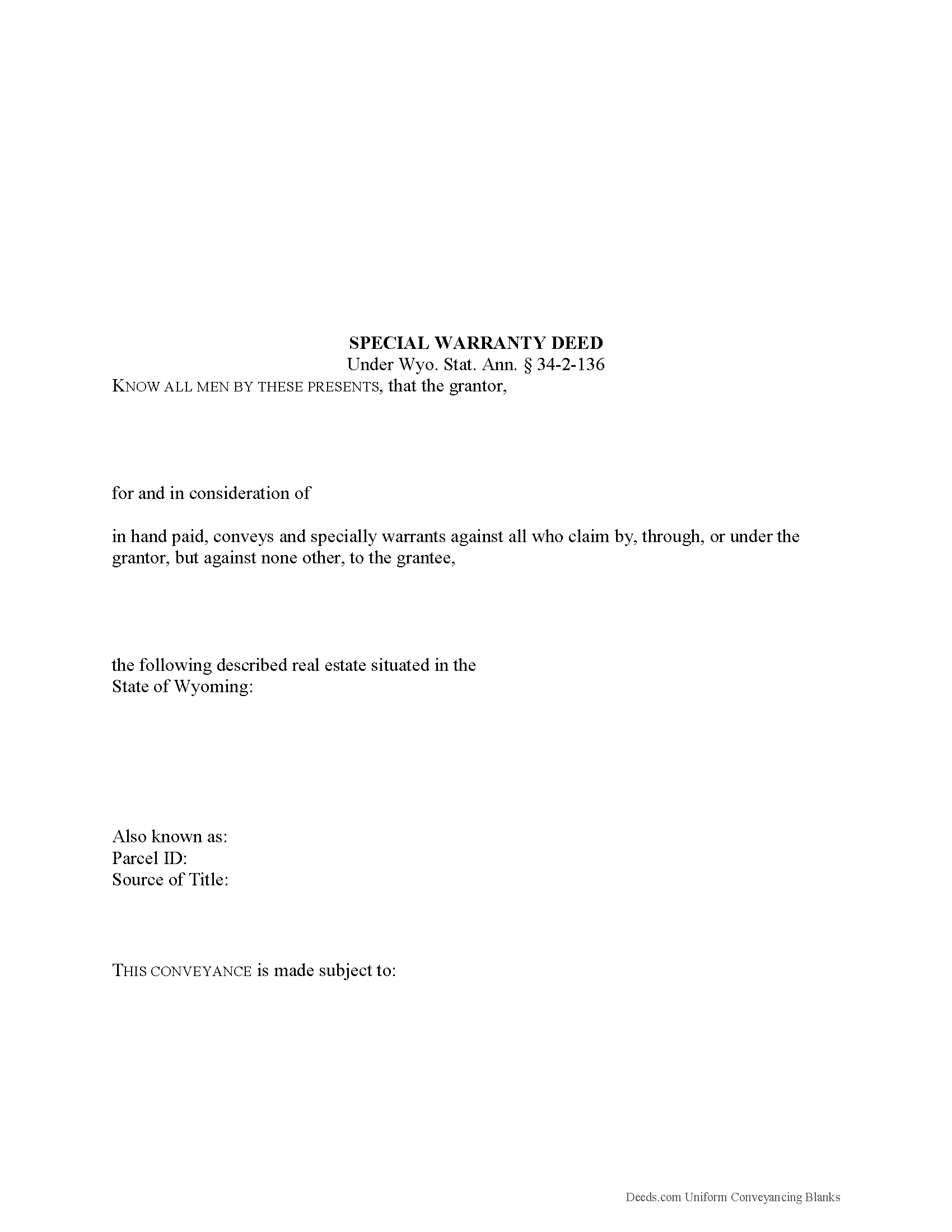
About the Wyoming Special Warranty Deed
How to Use This Form
- Select your county from the list
- Download the county-specific form
- Fill in the required information
- Have the document notarized if required
- Record with your county recorder's office
What Others Like You Are Saying
"Great"
"very professional"
"A download in word format would be a lot better than the pdf download."
"Great service that satisfied all my needs. Great prices too."
"after a poor start was able to get to the forms page and find what I was looking for and every thing…"
4.8/5 from 4,850 reviews. Read all
A Wyoming special warranty deed conveys real estate in fee simple and warrants the title against one class of claims only: those that arise by, through, or under the grantor, but against none other. This form prepares that deed in the form Wyoming Statutes Section 34-2-136 provides, with the covenants Section 34-2-137 attaches to it, for one or two natural persons conveying to one or two grantees.
A warranty that stops at the grantor's own chain
Wyoming's conveyancing statutes do not imply covenants. Section 34-1-135 provides that no covenant is implied in a conveyance of real estate other than a conveyance of minerals, so the covenants of a deed come from its operative words. The words conveys and warrants in the Section 34-2-102 form carry the full covenants of Section 34-2-103, and the words conveys and quitclaims carry none. Between those two sits this deed. Its operative words, conveys and specially warrants against all who claim by, through, or under the grantor, but against none other, give the grantee a fee simple with its appurtenances, a covenant that the property is free from encumbrances made by that grantor, and a promise to defend the title against anyone claiming through the grantor. A defect created by an earlier owner is outside the promise. Section 34-2-137(b) lets the grantor insert exceptions to those covenants following the description of the land, and the form carries a section for them in exactly that place.
The homestead release and who signs
Wyoming is a common-law property state with no dower, curtesy, or community interest for a spouse to release, but Section 34-2-121 makes an instrument conveying a homestead void unless it contains in substance a release of homestead rights and is signed and acknowledged by the owner and the owner's spouse. The conveyance section of this deed prints that release verbatim, hereby releasing and waiving all rights under and by virtue of the homestead exemption laws of this state, so a married grantor conveying the family residence has the statutory words on the page and a second grantor block for the joining spouse. On land that is not a homestead the printed words release nothing. Each grantor acknowledges before a notarial officer under Sections 34-1-113 and 34-1-118, and the certificate the form carries is the Section 32-3-115 short form.
One deed, four signing patterns
This is the general configuration of the Wyoming special warranty deed. The grantor block and the grantee block are free-form entries that take one or two natural persons each, so the same instrument recites one grantor conveying to one grantee, one grantor to two grantees, two grantors to one grantee, or two grantors to two grantees. Nothing about marital status, existing ownership, or signing capacity is preprinted; the entries carry it. Under Section 34-1-140(b) grantees designated as husband and wife or spouses take as tenants by the entirety unless the deed specifies another form. Two signature blocks and two acknowledgment certificates follow, one for each grantor, so two grantors may acknowledge on different dates before different officers; on a single-grantor conveyance the second block and certificate stay blank. The form is not set up for an entity, trustee, personal representative, or attorney-in-fact as grantor, each of which signs in a representative capacity with its own certificate, or for three or more parties on either side.
Recording in the county where the land lies
The deed is recorded with the county clerk of the county where the property is located. Section 18-3-402 fixes the fee statewide at twelve dollars for the first page and three dollars for each additional page, and no Wyoming statute imposes a transfer tax. Two companion rules shape the trip to the counter: Section 34-1-119(a) bars the clerk from recording until the grantee's address is furnished, which the grantee mailing address entry supplies, and Section 34-1-142 bars the clerk from accepting any transfer instrument until the grantee's sworn Statement of Consideration is received, a confidential form published by the State Board of Equalization and prepared separately from the deed. The form reserves the top two inches of the first page for the clerk's recording label and prints at twelve point with one-inch margins.
The package includes the fillable special warranty deed, a completed example filled in for a realistic Natrona County fact pattern, and the guide that walks through every numbered section and the recording process. This description and the guide describe the form and the governing Wyoming statutes in general terms; they are not legal advice.
Important: County-Specific Forms
Our special warranty deed forms are specifically formatted for each of the 23 counties in Wyoming.
After selecting your county, you'll receive forms that meet all local recording requirements, ensuring your documents will be accepted without delays or rejection fees.