Alabama Correction Quitclaim Deed
County Specific Legal Forms Validated as recently as October 19, 2026 by our Forms Development Team
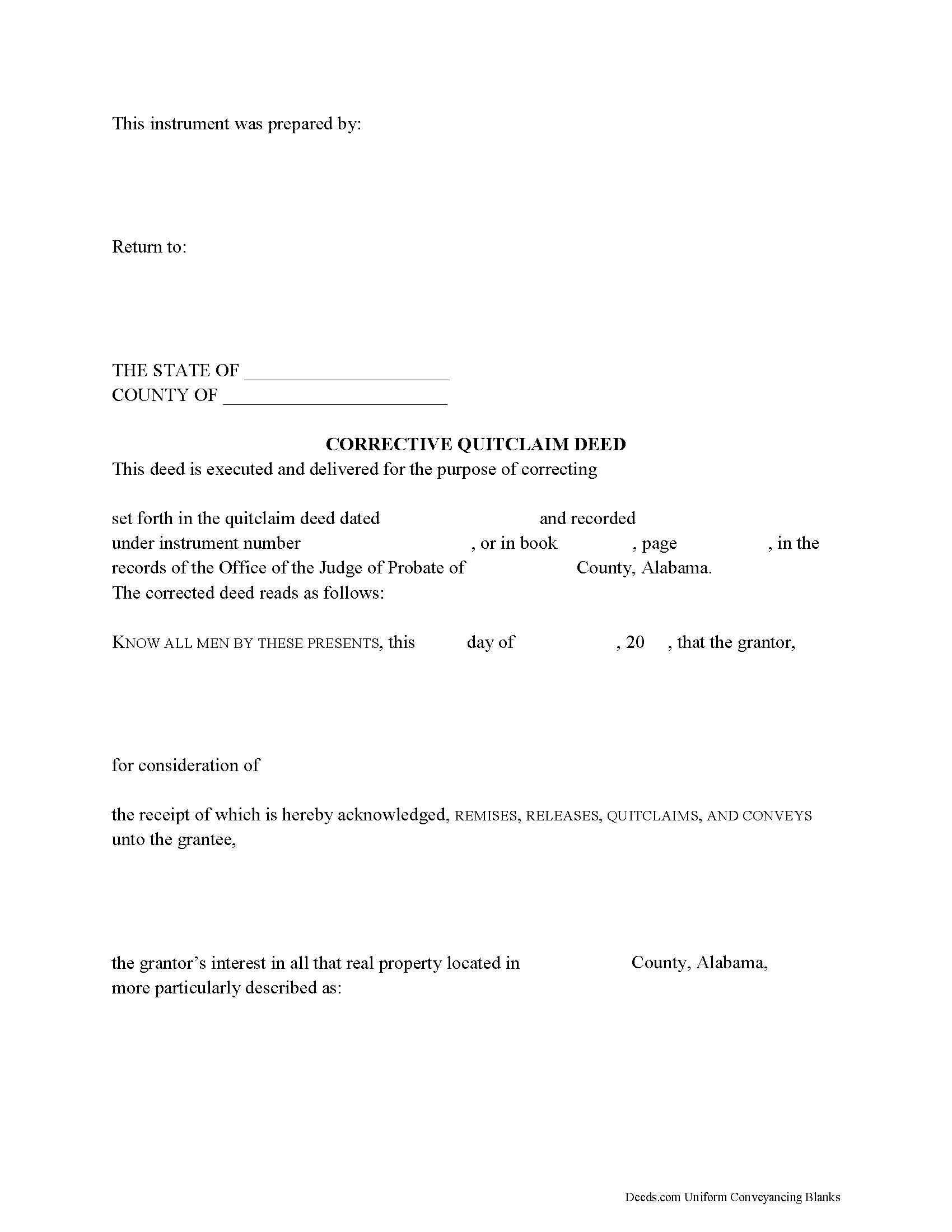
About the Alabama Correction Quitclaim Deed
How to Use This Form
- Select your county from the list
- Download the county-specific form
- Fill in the required information
- Have the document notarized if required
- Record with your county recorder's office
What Others Like You Are Saying
"Found the forms to be very easy to use, instructions very clear and helpful. Recording office was su…"
"This was so easy to download, open the files and then complete the document on the computer then pri…"
"no problems got what i needed."
"This is the most comprehensive, helpful real estate tool I have seen. I was at first worried because…"
"Prompt efficient service."
4.8/5 from 4,829 reviews. Read all
An Alabama Correction Quitclaim Deed is used to fix a recorded Alabama quitclaim deed when the original instrument contains a non-material mistake, such as a misspelled name, omitted marital status, or an error in the legal description that does not change the substance of the transfer. Alabama makes this deed type especially useful because the state has recording rules that can stop a corrective instrument cold over details other states may treat more casually, including marital-status recitals, homestead spousal assent, preparer identification, and county probate recording requirements.
When an Alabama Correction Quitclaim Deed is commonly used
This deed is commonly used after an Alabama quitclaim deed has already been recorded and the parties discover a clerical or scrivener’s error that needs to be corrected in the public record without changing the underlying nature of the conveyance. The corrective instrument refers back to the earlier recorded deed, identifies the mistake, and states the corrected information, while remaining a quitclaim deed rather than converting the transaction into a different deed type.
Alabama execution and content requirements
In Alabama, conveyances of land must be in writing and signed at the foot of the document by the party conveying the property or by an agent with written authority (Ala. Code § 35-4-20). A deed ordinarily must be attested by one witness, but if the signer cannot write, or if another person writes the signer’s name for a signer who can write but does not sign personally, Alabama requires two witnesses who can and do write their names (Ala. Code § 35-4-20). A proper acknowledgment operates as compliance with the witness requirement, and acknowledgments may be taken in Alabama by officers including judges of probate and notaries public (Ala. Code §§ 35-4-23, 35-4-24).
A correction deed should clearly identify the earlier recorded quitclaim deed by date and recording information, state the nature of the error, and set out the corrected information in the body of the instrument. Because Alabama requires the marital status of an individual grantor or vendor to be recited before the deed will be accepted for record, that recital needs to be handled carefully on a corrective instrument as well (Ala. Code § 35-4-73).
Alabama also requires a printed, typed, or stamped statement showing the name and address of the individual who prepared the instrument. For a form deed, the preparer is the person who filled in the blanks or examined the completed entries, so that line is not just cosmetic in Alabama; it is part of recordability (Ala. Code § 35-4-110).
Alabama-specific traps that matter on a correction deed
The biggest Alabama trap is assuming that any error can be fixed with a correction deed. A correction quitclaim deed is suited to clerical and non-substantive mistakes. It is not a clean substitute for changing the actual parties, changing the property conveyed, altering consideration in a way that changes the transaction, or otherwise rewriting the substance of the earlier transfer. When the problem is more than a minor correction, the fix usually moves outside simple re-recording territory, and Alabama law separately recognizes court actions to reform instruments containing erroneous descriptions (Ala. Code § 35-4-151).
Homestead rights are another Alabama-specific danger point. If the property is homestead property and the grantor is married, a deed or other conveyance of the homestead is not valid without the voluntary signature and assent of the spouse, shown by proper acknowledgment (Ala. Code § 6-10-3). That issue does not disappear just because the document is labeled corrective. If the original conveyance implicated homestead rights, the corrective instrument needs to be reviewed with that same rule in mind.
Marital-status recitals also matter in Alabama beyond homestead questions. A probate judge may refuse a deed that does not recite the marital status of an individual grantor, and knowingly making a false recital is a misdemeanor (Ala. Code § 35-4-73). On top of that, county probate offices commonly scrutinize the legal description closely. If the property is described by lot and block, the deed should track the recorded plat reference accurately. If the property is described by government survey, section, township, and range details should match the earlier record. A correction deed meant to fix one problem can create a second one if the replacement description is incomplete or inconsistent.
Recording, deed tax, and why timing still matters in Alabama
Alabama deeds are recorded in the office of the judge of probate, and instruments executed in accordance with law are admitted to record there, with filing serving as notice of their contents (Ala. Code §§ 35-4-50, 35-4-51). Even though a correction deed points back to an earlier instrument, prompt recording still matters because Alabama protects purchasers, mortgagees, and judgment creditors without notice who record first under the state’s recording rules (Ala. Code § 35-4-90).
One useful Alabama feature is that the re-recordation of corrected deeds executed for the purpose of perfecting title is exempt from the privilege or license tax otherwise imposed on deeds (Ala. Code § 40-22-1(b)(3)). That exemption is important because Alabama deed tax rules are strict, and probate offices expect the recording package to line up with the tax treatment claimed. A corrective deed that really is correcting the prior quitclaim deed is treated differently from a new taxable conveyance.
Vesting and survivorship in Alabama
A correction quitclaim deed can also be used to clean up vesting language when the original recorded quitclaim deed contains a non-substantive error in how ownership was stated, but Alabama has its own survivorship rule that makes wording important. In Alabama, survivorship does not arise automatically from joint ownership. Unless the instrument states that the tenancy is with right of survivorship, or uses other words clearly showing that intent, the deceased owner’s interest does not automatically pass to the surviving co-owner (Ala. Code § 35-4-7). Because of that rule, any correction involving vesting language needs to track the intended ownership language exactly and stay within the bounds of a true correction rather than a new conveyance.
What is included in the Alabama Correction Quitclaim Deed package
The Alabama Correction Quitclaim Deed package includes the county-ready deed form, step-by-step guidelines, and a completed example to help you prepare the corrective instrument for recording in the appropriate Alabama probate office. The package is designed to address the practical Alabama details that matter on this deed type, including reference to the prior recorded quitclaim deed, execution formalities, and recording-related requirements that commonly affect acceptance.
Important: County-Specific Forms
Our correction quitclaim deed forms are specifically formatted for each of the 67 counties in Alabama.
After selecting your county, you'll receive forms that meet all local recording requirements, ensuring your documents will be accepted without delays or rejection fees.