Fayette County Correction Quitclaim Deed Form
Last validated October 1, 2026 by our Forms Development TeamFormatted for recording in Fayette County, for property anywhere in the county: rural and unincorporated areas as well as Bankston, Belk, Berry, Fayette, Glen Allen.
- 3 documents included
- Immediate PDF download
- Formatting guarantee
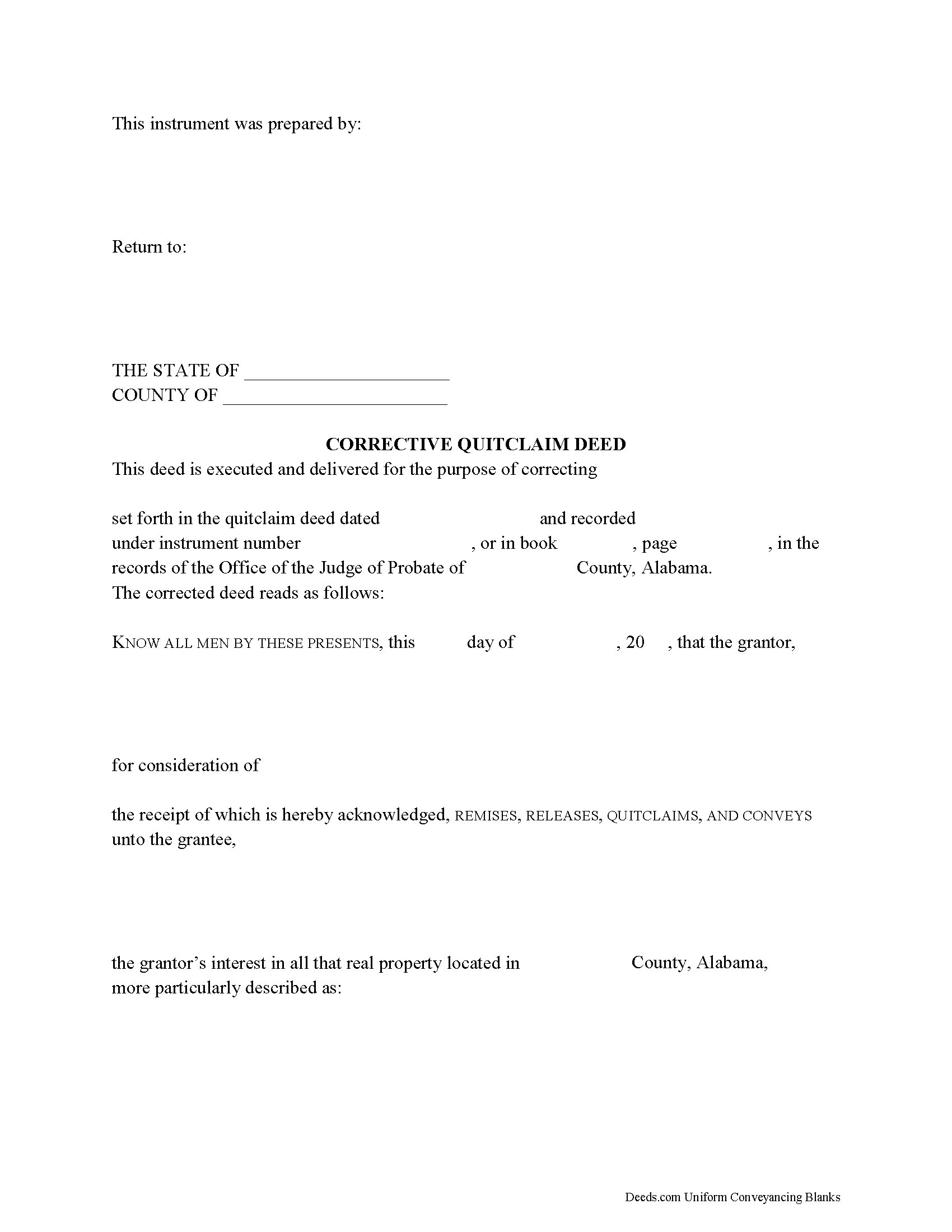
Fayette County Correction Quitclaim Deed Form
Fill in the blank Correction Quitclaim Deed form formatted to comply with all Alabama recording and content requirements.
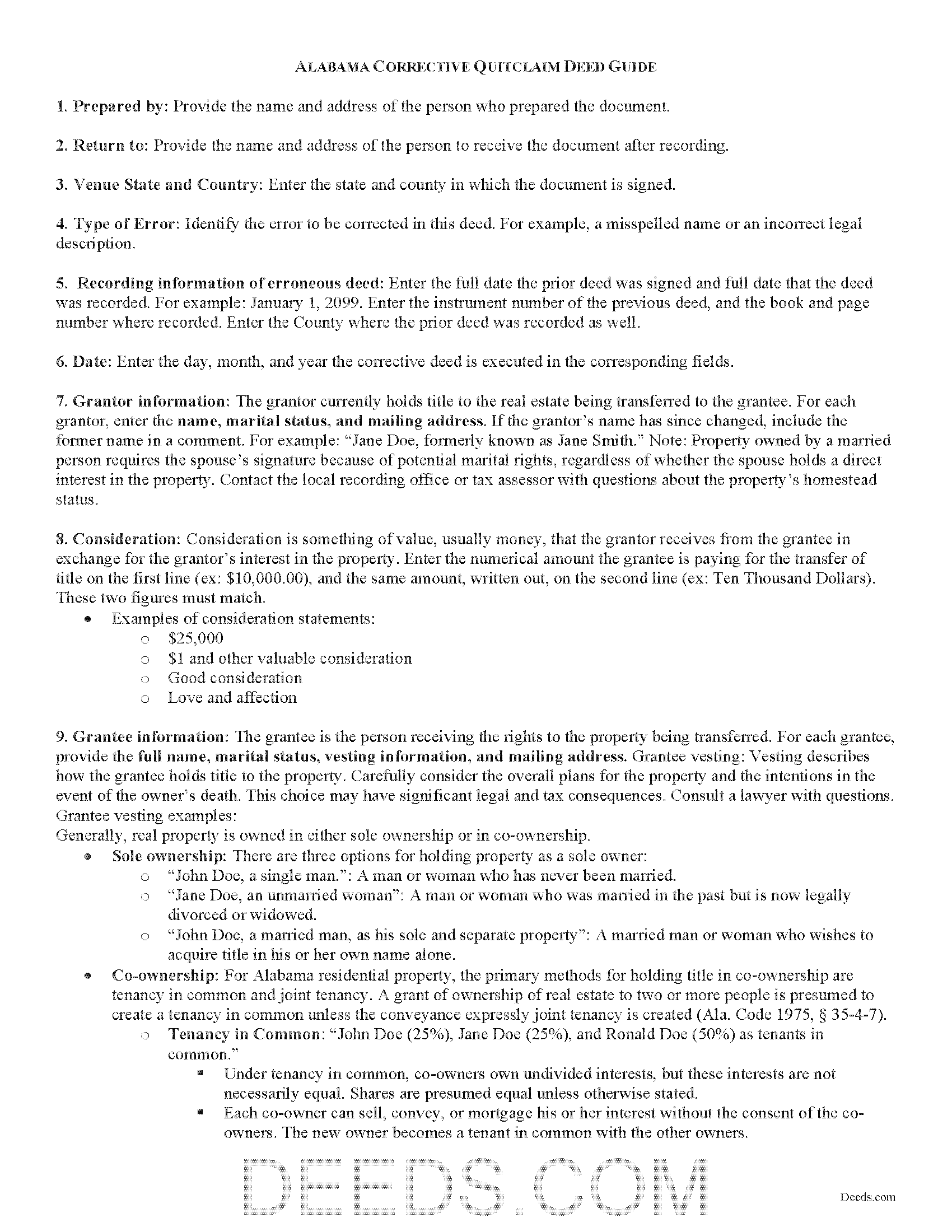
Fayette County Correction Quitclaim Deed Guide
Line by line guide explaining every blank on the Correction Quitclaim Deed form.
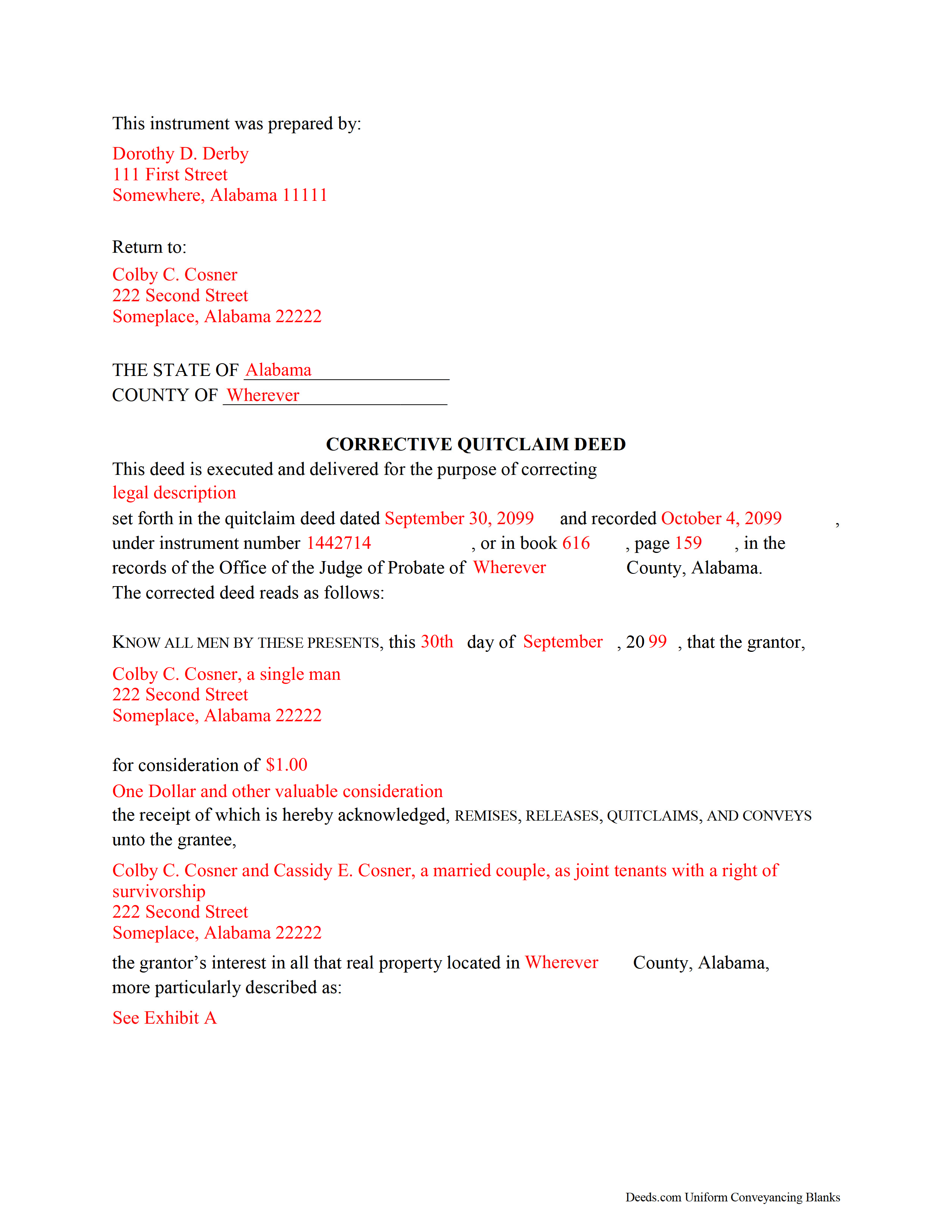
Fayette County Completed Example of the Correction Quitclaim Deed Document
Example of a properly completed Alabama Correction Quitclaim Deed document for reference.
All 3 documents above included • One-time purchase • No recurring fees
Immediate Download • Secure Checkout
Additional Alabama and Fayette County documents included at no extra charge:
Where to Record Your Documents
Fayette County Probate Office
Fayette, Alabama 35555
Hours: Mon 8:00 to 5:00; Tue-Fri 8:00 to 4:00
Phone: (205) 932-4519
Recording Tips for Fayette County:
- Bring your driver's license or state-issued photo ID
- Ensure all signatures are in blue or black ink
- Ask if they accept credit cards - many offices are cash/check only
- Check that your notary's commission hasn't expired
- Documents must be on 8.5 x 11 inch white paper
Cities and Jurisdictions in Fayette County
Properties in any of these areas use Fayette County forms:
- Bankston
- Belk
- Berry
- Fayette
- Glen Allen
Hours, fees, requirements, and more for Fayette County
How do I get my forms?
Forms are available for immediate download after payment. The Fayette County forms will be in your account ready to download to your computer. An account is created for you during checkout if you don't have one. Forms are NOT emailed.
Are these forms guaranteed to be recordable in Fayette County?
Yes. Our form blanks are guaranteed to meet or exceed the applicable formatting requirements used for recording in Fayette County, including margin requirements, font requirements, and other layout standards. This guarantee applies to formatting, not to the legal sufficiency of information entered by the user or the suitability of a form for a particular transaction.
Can I reuse these forms?
Yes. You can reuse the forms for your personal use. For example, if you have multiple properties in Fayette County you only need to order once.
What do I need to use these forms?
The forms are PDFs that you fill out on your computer. The free Adobe Acrobat Reader is recommended, and most PDF apps also work. You do NOT enter your property information online - you download the blank forms and complete them privately on your own computer.
Are there any recurring fees?
No. This is a one-time purchase. Nothing to cancel, no memberships, no recurring fees.
How much does it cost to record in Fayette County?
Recording fees in Fayette County vary. Contact the recorder's office at (205) 932-4519 for current fees.
Questions answered? Let's get started!
An Alabama Correction Quitclaim Deed is used to fix a recorded Alabama quitclaim deed when the original instrument contains a non-material mistake, such as a misspelled name, omitted marital status, or an error in the legal description that does not change the substance of the transfer. Alabama makes this deed type especially useful because the state has recording rules that can stop a corrective instrument cold over details other states may treat more casually, including marital-status recitals, homestead spousal assent, preparer identification, and county probate recording requirements.
When an Alabama Correction Quitclaim Deed is commonly used
This deed is commonly used after an Alabama quitclaim deed has already been recorded and the parties discover a clerical or scrivener’s error that needs to be corrected in the public record without changing the underlying nature of the conveyance. The corrective instrument refers back to the earlier recorded deed, identifies the mistake, and states the corrected information, while remaining a quitclaim deed rather than converting the transaction into a different deed type.
Alabama execution and content requirements
In Alabama, conveyances of land must be in writing and signed at the foot of the document by the party conveying the property or by an agent with written authority (Ala. Code § 35-4-20). A deed ordinarily must be attested by one witness, but if the signer cannot write, or if another person writes the signer’s name for a signer who can write but does not sign personally, Alabama requires two witnesses who can and do write their names (Ala. Code § 35-4-20). A proper acknowledgment operates as compliance with the witness requirement, and acknowledgments may be taken in Alabama by officers including judges of probate and notaries public (Ala. Code §§ 35-4-23, 35-4-24).
A correction deed should clearly identify the earlier recorded quitclaim deed by date and recording information, state the nature of the error, and set out the corrected information in the body of the instrument. Because Alabama requires the marital status of an individual grantor or vendor to be recited before the deed will be accepted for record, that recital needs to be handled carefully on a corrective instrument as well (Ala. Code § 35-4-73).
Alabama also requires a printed, typed, or stamped statement showing the name and address of the individual who prepared the instrument. For a form deed, the preparer is the person who filled in the blanks or examined the completed entries, so that line is not just cosmetic in Alabama; it is part of recordability (Ala. Code § 35-4-110).
Alabama-specific traps that matter on a correction deed
The biggest Alabama trap is assuming that any error can be fixed with a correction deed. A correction quitclaim deed is suited to clerical and non-substantive mistakes. It is not a clean substitute for changing the actual parties, changing the property conveyed, altering consideration in a way that changes the transaction, or otherwise rewriting the substance of the earlier transfer. When the problem is more than a minor correction, the fix usually moves outside simple re-recording territory, and Alabama law separately recognizes court actions to reform instruments containing erroneous descriptions (Ala. Code § 35-4-151).
Homestead rights are another Alabama-specific danger point. If the property is homestead property and the grantor is married, a deed or other conveyance of the homestead is not valid without the voluntary signature and assent of the spouse, shown by proper acknowledgment (Ala. Code § 6-10-3). That issue does not disappear just because the document is labeled corrective. If the original conveyance implicated homestead rights, the corrective instrument needs to be reviewed with that same rule in mind.
Marital-status recitals also matter in Alabama beyond homestead questions. A probate judge may refuse a deed that does not recite the marital status of an individual grantor, and knowingly making a false recital is a misdemeanor (Ala. Code § 35-4-73). On top of that, county probate offices commonly scrutinize the legal description closely. If the property is described by lot and block, the deed should track the recorded plat reference accurately. If the property is described by government survey, section, township, and range details should match the earlier record. A correction deed meant to fix one problem can create a second one if the replacement description is incomplete or inconsistent.
Recording, deed tax, and why timing still matters in Alabama
Alabama deeds are recorded in the office of the judge of probate, and instruments executed in accordance with law are admitted to record there, with filing serving as notice of their contents (Ala. Code §§ 35-4-50, 35-4-51). Even though a correction deed points back to an earlier instrument, prompt recording still matters because Alabama protects purchasers, mortgagees, and judgment creditors without notice who record first under the state’s recording rules (Ala. Code § 35-4-90).
One useful Alabama feature is that the re-recordation of corrected deeds executed for the purpose of perfecting title is exempt from the privilege or license tax otherwise imposed on deeds (Ala. Code § 40-22-1(b)(3)). That exemption is important because Alabama deed tax rules are strict, and probate offices expect the recording package to line up with the tax treatment claimed. A corrective deed that really is correcting the prior quitclaim deed is treated differently from a new taxable conveyance.
Vesting and survivorship in Alabama
A correction quitclaim deed can also be used to clean up vesting language when the original recorded quitclaim deed contains a non-substantive error in how ownership was stated, but Alabama has its own survivorship rule that makes wording important. In Alabama, survivorship does not arise automatically from joint ownership. Unless the instrument states that the tenancy is with right of survivorship, or uses other words clearly showing that intent, the deceased owner’s interest does not automatically pass to the surviving co-owner (Ala. Code § 35-4-7). Because of that rule, any correction involving vesting language needs to track the intended ownership language exactly and stay within the bounds of a true correction rather than a new conveyance.
What is included in the Alabama Correction Quitclaim Deed package
The Alabama Correction Quitclaim Deed package includes the county-ready deed form, step-by-step guidelines, and a completed example to help you prepare the corrective instrument for recording in the appropriate Alabama probate office. The package is designed to address the practical Alabama details that matter on this deed type, including reference to the prior recorded quitclaim deed, execution formalities, and recording-related requirements that commonly affect acceptance.
Important: Your property must be located in Fayette County to use these forms. Documents should be recorded at the county recording office listed above.
This Correction Quitclaim Deed meets all recording requirements specific to Fayette County.
Our Promise
The documents you receive here are guaranteed to meet or exceed the applicable Fayette County recording format requirements. If there is a rejection caused by our formatting, we will correct the issue or refund your payment. This guarantee applies to document formatting only and does not extend to information entered by the user, the selection of the form, or the legal effect of the completed document.
Save Time and Money
Get your Fayette County Correction Quitclaim Deed form done right the first time with Deeds.com Uniform Conveyancing Blanks. At Deeds.com, we understand that your time and money are valuable resources, and we don't want you to face a penalty fee or rejection imposed by a county recorder for submitting nonstandard documents. We constantly review and update our forms to meet rapidly changing state and county recording requirements for roughly 3,500 counties and local jurisdictions.
4.8 out of 5 - ( 4,824 Reviews )
Hans K. 5 out of 5 stars
The deeds.com site provides clarifying useful information for the do-it-yourself type of person.
We appreciate your business and value your feedback. Thank you. Have a wonderful day!
Wanda W. 5 out of 5 stars
Terrific!!!
Thank you!
Theresa J. 5 out of 5 stars
The beginning of the process was very simple. In the middle now waiting for the invoice to move forward.
Thank you for your feedback. We really appreciate it. Have a great day!
Galina K. 5 out of 5 stars
Was fast and easy to get the forms with instructions on how to fill them out.
Thank you for the kind words Galina. We appreciate you. Have an amazing day!
Kimberly E. 5 out of 5 stars
This process could not have been made any easier!! Very easy instructions to follow and the response time was incredible! Thank you!
Thank you!
chungming a. 5 out of 5 stars
easy to use website.
Thank you!
Christina D. 3 out of 5 stars
The papers allowed me to get done what I needed. But for the price I would expect a spell check. There were spelling errors when there should not have been any. Please proof read
Your feedback is a crucial part of our dedication to ongoing improvement. Thank you for your insightful comments.
Missie R. 5 out of 5 stars
Very fast and professionally handled.
Thank you!
Mary-Ann K. 5 out of 5 stars
Very pleasantly pleased so far. Hope to hear from the town registrar Transfer On Death Deed accepted. Wish all legal proceedings were so simple . . .
Thank you for your feedback. We really appreciate it. Have a great day!
Claire W. 5 out of 5 stars
The price is right, and very simple to follow
Thank you!
Benjamin A. 4 out of 5 stars
This method seems simple for me to complete. Wish me luck.
Thank you for your feedback. We really appreciate it. Have a great day!
Richard T. 5 out of 5 stars
This was a complete set of the necessary forms, with instructions. It will be very useful. Instant download was great.
We appreciate your feedback Richard. Have a wonderful day!
Rebecca K. 5 out of 5 stars
I was able to find EXACTLY what I was looking for in just a couple minutes, plus a helpful guide, all for less than $30. I was very impressed.
We appreciate your business and value your feedback. Thank you. Have a wonderful day!
Wesley B. 4 out of 5 stars
Exactly what I needed
Thank you!
Dale S. 5 out of 5 stars
I used the Affidavit of Death form provided by Deeds.com. The form and directions were easy to follow. I took the form to the county clerk's office for filing after getting it notarized. They accepted the form with no issues. A task that many people go to a lawyer complete was completed easily by me in less than an hour.
Thanks, Dale! Glad it worked exactly as it should — clear form, smooth filing, no issues at the clerk's office. That's the goal every time.