Alabama Correction Warranty Deed
County Specific Legal Forms Validated as recently as April 30, 2026 by our Forms Development Team
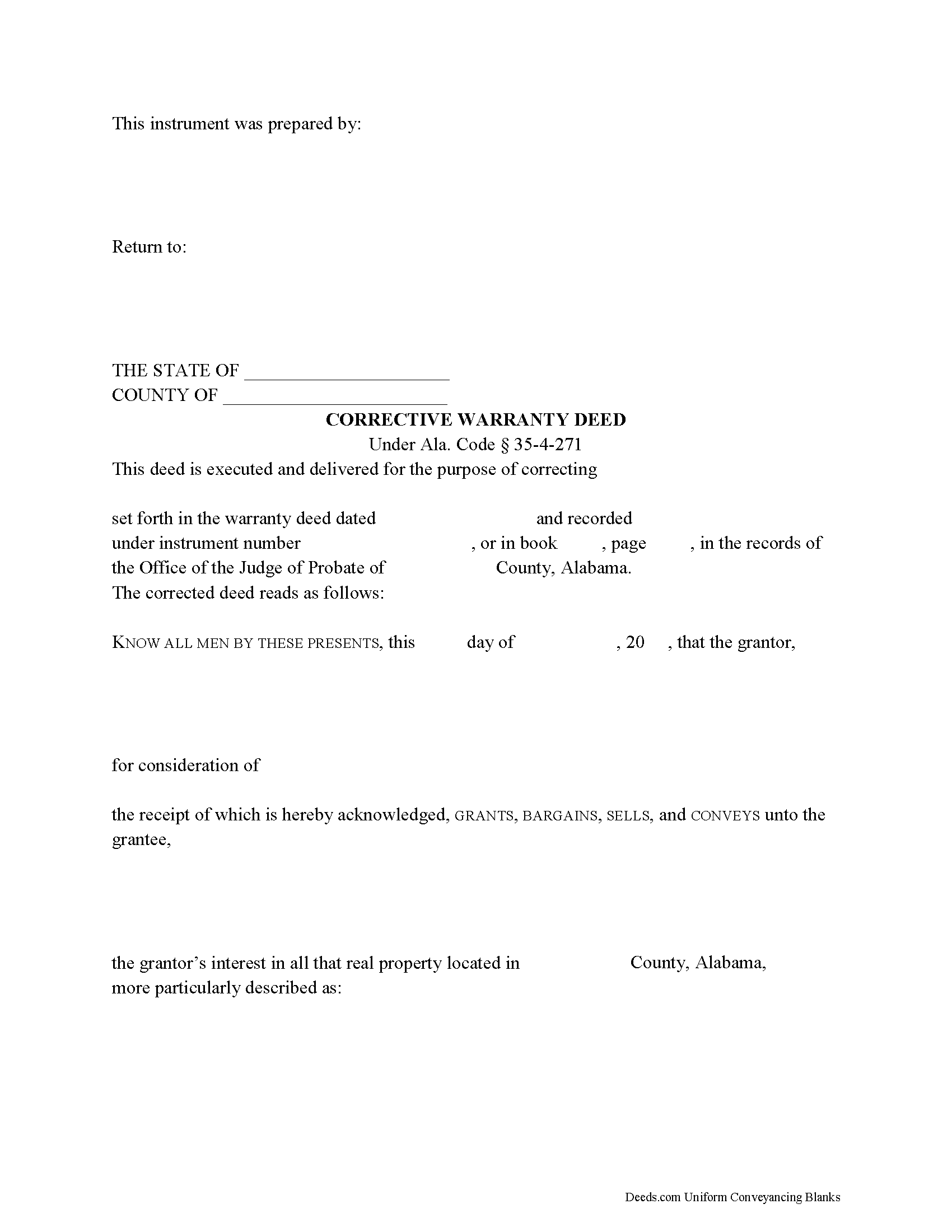
About the Alabama Correction Warranty Deed
How to Use This Form
- Select your county from the list on the left
- Download the county-specific form
- Fill in the required information
- Have the document notarized if required
- Record with your county recorder's office
What Others Like You Are Saying
"I am not so happy. I did find and purchase the document I needed. But there is one problem. It is in…"
"Great, immediate access to everything I needed to assist my client! This is truly a great resource f…"
"5 stars!"
"Very easy to follow and complete."
"Found what I needed, thanks."
Alabama's recording system operates on a race-notice basis, which means a deed error left unresolved in the public record can cloud title, delay a future sale, or create priority disputes with later creditors and purchasers. A Correction Warranty Deed — sometimes called a corrective deed — is the instrument Alabama practitioners use to fix non-material errors in a previously recorded warranty deed without disturbing the underlying conveyance. Because Alabama has no single statutory form for corrective deeds, the instrument must be drafted to mirror the original deed while clearly identifying the error, reciting the prior deed's recording information, and meeting all current execution requirements. Getting those details right determines whether the probate court accepts the filing and whether the correction actually clears the record.
When a Correction Warranty Deed Is Used in Alabama
A Correction Warranty Deed is used when a recorded warranty deed contains a non-material error — one that does not alter the substance of the conveyance. Common examples include a misspelled grantor or grantee name, an omitted marital status recital, a transposition of courses and distances in the legal description, or missing recording cross-references for a subdivision plat. The corrective deed restates the original conveyance, identifies the specific error, and substitutes the correct information. It does not create a new conveyance; it confirms and clarifies the one already in the record. Errors that change who holds title, what interest was conveyed, or what property was transferred require a new deed rather than a corrective instrument.
Alabama Statutory Framework for Corrective Deeds
Alabama law provides for judicial reformation of a deed when parties cannot agree or when the error is material (Ala. Code 1975, § 35-4-150). For straightforward non-material errors, a corrective deed recorded in the same probate office as the original is the more efficient remedy. The corrective deed must meet the same formal requirements as any deed recorded in Alabama, including proper acknowledgment before an officer authorized under Ala. Code 1975, § 35-4-24 — which includes notaries public and other officers authorized to take acknowledgments within or outside the state.
Execution Requirements — Who Must Sign and How
All parties who executed the original deed must sign the Correction Warranty Deed. Alabama requires at least one witness to the grantor's signature in addition to the notarial acknowledgment (Ala. Code 1975, § 35-4-20). This is a point where Alabama differs from several other states that have eliminated the lay-witness requirement — omitting the witness line will result in rejection at recording.
If the grantor was married at the time of the original conveyance, Alabama's homestead law requires both spouses to appear before an authorized officer and sign any deed affecting homestead property (Ala. Code 1975, § 6-10-3). This obligation carries forward to the corrective deed. A correction deed signed only by the original grantor — without the spouse's signature and acknowledgment — will not cure the homestead defect and may itself be unrecordable depending on the probate office.
Alabama-Specific Traps for Correction Warranty Deeds
Marital Status Recitals
One of the most common reasons a corrective deed is needed in Alabama is a missing or incorrect marital status recital in the original instrument. Alabama probate offices routinely flag deeds that fail to state whether the grantor is single, married, or widowed. The corrective deed must include the accurate marital status at the time of the original conveyance, and the current marital status if different.
Spousal Joinder and Homestead
If the property is or was the grantor's homestead, the corrective deed must include the non-grantor spouse's signature and separate acknowledgment regardless of whether the spouse had any ownership interest. Failure to obtain spousal joinder on homestead property is a material defect that a corrective deed cannot cure after the fact — it requires a new conveyance with proper spousal execution.
Prior Deed Recording Information
Alabama does not have a statute that specifies exactly what recitals a corrective deed must contain, but recording practice across the state's probate offices requires the instrument to identify the prior deed by date of execution, date of recording, and the book and page number (or instrument number) where it appears in the public record. A corrective deed that does not tie back to the original recorded instrument may be rejected or may fail to achieve its purpose of linking the correction to the erroneous filing.
Deed Privilege Tax Exemption
Most Alabama real estate transfers are subject to the state deed privilege tax (Ala. Code 1975, § 40-22-1). Correction deeds are exempt from this tax because no new consideration is being conveyed. The Real Estate Sales Validation Form (Form RT-1), which is typically required at recording, is also not required for a corrective deed. Nonetheless, the instrument should include a clear recital that it is a corrective deed confirming a prior conveyance, so the probate office does not assess the tax in error.
Preparer Identification
Some Alabama counties require that the deed identify the person who drafted it. Including a preparer identification line — stating the name and address of the individual or entity who prepared the instrument — eliminates a common cause of rejection at recording and is considered best practice statewide regardless of whether the specific county mandates it.
Recording the Correction Warranty Deed in Alabama
Deeds in Alabama are recorded in the Probate Court of the county where the property is located. Recording fees vary by county and are based on the number of pages. The corrective deed should be recorded promptly after execution. Alabama is a race-notice state, meaning a subsequent purchaser or creditor who records first without notice of a prior unrecorded interest takes priority — an uncorrected, potentially ambiguous deed in the record increases risk until the correction is filed. Once recorded, the corrective deed becomes part of the chain of title and the public record reflects the accurate information.
What Is Included in the Download Package
The Alabama Correction Warranty Deed package available on Deeds.com includes the deed form specific to the county where the property is located, a completed example showing how the form should be filled out, and a guide covering Alabama's execution and recording requirements. The forms are prepared by Deeds.com's forms development team and are formatted to meet Alabama probate court standards. All files are available for immediate download after purchase.
How to Use This Form
- Select your county from the list above
- Download the county-specific form
- Fill in the required information
- Have the document notarized if required
- Record with your county recorder's office
What Others Like You Are Saying
"I am not so happy. I did find and purchase the document I needed. But there is one problem. It is in…"
"Great, immediate access to everything I needed to assist my client! This is truly a great resource f…"
"5 stars!"
"Very easy to follow and complete."
"Found what I needed, thanks."
Common Uses for Correction Warranty Deed
- Correct the marital status listed on a deed
- Correct a missing or incorrect notary acknowledgment
- Fix a transposition error in a property's legal description
- Fix a legal description that excluded part of the property
Compare other Alabama deed forms and documents
Important: County-Specific Forms
Our correction warranty deed forms are specifically formatted for each county in Alabama.
After selecting your county, you'll receive forms that meet all local recording requirements, ensuring your documents will be accepted without delays or rejection fees.