Tuscaloosa County Mineral Deed with Quitclaim Covenants Form
Last validated October 23, 2026 by our Forms Development TeamFormatted for recording in Tuscaloosa County, for property anywhere in the county: rural and unincorporated areas as well as Abernant, Brookwood, Buhl, Coaling, Coker, Cottondale, Duncanville, Echola and 9 more.
- 3 documents included
- Immediate PDF download
- Formatting guarantee
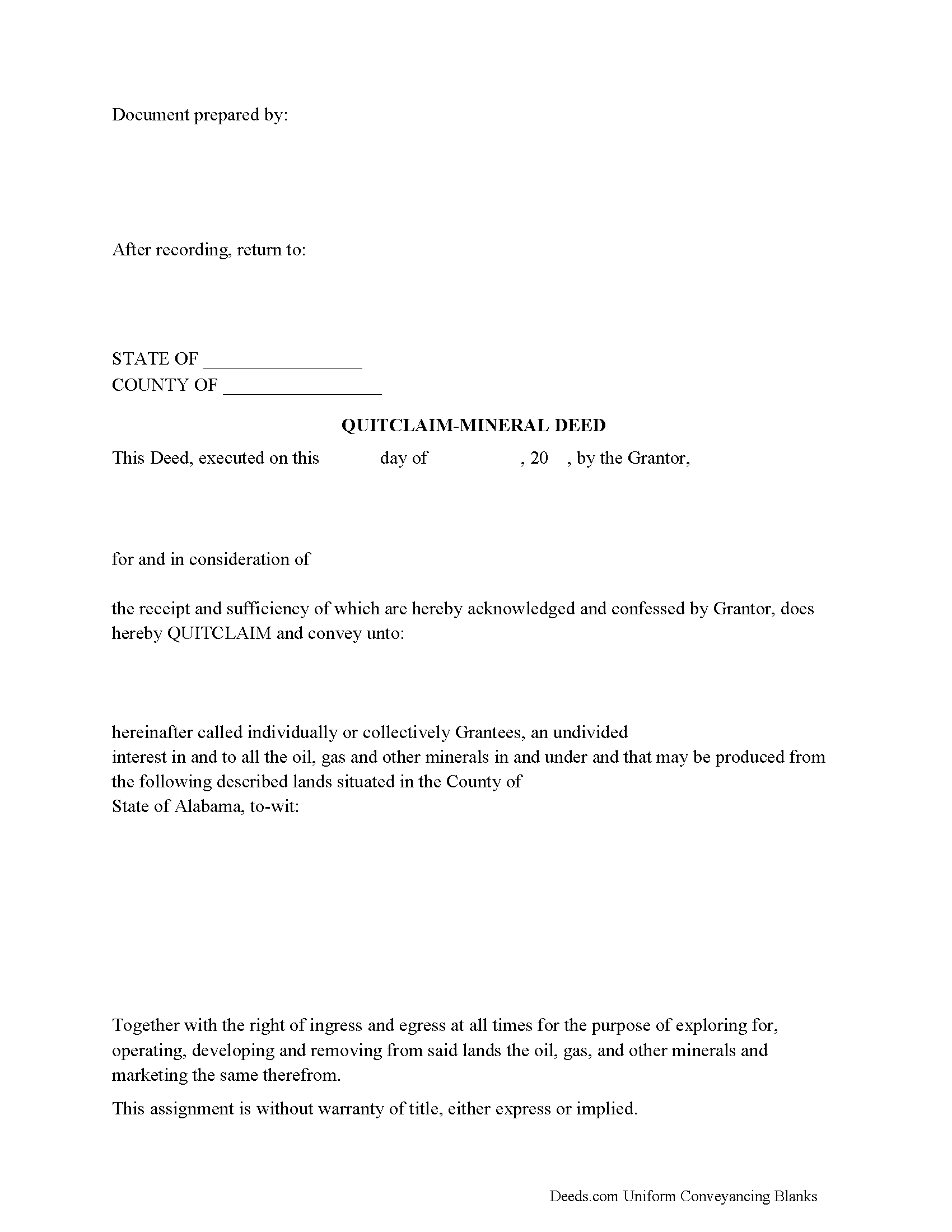
Tuscaloosa County Mineral Deed with Quitclaim Covenants Form
Fill in the blank Mineral Deed with Quitclaim Covenants form formatted to comply with all Alabama recording and content requirements.
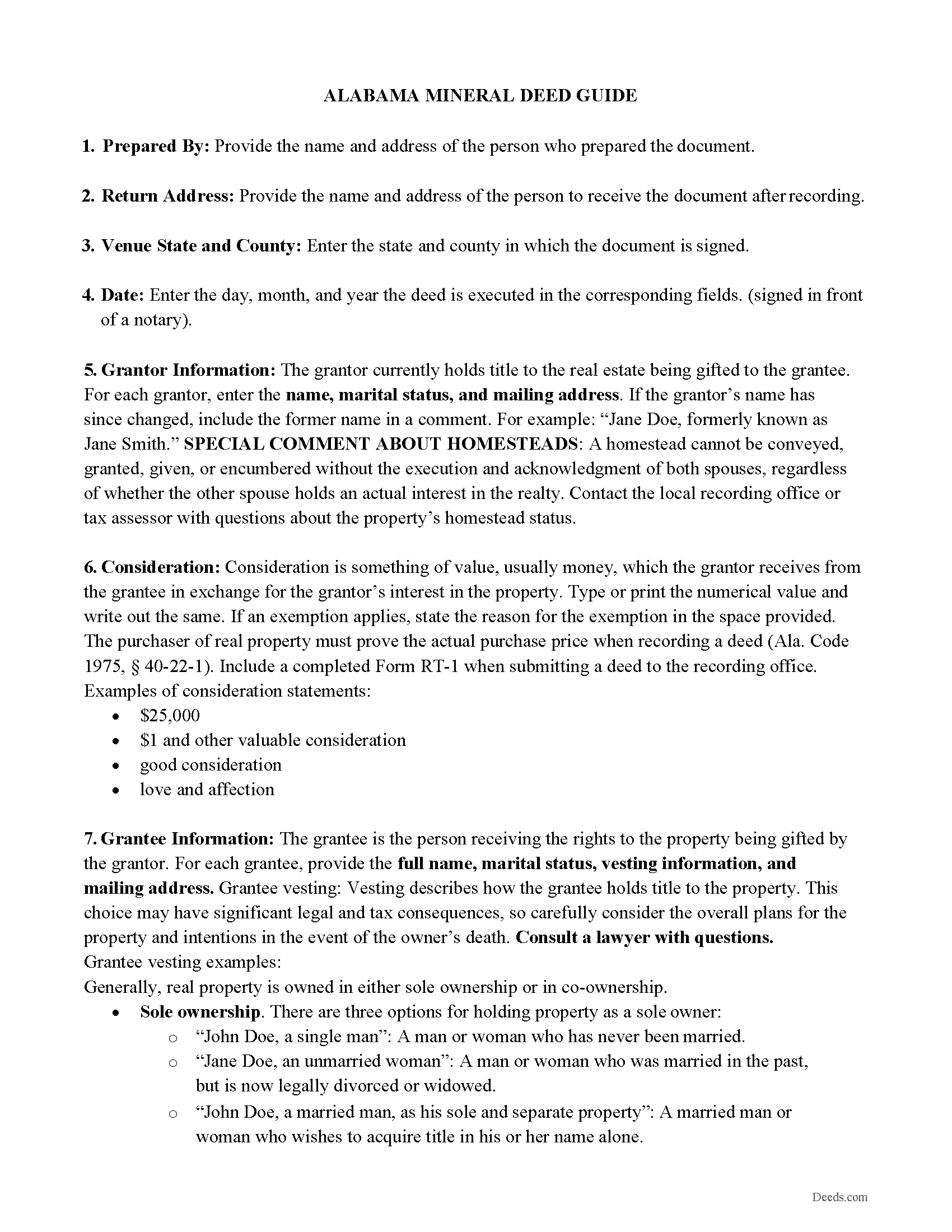
Tuscaloosa County Mineral Deed with Quitclaim Covenants Guide
Line by line guide explaining every blank on the Mineral Deed with Quitclaim Covenants form.
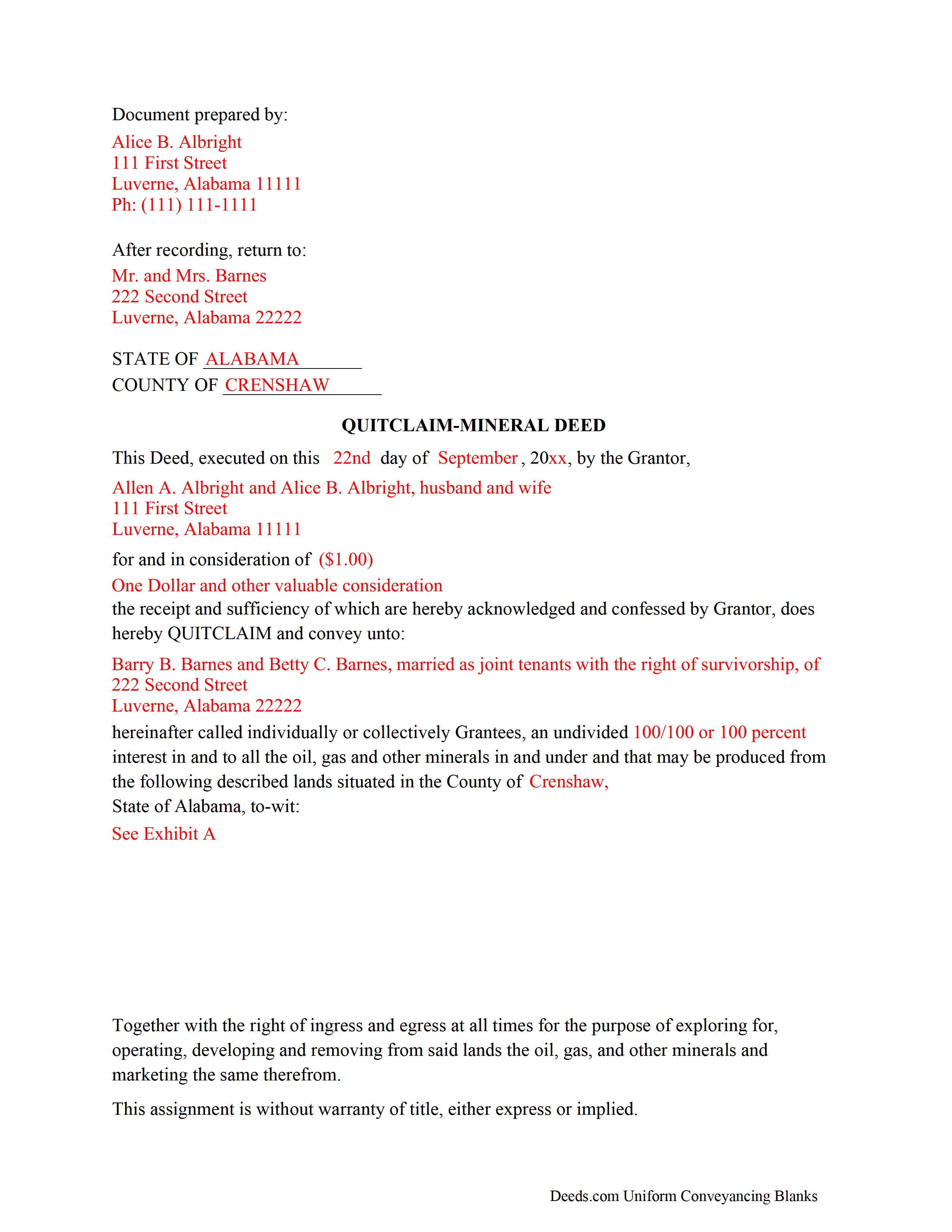
Tuscaloosa County Completed Example of the Mineral Deed with Quitclaim Covenants Document
Example of a properly completed Alabama Mineral Deed with Quitclaim Covenants document for reference.
All 3 documents above included • One-time purchase • No recurring fees
Immediate Download • Secure Checkout
Additional Alabama and Tuscaloosa County documents included at no extra charge:
Where to Record Your Documents
Tuscaloosa County Probate Judge
Tuscaloosa, Alabama 35401-1891 / 35402
Hours: 8:30 to 5:00 M-F
Phone: (205) 464-8204
Mail to: Tuscaloosa County Commission
Tuscaloosa, Alabama 35402
Hours:
Phone:
Recording Tips for Tuscaloosa County:
- Bring your driver's license or state-issued photo ID
- Ensure all signatures are in blue or black ink
- Documents must be on 8.5 x 11 inch white paper
- Double-check legal descriptions match your existing deed
- Verify all names are spelled correctly before recording
Cities and Jurisdictions in Tuscaloosa County
Properties in any of these areas use Tuscaloosa County forms:
- Abernant
- Brookwood
- Buhl
- Coaling
- Coker
- Cottondale
- Duncanville
- Echola
- Elrod
- Fosters
- Kellerman
- Northport
- Peterson
- Ralph
- Samantha
- Tuscaloosa
- Vance
Hours, fees, requirements, and more for Tuscaloosa County
How do I get my forms?
Forms are available for immediate download after payment. The Tuscaloosa County forms will be in your account ready to download to your computer. An account is created for you during checkout if you don't have one. Forms are NOT emailed.
Are these forms guaranteed to be recordable in Tuscaloosa County?
Yes. Our form blanks are guaranteed to meet or exceed the applicable formatting requirements used for recording in Tuscaloosa County, including margin requirements, font requirements, and other layout standards. This guarantee applies to formatting, not to the legal sufficiency of information entered by the user or the suitability of a form for a particular transaction.
Can I reuse these forms?
Yes. You can reuse the forms for your personal use. For example, if you have multiple properties in Tuscaloosa County you only need to order once.
What do I need to use these forms?
The forms are PDFs that you fill out on your computer. The free Adobe Acrobat Reader is recommended, and most PDF apps also work. You do NOT enter your property information online - you download the blank forms and complete them privately on your own computer.
Are there any recurring fees?
No. This is a one-time purchase. Nothing to cancel, no memberships, no recurring fees.
How much does it cost to record in Tuscaloosa County?
Recording fees in Tuscaloosa County vary. Contact the recorder's office at (205) 464-8204 for current fees.
Questions answered? Let's get started!
Alabama's mineral estate has a long history of severance from surface ownership, particularly across the state's coal-bearing counties in the Warrior Basin and oil-producing regions of the coastal plain. When mineral rights have been split off from surface title — sometimes generations ago — the chain of ownership can become fragmented, uncertain, or clouded in ways that complicate surface transfers. The Alabama Mineral Deed with Quitclaim Covenants is the instrument used to convey those severed interests, or to release whatever interest a grantor may hold, without making any warranty about the condition of title. Because Alabama treats severed mineral rights as a distinct real property estate subject to its own recording and tax requirements, the form must satisfy the same execution standards as any other deed filed with the county Judge of Probate.
What the Alabama Mineral Deed with Quitclaim Covenants Does
This deed conveys oil, gas, and other minerals of every kind and nature from the grantor to the grantee, including the right to access the surface for the purpose of exploring, drilling, mining, developing, operating, and producing those minerals, and for storing, transporting, and marketing production. The grantor may specify the percentage of mineral rights being conveyed — a partial interest is valid and enforceable in Alabama. The quitclaim covenant structure means the grantor transfers only whatever interest they actually hold, if any, and makes no representation that title is good, clear, or unencumbered. This instrument is a permanent conveyance of real property rights, not a lease.
When This Form Is Commonly Used in Alabama
Alabama's history of mineral severance — particularly in Jefferson, Walker, Tuscaloosa, Bibb, and Shelby counties where coal rights were stripped from surface tracts in the late nineteenth and early twentieth centuries — means clouds on mineral title appear regularly in title searches. The quitclaim mineral deed is used to resolve those clouds: by estate administrators releasing a decedent's uncertain mineral interest, by distant heirs settling ownership disputes, by parties correcting fragmented chains of title where prior conveyances left the ownership ambiguous, and by surface owners acquiring severed mineral rights that were previously held by third parties.
Alabama Statutory Requirements
Mineral rights constitute a real property estate in Alabama and are conveyed under the same statutory framework as surface deeds. The conveyance must comply with Alabama Code § 35-4-20, which requires the grantor's signature, acknowledgment before a notary public or other authorized officer, and attestation by at least one witness. All three elements — signature, notarization, and witness — must be present for the instrument to be eligible for recording. The deed must contain an adequate legal description identifying the land to which the mineral estate is appurtenant, including the county, section, township, range, and acreage where applicable. If mineral rights have previously been described by reference to a recorded plat or prior deed, that reference should be carried forward in the legal description.
Alabama Code § 35-4-110 requires that every deed presented for recording identify the name and address of the natural person who prepared the instrument. This preparer identification line must appear on the face of the deed — it is a recording requirement, not a formality, and instruments lacking it may be rejected by the Probate Court.
Alabama-Specific Traps
Homestead and Spousal Assent
If the grantor is married and the mineral rights are appurtenant to property that constitutes the family homestead, Alabama law requires the non-owner spouse to join in the conveyance or execute a separate assent (Alabama Code §§ 6-10-2, 6-10-3). Failure to obtain spousal signature on a homestead conveyance renders the deed voidable at the non-signing spouse's election. This requirement applies even when the mineral estate has been severed — if the surface qualifies as homestead, the associated mineral rights may be subject to the same protection. When in doubt, both spouses should sign.
Marital Status Recital
Alabama deeds should recite the grantor's marital status. This disclosure is a title standard in Alabama and affects the chain of title analysis a future buyer or title insurer will conduct. A grantor who is single should be identified as such; a married grantor should be identified as married, and the spouse's name included if the spouse is joining in the conveyance.
Deed Transfer Tax
Alabama imposes a state deed transfer tax of $0.50 per $500 of consideration, or fraction thereof, on instruments conveying real property (Alabama Code § 40-22-1). Because mineral rights are real property, this tax applies to the mineral deed when consideration is paid. If the deed is a gift or nominal-consideration transfer, the applicable consideration amount should be stated clearly on the face of the instrument. Several Alabama counties impose an additional local transfer tax. The tax must be paid at the time of recording, and the Probate Court will calculate it based on the consideration stated in the deed.
Percentage of Interest Must Be Stated
When conveying a fractional mineral interest, the deed must state the percentage or fraction being transferred with precision. Alabama's mineral title history is rife with instruments that conveyed vague or arithmetic-inconsistent fractions, compounding ownership problems across generations. A deed that fails to specify the interest conveyed — or that, when added to prior conveyances, purports to transfer more than 100% of the mineral estate — creates exactly the kind of cloud this form is typically used to resolve.
Surface Access Rights
In Alabama, the mineral estate is the dominant estate, meaning the mineral owner has the right to use as much of the surface as is reasonably necessary to develop the minerals. A quitclaim mineral deed that conveys the full bundle of mineral rights also conveys this surface access right unless the deed expressly limits it. Grantors should understand that a complete mineral conveyance includes the right of the grantee — and their assignees — to enter and use the surface for mineral development purposes.
No Title Warranty
The quitclaim covenant structure means the grantor conveys only what interest they hold, if any, and accepts no responsibility for title defects, gaps in the chain, or competing claims. A grantee acquiring mineral rights by quitclaim deed should conduct independent due diligence on the mineral title — the deed itself provides no protection if the grantor's interest turns out to be less than represented or nonexistent.
Recording in Alabama
Alabama deeds are recorded with the Judge of Probate in the county where the land is located — not with a county recorder or clerk of court. The executed, notarized, and witnessed original must be presented to the Probate Court along with transfer tax payment. Recording gives constructive notice to all subsequent purchasers and encumbrancers (Alabama Code § 35-4-51). An unrecorded mineral deed is valid between the parties but is vulnerable to being defeated by a subsequent bona fide purchaser who records first. Given the frequency with which mineral interests change hands and the complexity of Alabama's mineral title history, prompt recording is essential to protecting the grantee's interest.
Vesting and Co-Grantee Considerations
When mineral rights are conveyed to two or more grantees, Alabama law presumes a tenancy in common — not a joint tenancy with right of survivorship — unless the deed expressly creates a survivorship estate using language that satisfies Alabama Code § 35-4-7. A tenancy in common means each co-owner holds a separate, descendible share that passes through their estate at death rather than automatically to the surviving co-owners. Parties who intend survivorship must use explicit language to that effect; simply naming two grantees is not sufficient.
What Is Included in the Download Package
The Alabama Mineral Deed with Quitclaim Covenants download includes the deed form itself, formatted for recording in Alabama and compliant with the state's execution and preparer identification requirements. The package also includes a completed example showing how a properly executed Alabama mineral deed should look, and a guide covering the filing process, transfer tax calculation, and recording procedures for Alabama Probate Courts. Forms are prepared by Deeds.com's forms development team and are specific to Alabama.
Important: Your property must be located in Tuscaloosa County to use these forms. Documents should be recorded at the county recording office listed above.
This Mineral Deed with Quitclaim Covenants meets all recording requirements specific to Tuscaloosa County.
Our Promise
The documents you receive here are guaranteed to meet or exceed the applicable Tuscaloosa County recording format requirements. If there is a rejection caused by our formatting, we will correct the issue or refund your payment. This guarantee applies to document formatting only and does not extend to information entered by the user, the selection of the form, or the legal effect of the completed document.
Save Time and Money
Get your Tuscaloosa County Mineral Deed with Quitclaim Covenants form done right the first time with Deeds.com Uniform Conveyancing Blanks. At Deeds.com, we understand that your time and money are valuable resources, and we don't want you to face a penalty fee or rejection imposed by a county recorder for submitting nonstandard documents. We constantly review and update our forms to meet rapidly changing state and county recording requirements for roughly 3,500 counties and local jurisdictions.
4.8 out of 5 - ( 4,836 Reviews )
Robert B. 5 out of 5 stars
Excellent service. Very efficient. Electronic filing was far faster and less stress than doing it in person.
We appreciate your business and value your feedback. Thank you. Have a wonderful day!
Steven M. 5 out of 5 stars
They always get me the information I need, in a timely manner.
We appreciate your business and value your feedback. Thank you. Have a wonderful day!
charles c. 5 out of 5 stars
Great service, well worth the $15 fee. Especially helpful was the review of my documentation and the quick responses. Recommending it to associates who might need this service.
Thank you for your feedback. We really appreciate it. Have a great day!
Doris M M. 5 out of 5 stars
EXCELLENT SERVICE. WILL MAINTAIN CONTACT FOR FUTURE REFERENCE. THANK YOU!
We appreciate your business and value your feedback. Thank you. Have a wonderful day!
JOE M. 5 out of 5 stars
The form I needed were easy to find. And very affordable. Great service.
Thank you for your feedback. We really appreciate it. Have a great day!
Miranda C. 3 out of 5 stars
very expensive
Thank you for your continued trust and repeated purchases with us over the past year. We deeply value our loyal customers and understand the importance of providing value for your investment. Our pricing reflects the meticulous care, research, and expertise we put into each of our legal forms. However, we always strive to improve and genuinely value your feedback.
Kevin B. 4 out of 5 stars
It looks like it can be a huge time saver. I did a deed and appeared very professional.
Thank you for your feedback. We really appreciate it. Have a great day!
Derrell S. 5 out of 5 stars
I like the simplicity of your site and the reasonable charge for your services but for some reason you were unable to fulfill my order. Would appreciate knowing why. Derrell Sweem
Thank you for your feedback. We really appreciate it. Have a great day!
Mary M. 5 out of 5 stars
So easy to use. I was able to download all the forms I need, it saves a lot of time!
Thank you!
Linda C. 5 out of 5 stars
If I hadn't spent my career as an escrow officer (albeit in another state), I may have had a hard time figuring out exactly which deed I needed and how to prepare them, even with the back-up informational, how-to pdf documents, without an attorney. My experience speaks to how much the general public doesn't understand and how confusing it can be. Nonetheless, the access to so many documents at a fairly reasonable cost, the basic how-to docs made available along with the purchased doc makes all the difference. I appreciate having such things available to the public. Many thanks.
We appreciate your business and value your feedback. Thank you. Have a wonderful day!
Claudia S. 5 out of 5 stars
Very user friendly! Processing is very fast. I would highly recommend using Deed's.
We appreciate your business and value your feedback. Thank you. Have a wonderful day!
Corey G. 5 out of 5 stars
Very informative and helpful Thank you so much
Thank you for the kinds words Corey, glad we could help.
Jeri M. 5 out of 5 stars
Very happy with the site and the deed document I received.
We appreciate your business and value your feedback. Thank you. Have a wonderful day!
Joe D. 5 out of 5 stars
Complete coverage of deeds, laws, etc.
Thank you!
RUTH A. 5 out of 5 stars
I am so very thankful for the service that you provide for the public, thank you very much.
We deeply appreciate the trust you have placed in our services. Thank you for your valuable feedback and for choosing us.