Alaska Quitclaim Deed
Borough or Census Area Specific Legal Forms Validated as recently as September 18, 2026 by our Forms Development Team
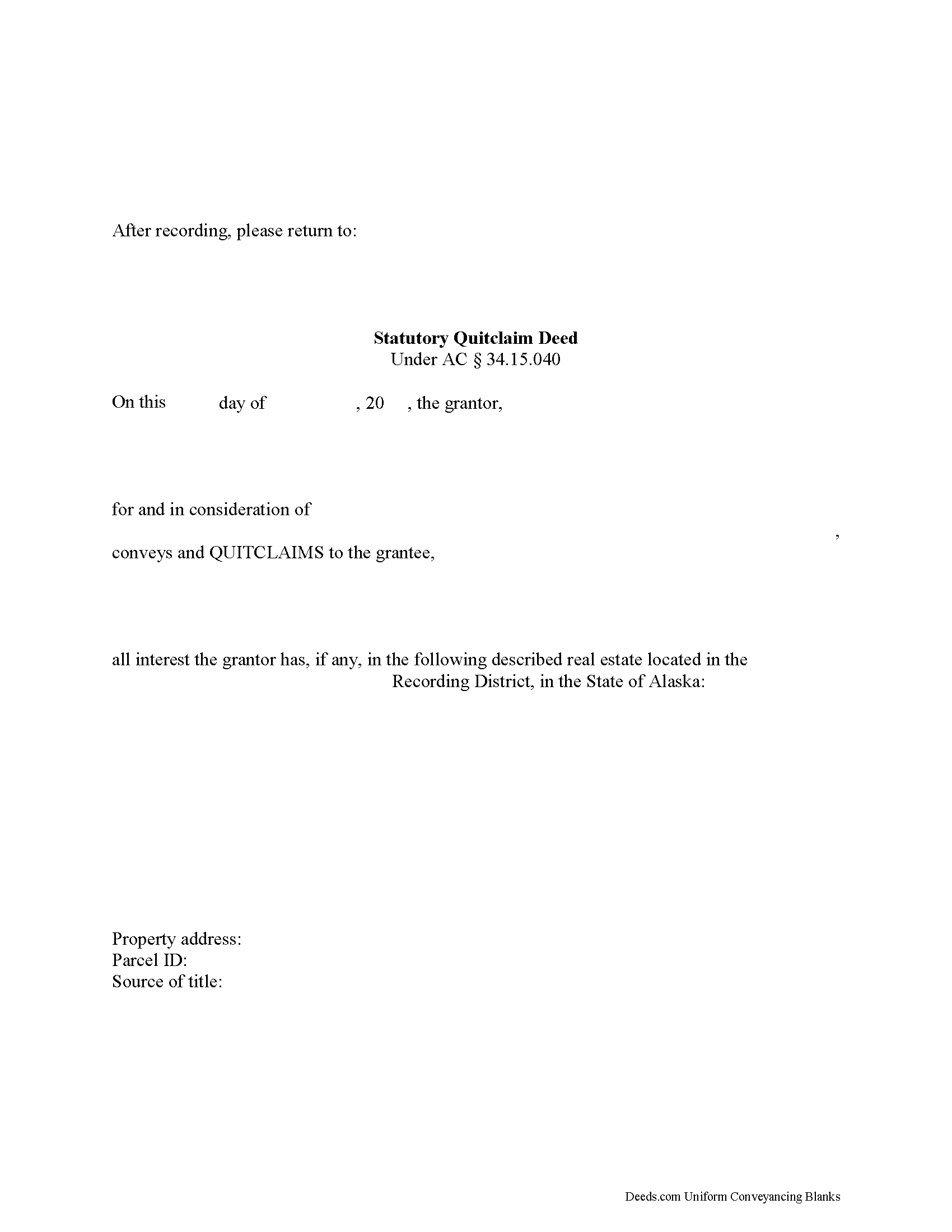
About the Alaska Quitclaim Deed
How to Use This Form
- Select your borough or census area from the list
- Download the borough or census area-specific form
- Fill in the required information
- Have the document notarized if required
- Record with your borough or census area recorder's office
What Others Like You Are Saying
"This site is so easy to use. It is so convenient to have access to forms for all states. I’d recomme…"
"So far so good. Thanks for making this easy and affordable."
"easy to use and upload."
"Easy forms to follow. Thank you for this service. You can even file them through e-filing. Great ser…"
"Excellent service"
4.8/5 from 4,829 reviews. Read all
Two words carry most of the character of the quitclaim deed Alaska prints in its own statutes: if any. The short form at AS 34.15.040 lets an owner pass along whatever stake is held in the land described, while asserting nothing about its size, its worth, or whether it exists. What moves is a position in the chain of title, not a measured quantity. This fillable form is the base Alaska quitclaim deed for natural persons signing in their own capacity, laid out for the state's recorder.
Transfer Without Measurement
The reach of that bargain is statutory. AS 34.15.040(a) fixes the operative words, conveys and quitclaims, reaching all interest which I (we) have, if any, in the real estate the deed goes on to describe. AS 34.15.040(b) then provides that a deed substantially in that form, otherwise duly executed, is a sufficient conveyance, release and quitclaim to the grantee and the heirs and assigns of the grantee, in fee, of all the existing legal and equitable rights of the grantor. Two neighboring sections size the estate that travels: AS 34.15.060 makes words of inheritance unnecessary to create a fee simple, and AS 34.15.070 passes the grantor's whole real estate unless a lesser estate appears by express terms or necessary implication. It promises nothing either: AS 34.15.080 implies no covenant in an Alaska conveyance of real estate.
One or Two Signers on Either Side
The party blocks are free-form and hold up to two natural persons apiece, so four count patterns fit one instrument: one conveying person to one receiving person, one to two, two to one, and two to two. The deed recites those patterns as a class, the ordinary shape of a conveyance between individuals in the Alaska record. Two signature blocks, headed GRANTOR and SECOND GRANTOR (if applicable), sit above two acknowledgment certificates, one for each block, so signers may appear before different notarial officers on different days; a deed executed by a lone grantor leaves the second block and its certificate empty. What the form is not set up as: a conveyance in an entity name, a signature by a trustee or other fiduciary, a signature by an agent under a power of attorney, or a deed from three or more owners on either side. Each recites a capacity, and takes a representative certificate, this deed does not print.
The Blank Where Alaska's Own Vocabulary Goes
Preprinting a co-ownership phrase would serve this state badly, so nothing about status or vesting is fixed anywhere on the document. Alaska's roster of estates is short and is not the national one. Joint tenancy in land is abolished, tenancy by the entirety excepted, so a survivorship label imported from another state accomplishes nothing for grantees who are not spouses. Spouses who acquire title hold by the entirety unless the instrument declares otherwise, and the conveyance recites the marital status of the parties acquiring title. Community property touches Alaska land only where spouses opt into it by agreement or trust under AS 34.77. The grantee blank is therefore four open lines, and the guide walks each recognized form, the words that create it, and the tenancy in common construction that governs when a deed to two or more grantees names none.
What the Recorder Reviews Before Accepting It
Land documents in Alaska go to the Department of Natural Resources, which runs one statewide system of 34 recording districts, and intake is an eligibility review. AS 40.17.030 sets the list: a title reflecting the document's overall intent, the district in which the property sits, the complete mailing address of every person who grants or acquires an interest, the return name and address with zip code, legible indexing information, and the fee. An omission costs in a particular way: AS 40.17.070 has the recorder reject a nonrecordable document and note the reason, rather than surcharge it and file it. Margins are the narrow exception that buys its way in, at a $50 nonstandard document fee. Each entry has a labeled place on this deed, the top two inches of page one stay clear for the stamp, and the type sits above the 10 point minimum of 11 AAC 06.040.
The download is three files: the blank quit claim deed as a fillable PDF, a completed example filled at two-signer capacity for a Fairbanks Recording District parcel, and a plain-language guide covering every numbered section, the certificates, and recording. The materials describe Alaska law in general terms and are not legal advice.
Important: Borough or Census Area-Specific Forms
Our quitclaim deed forms are specifically formatted for each of the 27 borough or census areas in Alaska.
After selecting your borough or census area, you'll receive forms that meet all local recording requirements, ensuring your documents will be accepted without delays or rejection fees.