Arizona Deed in Lieu of Foreclosure
County Specific Legal Forms Validated as recently as October 13, 2026 by our Forms Development Team
About the Arizona Deed in Lieu of Foreclosure
How to Use This Form
- Select your county from the list
- Download the county-specific form
- Fill in the required information
- Have the document notarized if required
- Record with your county recorder's office
What Others Like You Are Saying
"I have a Timeshare in Florida and started looking to sell it. Just finally downloaded this site, it …"
"Awesome service and so easy to use. I was amazed at how fast the process worked."
"I needed a Missouri Notice of Intent to Sell without a named designated buyer. Mo Statutes require n…"
"Bought the wrong form and they refunded my money Honest company"
"Really a simple, quick, professional experience!"
4.8/5 from 4,829 reviews. Read all
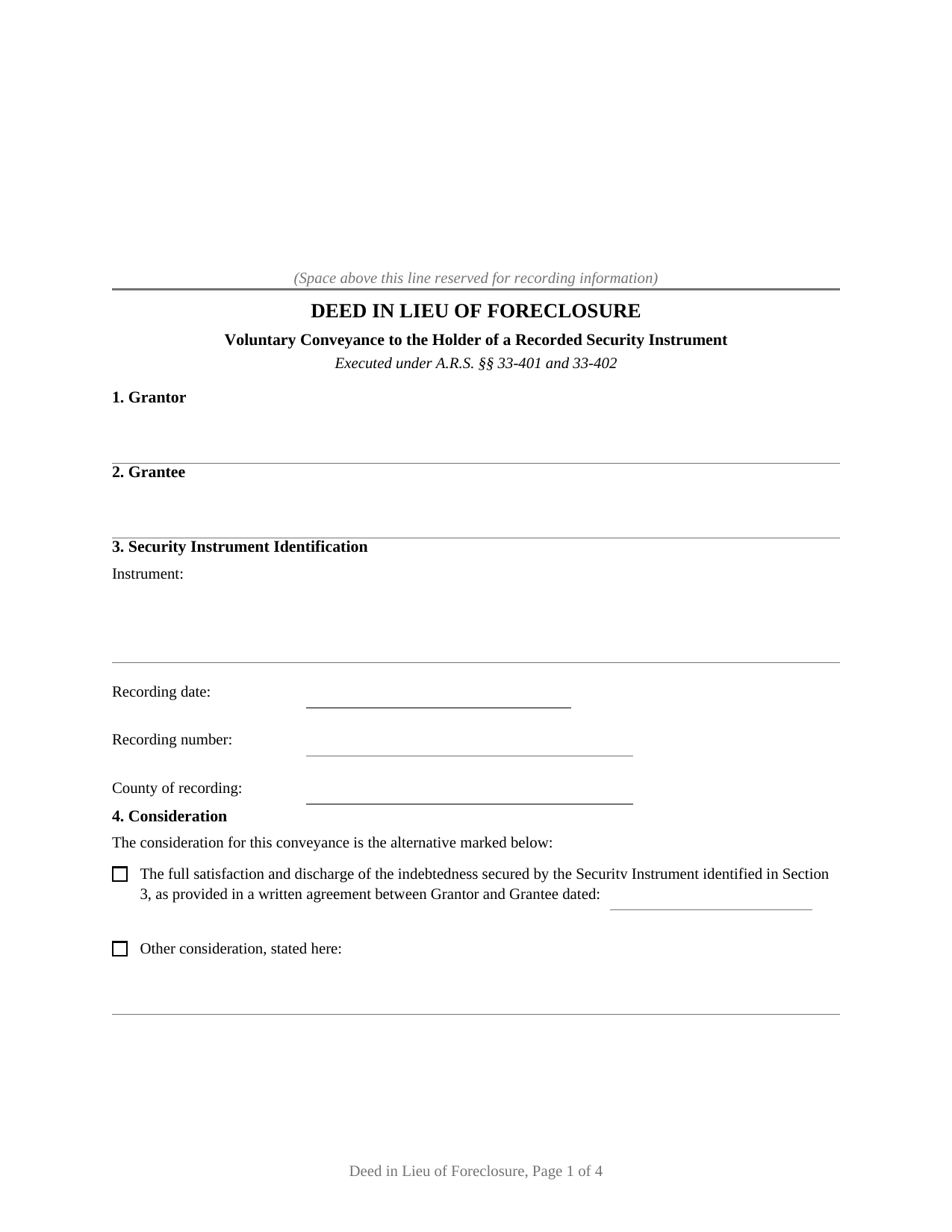
An Arizona deed in lieu of foreclosure ends a defaulted loan the negotiated way: the owner conveys the property to the holder of the deed of trust or mortgage by agreement, and the trustee's sale never happens. This form prepares that conveyance for Arizona real property, with the recitals Arizona practice builds into the instrument: a voluntary, absolute conveyance, an express absence of warranty, and a non-merger clause that keeps the lender's lien alive against junior interests.
A conveyance that stands in for the foreclosure sale
Arizona has no statute creating the deed in lieu of foreclosure. Sometimes called a lieu deed or simply a voluntary conveyance to the lender, it is a common law instrument resting on the general conveyance statutes, A.R.S. 33-401 and 33-402, and on decisions describing the transaction: a consensual arrangement in which borrower and lender agree that the lender becomes owner of the fee, valid where it is made fairly, for sufficient consideration, and without fraud, oppression, or undue advantage. The form identifies the recorded security instrument by its description, recording date, recording number, and county, states the consideration for the conveyance, and transfers the grantor's entire interest in the property.
One recital does especially heavy lifting. Under A.R.S. 33-702(A), a transfer of real property made only as security for another act is a mortgage, whatever the parties call it. The deed therefore declares itself an absolute conveyance, effective on delivery and acceptance and not given as security, the statement that separates a true deed in lieu from a disguised mortgage.
Why the lien survives its own deed
A deed in lieu of foreclosure is not a foreclosure sale, so it extinguishes nothing junior: judgment liens, tax liens, and second deeds of trust ride through, and the grantee takes title subject to them. That is where the merger doctrine turns dangerous. If the lender's lien merged into the title it just received, the lender would lose the senior position that a later foreclosure needs in order to clear those junior interests. Merger turns on intent, so the deed states the intent plainly: the lien of the security instrument does not merge with the title conveyed, and it remains valid and continuous, with its existing priority, until the grantee releases it of record.
The consideration and the debt
The consideration section states the debt position on the face of the deed: fixed text reciting the full satisfaction and discharge of the secured debt as provided in the parties' written agreement, with a checkbox alternative for other consideration, and the completed example shows the full satisfaction alternative marked. Arizona's anti-deficiency statute for trustee's sales, A.R.S. 33-814, attaches to a completed sale rather than to a consensual conveyance, so the written agreement between owner and lender is where the treatment of any remaining balance lives; the deed records the consideration and leaves the debt terms to that agreement. The conveyance itself carries no warranty of title, stated expressly on the face of the deed. Married owners conveying Arizona community property both sign under A.R.S. 25-214(C)(1), and the form carries two grantor signature blocks with separate acknowledgment certificates for exactly that pattern; a sole owner signs alone and leaves the second block blank.
The sworn companion: an estoppel affidavit
The final pages of the fillable deed hold an optional estoppel affidavit, the sworn statement title insurers commonly request before insuring title taken by deed in lieu. The grantor, as affiant, swears that the deed was a free and voluntary act made without duress or misrepresentation, that it was intended as an absolute conveyance rather than security, that the consideration was fair and adequate, that no agreements exist beyond the deed and the written agreement it identifies, and that the conveyance was not made to hinder, delay, or defraud any creditor. Each affiant signs before a notary, who completes a jurat on the A.R.S. 41-265 verification on oath form. The affidavit carries its own reserved recording space and its own page numbering, so it is recorded with the deed, recorded separately, or retained in the transaction file, and its pages are simply removed where the transaction does not call for it.
Recording in Arizona
The deed is recorded with the county recorder of the county where the property is located, formatted to A.R.S. 11-480: a caption, letter size pages, 10 point print, and a two inch top margin on page one reserved for recording information. The statewide fee under A.R.S. 11-475 is $30 for an ordinary instrument, which already includes Arizona's $2 real estate transfer fee; Arizona imposes no separate deed tax. Arizona also ties recording to the Affidavit of Property Value: the recorder refuses a deed without a completed affidavit unless the deed bears an exemption notation under A.R.S. 11-1134. The exemption for a transfer made solely to provide or release security for a debt or obligation is the one that county exemption code explanations illustrate with the deed in lieu pattern, and the form carries a dedicated notation line beneath the legal description, where Department of Revenue instructions place it. An assessor's parcel number line sits with the legal description as well; A.R.S. 11-480 does not require one, but county intake staff commonly look for it, and the same number appears on the Affidavit of Property Value where one is filed. Deeds notarized on or after September 12, 2026 also pick up Arizona's new notary journal thumbprint rule, described in the guide.
The download prepares one complete package: the Arizona deed in lieu of foreclosure as a fillable PDF, a completed example showing every entry for a realistic Maricopa County fact pattern, and a plain language guide that walks through each numbered section, the signing and notarization formalities, and the recording steps. The materials are informational and are not legal advice; an Arizona attorney can address how a deed in lieu of foreclosure operates on a specific loan and title.
Important: County-Specific Forms
Our deed in lieu of foreclosure forms are specifically formatted for each of the 15 counties in Arizona.
After selecting your county, you'll receive forms that meet all local recording requirements, ensuring your documents will be accepted without delays or rejection fees.